
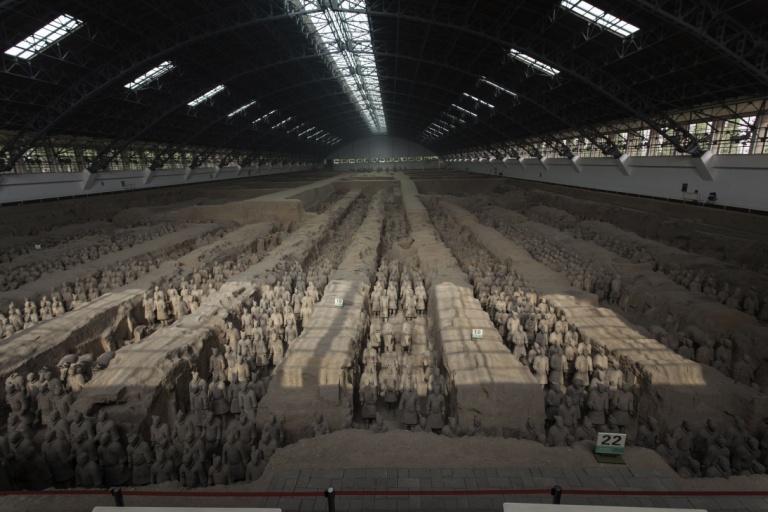
In 1974, the Terracotta Army of the First Qin Emperor was unearthed, causing a worldwide sensation and earning it the title of the “Eighth Wonder of the World.” Subsequently, archaeologists discovered many more precious artifacts around the mausoleum. However, more than 40 years have passed, and no one dares to excavate the underground palace of the mausoleum. What is the reason for this?
Qin Shi Huang, Ying Zheng (259-210 B.C.), was a man of great talent and ambition. He ended centuries of war during the Warring States period, unified China, and established the first imperial power in Chinese history. He achieved countless firsts and erected numerous monuments in history, truly deserving the title of “Emperor of the Ages.”
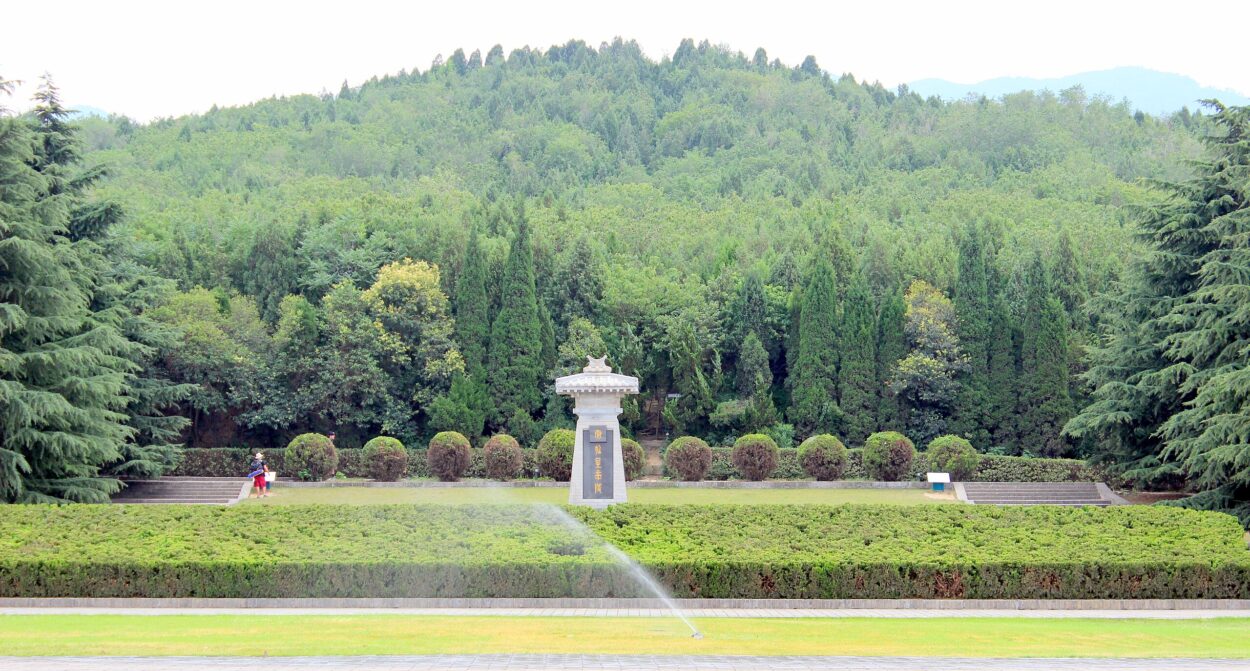
The “Qin Shi Huang Mausoleum” is the tomb of Emperor Qin Shi Huang. It is one of the world’s largest, most uniquely structured, and most richly endowed imperial tombs, a source of pride and a precious treasure of the Chinese nation. Located at the northern foot of Mount Li in Xi’an, Shaanxi Province, the complex took 39 years to complete. Spanning an area of 56.25 square kilometers — equivalent to nearly 78 Forbidden Cities — the mausoleum consists of an inner and outer city.
Beyond the world-renowned Terracotta Warriors and Horses pits, the complex also contains pits for exotic birds and beasts, stables, victims of human sacrifice, convict laborers, stone armor, acrobatic performers, civil officials, and numerous subsidiary tombs. Over the course of decades of excavation, more than 100,000 artifacts have been unearthed from the Qin Mausoleum. Recently, archaeologists unearthed an exquisitely crafted single-piece golden camel.
It is interesting to note that all these discoveries were made in the outer surroundings of the mausoleum. As for the underground palace where Qin Shi Huang is buried, despite repeated proposals from scholars to excavate it, the authorities have consistently refused to grant them permission. Why are they erring on the side of caution?

The impenetrable mausoleum mound
Imperial burial mounds are typically constructed using rammed earth composed of a mixture of white lime, sand, and loess (mineral-rich, fine windblown silt deposit). This mixture is reinforced with glutinous rice paste and iron nails, rendering it impervious to wind and rain. It is said that when tomb raiders attempted to break through, a single chisel strike revealed only a white speck, and even explosives failed to crack it open.
The colossal mound of the Qin Mausoleum, shaped like an inverted pyramid, stands 76 meters tall and measures approximately 350 meters in length and width. Such a massive mound is unparalleled in scale nationwide. Using heavy machinery for excavation would inevitably destroy the contents within, making the cost far outweigh the benefits.
Excavation of ancient artifacts
Excavating the Qin Emperor’s underground palace would be an immense undertaking. Not only would this process be time-consuming and labor-intensive, but there is no guarantee that the precious ancient artifacts could be removed intact. The excavation of the Terracotta Army serves as a cautionary tale. Due to inadequate preservation techniques at the time, the originally vibrantly colored terracotta warriors soon weathered, turning to the earthen hues we see today.
Mercury used to repel intruders
The Records of the Grand Historian: The Annals of Emperor Qin Shi Huang states, “Three springs were excavated, bronze was laid to form the coffin chamber, palaces, official offices, rare artifacts, and precious curiosities were transported to fill it. Craftsmen were ordered to construct mechanical crossbows and arrows; anyone approaching would be shot. Mercury was used to represent a hundred rivers, streams, and seas, mechanically circulating to simulate their flow. Above, it depicted the heavens; below, it depicted the earth.”
Legend holds that the Qin Mausoleum employed vast quantities of mercury and intricate traps to deter decay and thieves. Experts estimate that the underground palace may contain over 100 tons of mercury. This mercury not only simulated rivers and seas but also generated highly toxic gases that would repel intruders.
Layers of traps
Beyond the toxic mercury, the Qin Mausoleum’s underground palace is riddled with traps. Legend holds that the first defense is quicksand — any tomb raider stepping into the burial chamber would be buried alive. Additionally, trigger-activated hidden crossbows are installed at the tomb door’s inner and outer entrances, passageways, and other critical points. Once triggered, these concealed crossbows fire automatically. A powerful crossbow with a range exceeding 831.6 meters and a draw weight surpassing 738 jin (approximately 369 catties — 1 cattie = 0.5kg) was unearthed from the Terracotta Army pits.
Qin Shi Huang was a legendary figure, and his underground palace is equally shrouded in mystery. Legends speak of the “Terracotta Army Curse” and the “Nine-Story Demon Pagoda.” There are also rumors that Qin Shi Huang consumed an elixir of immortality and still lives to this day. To some, these remain as fantastical tales – others, the truth? Time itself may reveal the answer!
Translated by Eva and edited by Maria
Follow us on X, Facebook, or Pinterest
