

Few moments test a parent more than being told their child has committed a serious wrongdoing. In that instant, fear, shame, and doubt rush in — and how a parent responds can either break a child’s spirit or quietly shape their entire life. No matter what happens, parents are meant to be a child’s strongest shelter. When even a parent withdraws trust, that loss often becomes the deepest wound a child carries.
When one mother received a call saying her son had stolen money at school, what she did next defied expectation. It did not erase the accusation, but it preserved something far more important: her child’s sense of safety, dignity, and trust.
The call that tested her heart
It was a busy workday like any other when, without warning, a young mother’s phone rang. She glanced at the screen and felt a sudden unease — it was her son’s school. The voice on the other end was tense and direct. “Your son is accused of stealing 1,000 yuan from Teacher Wang. He has admitted to taking the money. The police are already here.”
For a moment, the words did not fully register. This was not the kind of call any parent expects to receive. Shock rose quickly, followed by fear — but she forced herself to calm down. “Whatever my child may have done,” she said steadily, “please do not hit him or scold him. I will come to the school immediately. Please wait until I arrive.”
Before hanging up, she asked to speak to her son. When his voice came through the phone, it was broken and trembling. “Mommy…” Her tone softened instantly. “Don’t be afraid,” she said. “No matter what happens, Mommy will always be here for you. I’m coming right now.”
She rushed to the school on her electric bike. A police car was already parked outside the teachers’ office. Inside the room stood two police officers with serious expressions, two teachers — one male and one female — and the senior disciplinary director. The atmosphere was tense and heavy. The female teacher spoke first, her tone sharp and accusatory. “Your son took 1,000 yuan from my drawer this morning. He’s already admitted it. What are you going to do about it?”
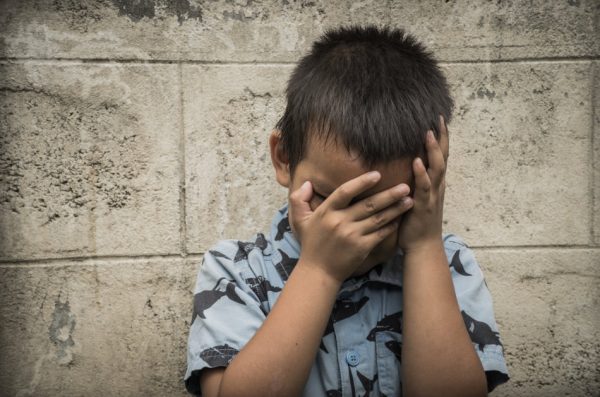
The mother did not answer her right away. Instead, she walked straight toward her son. He was sitting on the floor in the corner of the room, his whole body shaking. His clothes were dirty, his face wet with tears. Without hesitation, she bent down and pulled him into her arms, holding him tightly. “Mommy,” he sobbed, clinging to her. “If it weren’t for what you said on the phone, I might have climbed onto the rooftop. They said they would put me in jail. I was so scared…”
Her heart tightened, but her hands remained steady as she stroked his head. “Son,” she said softly, “tell Mommy the truth. I will believe you.” He shook his head again and again. “I didn’t do it.” The mother slowly stood up. Her voice was calm, but unwavering. “I believe my son,” she said. “If he says he didn’t steal the money, then he didn’t.” The boy looked up at her, his eyes filled with gratitude.
The teacher sneered, clearly thinking this was just another soft-hearted mother blindly defending her child. “He admitted it himself,” she said impatiently. The mother’s voice remained even. “Then tell me — how did he ‘admit’ it? Where is the money? What evidence do you have? Even the police do not arrest people without proof.”
One of the officers shifted uncomfortably. “There’s no physical evidence,” he said. “Only the child’s confession.” The teacher began explaining how she had questioned him earlier that day. The mother turned to her son. “Is that what happened?” He shook his head. “They wouldn’t let me go to class all day. They called the police. I was really scared. The teacher said if I admitted I took the money, I could go home…” The teacher’s face drained of color. “That is coercion,” the mother said firmly. “And it is a false accusation. I could take legal action for slander.”
No one knew where this slight, plainly dressed woman — who had arrived on an electric bike — found such resolve. Without waiting for a response, she took her son by the hand and led him out of the room.
The truth — and a lesson that lasted a lifetime
Perhaps this is why, in the eyes of their children, mothers so often appear extraordinary. On the way home, the boy clung to her and whispered: “Thank you, Mommy. You gave me strength.” Not long after they got home, the disciplinary director called. The missing 1,000 yuan had been found. The teacher herself had accidentally put it in another drawer and forgotten. The incident left the child shaken — but his mother’s actions gave him something far more powerful: a deep sense of safety and courage. Even as an adult, he would remember the warmth of that moment.
Why punishment often makes things worse
Many mothers write in despair: Why does my child keep stealing? The more I scold and punish, the worse it becomes. The answer often lies in a single word: trust. Many young children take things not because they are “bad,” but because they do not yet fully understand ownership, consequences, or why the behavior is wrong. When adults respond with harsh punishment — beatings, humiliation, or labels like “thief” — they do more than correct behavior. They reshape how a child sees themselves.
What takes root is not understanding, but anger, shame, and broken self-esteem. Trust collapses — both trust in the parent and trust in oneself. Even worse, harsh punishment can provoke defiance. A child who is repeatedly condemned may eventually think: If you insist I’m a thief, then I might as well become one.
Discipline without trust, openness, and discussion does not teach a child right from wrong; it teaches fear, resentment, and the need to protect oneself. Only when guidance is paired with understanding, respect, and belief in the child does it cultivate genuine moral growth.

When trust disappears
Consider another story. There was a young boy who was known at his school for being mischievous. He talked too much in class, played roughly during recess, and was often singled out by his teachers. Each time something went wrong, the teacher called his father. And each time, the father responded the same way — furious and unyielding.
After school, the punishments began. The boy was denied yogurt and snacks, his toys were taken away, and television was forbidden. Sometimes, he was ordered to stand in the corner for long periods in silence. The father believed this was discipline. He believed it would make his son behave. Over time, the boy became quieter. He complained less. He stopped asking for things. When he felt tired or unwell, he said nothing. And then one day, he collapsed.
At the hospital, the diagnosis was devastating: leukemia. Overwhelmed with guilt and fear, the father asked through tears: “Why didn’t you tell us that you weren’t feeling well?” The boy looked at him and replied softly: “Because you and the teacher are on the same side.” The father had no words.
This is how trust disappears — not all at once, but slowly, through countless small moments that seem insignificant to adults. A baby cries in the crib seeking comfort, and adults call it spoiling if he’s picked up. A muddy child runs home excited after playing, and adults see only stained clothes. A young child proudly shows his drawings on the wall, and adults see only mess and damage.
When a child refuses to share a toy and looks to a parent for help, adults see selfishness instead of insecurity. When a child hands over a disappointing report card with their head lowered, adults see laziness rather than confusion or fear.
Choose trust first
Children are not born distrusting adults. They begin by offering their hearts openly, believing they will be understood and protected. But when those offerings are repeatedly met with ridicule, harsh scolding, punishment, disbelief, or indifference, trust slowly drains away — drop by drop.
Over time, children stop explaining. They stop asking. They stop sharing. They learn to protect themselves, sometimes through silence, sometimes through distance, sometimes by putting on armor. And one day, when parents realize their child no longer tells them anything at all, they discover — too late — that they have already been quietly removed from the child’s inner world.
Parents, choose to trust your child before trusting accusations, labels, or others’ judgments. Trust opens a door that discipline alone can never. Home should be a safe harbor, a place where a child can rest, speak freely, and know that they will be understood and supported no matter what storms arise outside its walls. When children feel trusted, they speak to their parents as they would to a friend. They come first — without fear — when trouble arises. And when they are treated with respect, they carry that faith within them, turning it into strength and self-worth.
Are they perfect? No. Children are still learning, still testing boundaries, still discovering the world. But it is up to us, as parents, to guide them with a calm heart, wisdom, and rationality. We must not react out of anger, fear, or concern that their mistakes might damage our reputation or infringe on our busy schedules. Put your child first. Consider how to guide them, with kindness and love, toward becoming a strong, secure, and compassionate person — someone who can face the world with confidence, integrity, and trust in themselves and others.
Sometimes, the greatest gift a parent can give is not correction or control, but trust. And yes, that trust can change a life.
Translated by Katy Liu and edited by Tatiana Denning
Follow us on X, Facebook, or Pinterest
