

In traditional society, people helped one another, and heartwarming stories ofhttps://nspirement.com/2026/02/22/the-best-way-to-practice-kindness.html their kindness were abundant. Today, I will share a few anecdotes that are not far from our present time.
The rickshaw puller who helped an exam candidate
During the late Qing period, a poor scholar traveled to Beijing to take the imperial examination. He had journeyed from the south and had almost no money left. When he arrived at the city gate, he had not eaten for two days. A rickshaw puller, noticing his old, torn clothes and scrolls, asked: “Are you here to take the exam, sir?” The scholar nodded and said he had run out of travel expenses.
The puller, after hearing this, said nothing more and took him directly across half of Beijing to the examination hall. Once they arrived, the scholar searched his pockets and could only find a few copper coins. The puller waved his hand and said: “Scholars are the hope of the nation; today, consider it my treat.” With that, he left.
Years later, this scholar, who had passed the examination and had become an official, returned to Beijing to repay the rickshaw puller for his kindness, but the man had long since disappeared. The official used to often tell others: “I owe my success to an unnamed rickshaw puller who helped me.”
The pancake seller who helped a student
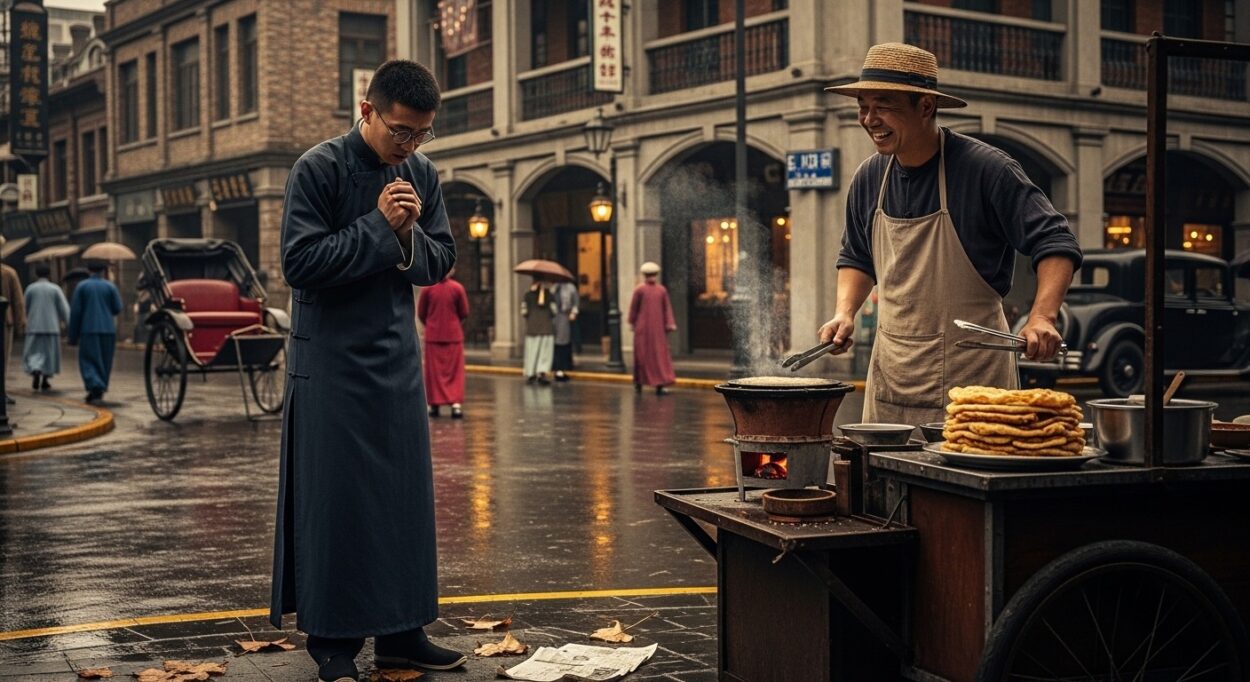
In the 1920s, a newspaper in Shanghai published a short story. A student from out of town came to Shanghai to study and, one day, accidentally lost all his tuition and living expenses. Standing on the street corner in distress, a pancake seller asked him what had happened. The young man explained the facts.
After listening, the seller was silent for a moment, then took out some money from his cloth bag and handed it to him, saying: “Child, education is important; take this for your use.” The student repeatedly refused. The seller insisted: “I’ve been selling pancakes for decades; helping the poor is nothing.” After graduating, the student returned to that street to look for the seller, but the pancake stall was gone.
The rice shop owner who distributed porridge
Records in some local gazetteers of Jiangnan mention that, during the late Qing period, some rice shop owners would set up stalls to distribute their food during years of disaster. For example, a rice shop owner in Suzhou would cook porridge at the entrance of his shop every winter or during famine years.
Poor people could come with bowls and have some for free. When asked if this would lead to losses, he replied: “The money I earn is worldly wealth; distributing porridge accumulates virtue.” Such charitable actions were very common during the late Qing and Republican periods.
The stuffed-bun shop owner who paid off debts for the poor
In late Qing Tianjin, there was a stuffed-bun shop owned by a man named Liu. One winter, a villager came to the city to sell firewood, but was cheated out of his money and could not pay for his accommodation. The innkeeper refused to let him leave until he paid. Upon hearing this, Liu went to inquire about the situation.
Seeing that the man was indeed poor, he took out his money to pay off his bill. The villager was so moved that he wanted to kneel. Liu said: “When we are out in the world, who doesn’t face difficulties?” Later, every year when the villager came to the city to sell firewood, he would buy stuffed buns from Liu’s shop and help with chopping wood.
The pedicab drivers who worked together to save a person
During the Republican period, a Shanghai newspaper reported an incident. An elderly man was hit by a car while crossing the street, and the driver fled. Several pedicab drivers on the street saw this and immediately lifted the old man onto their carts. They took turns pulling the cart and rushed him to the hospital. The doctor said that if they had been any later, he might not have survived. The elderly man’s family wanted to give them money as a token of gratitude, but the drivers all refused. One of them said: “Life is precious; we just helped out.”

The ferry boatman who saved a person at night
During the Republican period, an old boatman worked at a ferry crossing in a county in Shandong. In winter, he often waited till late for people to cross the river. One night, someone fell into the water. Hearing the cries, the old boatman immediately jumped into the river and pulled the person onto his boat. After getting to shore, the person wanted to give him money as a thank-you. The boatman said: “How can you put a price on saving a life?” This incident was later recorded in the local county gazetteer.
The porridge seller on the street who saved a child
In the early years of the Republic of China (1912 to 1949), there was an elderly porridge seller in Nanjing. One winter morning, while selling hot porridge, he saw a child fainting by the roadside. He entrusted his porridge stall to someone nearby and took the child to a clinic, where the child was saved. The boy’s parents found the older man and wanted to give him money, but he waved his hand and said: “I have grandchildren too; seeing a child suffer, I couldn’t bear it.” Indeed, kindness is powerful and heartwarming.
Translated by Joseph Wu and edited by Laura Cozzolino
Follow us on X, Facebook, or Pinterest
