
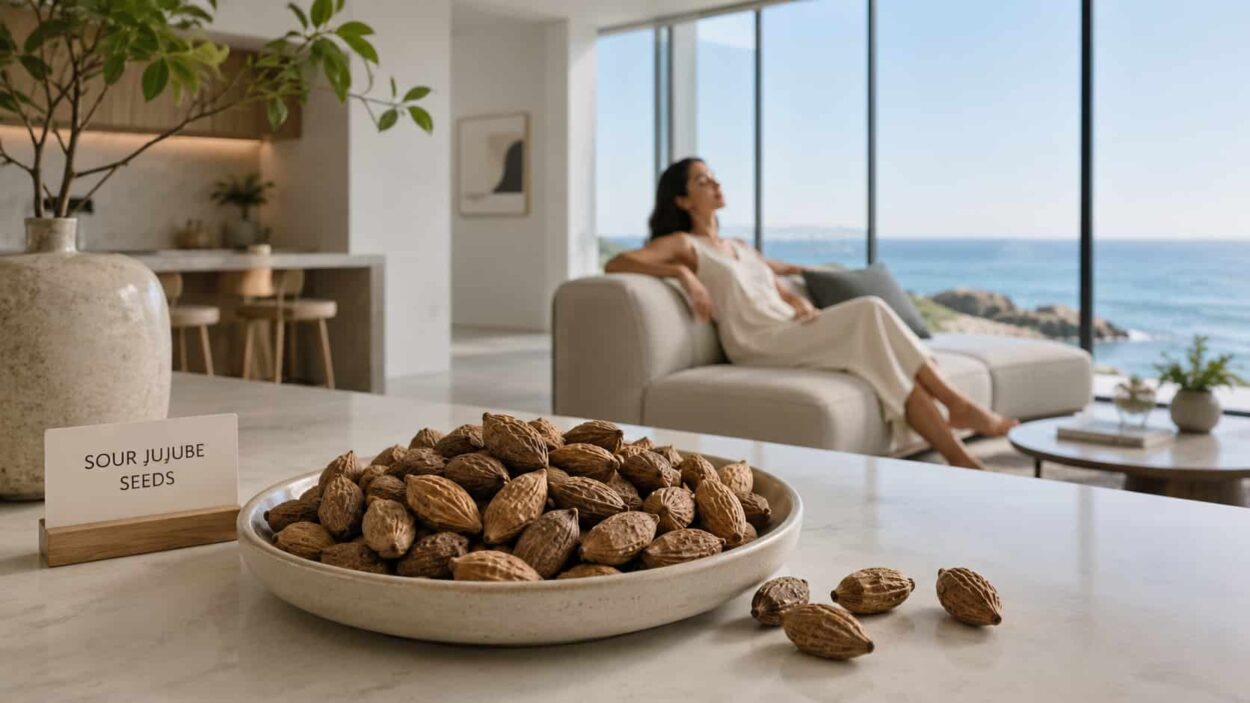
Sour jujube seeds have been used to calm restless minds for nearly 2,000 years, and the small, sour kernel still ends up in a teacup somewhere tonight, where a person cannot sleep. It is late. The house has gone quiet. And yet the mind has not. Thoughts circle. The body is tired, but the head refuses to follow. Chinese medicine has a phrase for this exact condition, and it is older than almost any sleep aid still in use: bu de wo, “unable to lie down.”
The phrase is not a poetic exaggeration. It names something millions of people recognize without being told — the strange insomnia of exhaustion, where the lights are off, and the eyes are closed, and sleep simply does not arrive. For most of human history, there was no pill for this. There was, instead, a seed.
The insomnia of the overworked mind
Modern life has industrialized the sleepless night. We carry glowing screens to bed, eat at irregular hours, and treat rest as the first thing to sacrifice when the day runs short. The result is a kind of insomnia that does not feel like a medical problem so much as a side effect of being awake too intensely for too long.

Chinese medicine arrived at a similar observation by a very different road. More than 2,000 years ago, the Huangdi Neijing — the foundational text of the tradition — set down two ideas that still describe the modern bedroom with uncomfortable accuracy. When the stomach is unsettled, the text holds, and lying down is uneasy. When the spirit is unquiet, sleep will not come. Insomnia, in this view, is rarely a problem located in sleep itself. It is a downstream symptom of something out of balance upstream.
Insomnia, in this view, is rarely a problem located in sleep itself. It is a symptom of something out of balance upstream.
A prescription from the Golden Cabinet
The remedy that the tradition reached for has a name and an author. In the late Eastern Han Dynasty, around the year 200, the physician Zhang Zhongjing recorded a formula in his medical classic, the Jin Gui Yao Lue — Essential Prescriptions from the Golden Cabinet. The entry is almost startling in its brevity. For depletion, restlessness, and an inability to sleep, it states that a sour jujube seed decoction governs.
That formula is Suanzaoren Tang. It is built from five ingredients — sour jujube seeds, the herb zhimu (Anemarrhena), the fungus fuling (Poria), the root chuanxiong (Ligusticum), and gancao (licorice). The recipe is simple, but it was aimed at a very specific complaint: the insomnia where the harder you try to sleep, the more awake you become. Generations of Chinese physicians regarded it as the single most important prescription for sleeplessness rooted in depletion.
It is worth being precise about one detail, because the tradition itself is. Zhang Zhongjing did not invent the seed; he framed it. Sour jujube seeds appear in the even older Shennong Bencao Jing, the earliest Chinese materia medica, where they are listed as a top-grade herb said to settle the five organs with long use. What Zhang Zhongjing did was place that ingredient inside a complete therapeutic logic — and place insomnia, notably, in his chapter on chronic depletion rather than acute disease. Sleeplessness, to him, was a sign of a body running low, not a body under attack.
The heart that houses the spirit
Many people assume that lying awake and agitated means there is too much heat in the system — that one is, in the casual phrase, fired up. Chinese medicine often sees the opposite. A great deal of insomnia, in this framework, comes from too little rather than too much: insufficient blood, a depleted reserve, an inner fuel that has run thin.
The logic runs through two organs. When the blood of the heart is insufficient and the yin of the liver is depleted, the spirit — the shen — has nothing to nourish it and nowhere to rest. The result is the familiar cluster: shallow sleep, easy waking, vivid dreams, a mind that cannot be talked into stillness. Classical writers offered an image for it. The spirit is like a small bird; with no branch to land on, it has no choice but to keep flying, circling endlessly through the night.
The spirit is like a small bird. With no branch to land on, it has no choice but to keep circling through the night.
This is why the entire approach rests on a single line from the Huangdi Neijing: the heart houses the spirit. Mental activity and sleep, in this view, both depend on the heart having enough blood to anchor the shen. When the reserve is full, the spirit settles, and sleep comes on its own. When it runs low, the spirit has nowhere to stay, and the night fills with restlessness and dreams.
The strategy that follows is almost the opposite of a sedative. The formula does not force the mind into unconsciousness. It nourishes the blood, settles the spirit, and lets sleep return as a natural consequence of a body brought back toward balance. You do not knock the bird out of the air. You give it a branch.
What is actually in the seeds
Sour jujube seeds are the ripe kernels of Ziziphus jujuba var. spinosa, a wild thorny shrub common across the hills of northern China. Its fruit is small and sour, and its seed has been classified for centuries as a substance that nourishes the heart and calms the spirit. In Chinese pharmacology, it is considered neutral in nature and sweet-and-sour in taste, and it enters the heart, liver, and gallbladder channels. The old saying is plain: When the heart is at peace, one sleeps.
What is striking is how much of that traditional description modern chemistry has been able to put a name to. The seeds turn out to contain more than 150 compounds, and several are genuinely active in the nervous system. The most studied are a saponin called jujuboside A, a flavonoid glycoside called spinosin, and an alkaloid called sanjoinine A. In laboratory and animal studies, these compounds have shown sedative effects working primarily through two of the brain’s own quieting systems: the GABA pathway, which is the main inhibitory brake on the nervous system, and the serotonin pathway, which helps regulate mood and the timing of sleep.
The same GABA system, it is worth noting, is the one that conventional sleeping pills target. The difference researchers have repeatedly flagged is one of degree. Where benzodiazepines tend to act as forceful agonists — and carry well-known risks of tolerance, dependence, and morning grogginess — the jujube compounds appear to act more gently, in some studies as partial rather than full agonists. That milder action may be part of why the seed has a long reputation for calming without the heavy sedation.
The traditional claim and the laboratory finding point in the same direction: a quieting of the nervous system, but a gentle one.
Why the seeds are roasted
In practice, sour jujube seeds are almost always lightly roasted before use. The traditional instruction is to dry-fry them over low heat until the surface just begins to crack. Roasting deepens the aroma and is held to soften the seed’s character, making its spirit-calming action more pronounced; raw seed is regarded as more moistening. A typical culinary or food-therapy amount runs to roughly 10 to 15 grams.
Here, honesty requires a small footnote, because the tradition is not entirely settled on this point. A debate runs across the centuries about whether raw and roasted seeds do genuinely different things — one classical source even claims raw seeds are for excessive sleepiness and roasted seeds for the inability to sleep, an opposition that modern practice does not strictly follow. Zhang Zhongjing’s original text simply directed that the seeds be boiled first, without specifying whether they were raw or processed. It is a reminder that even a remedy this old contains arguments around it.
From clinic to kitchen
Suanzaoren Tang began as a clinical decoction, but over centuries it migrated into the everyday food culture of China, where the seed appears in teas, porridges, and gentle soups. There is even a homely folk line for it: if you cannot sleep, ask the jujube seed. Three preparations are especially common, and they read less like medicine than like the quiet rituals of a slow evening.
Sour jujube seed porridge
Lightly roast 15 grams of sour jujube seeds, then crush them and simmer in water for about 20 minutes to draw out the liquid. Use that liquid to cook 50 to 100 grams of white rice into a porridge, adding a few red dates, a little longan flesh, and a handful of lotus seeds. The result is faintly fragrant and gently sour with a thread of sweetness from the dates — a bowl that is easy to digest and traditionally taken at the evening meal to settle the heart before sleep.
Sour jujube seed tea
The simplest version. Crush 10 grams of sour jujube seeds and simmer them with 5 grams of schisandra berry and 5 grams of goji berry for 20 minutes, or steep the lot in hot water for half an hour. Drink it warm before bed. It is the preparation most often reached for by people with light, easily broken sleep and a mind crowded with dreams.
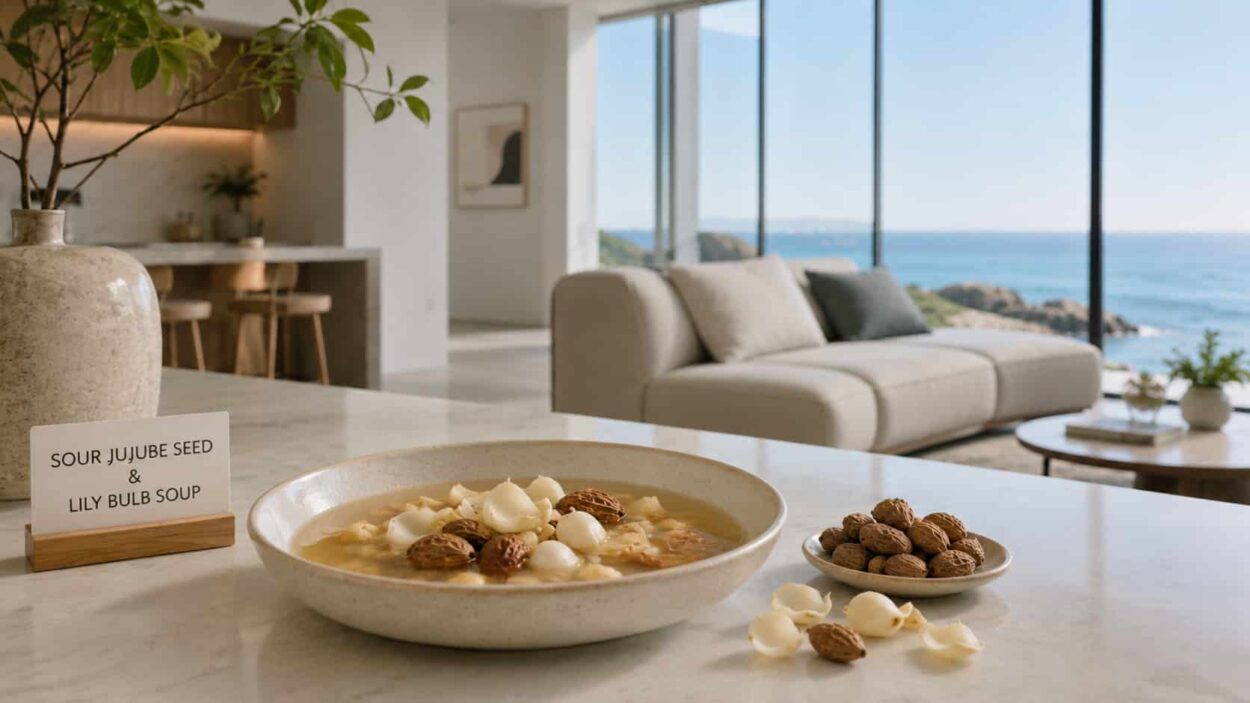
Sour jujube seed and lily bulb soup
Simmer 15 grams of sour jujube seeds with 20 grams of lily bulb, 20 grams of lotus seed, and 4 red dates for about half an hour. The soup is clear, sweet, and warming — well-suited to autumn and winter, and traditionally favored by those who feel a dry, restless heat at night and wake too easily.
How much of this holds up
It would be dishonest to leave the laboratory findings to do more work than they can. The evidence that sour jujube seeds and their formula help with sleep is real but uneven. The most convincing pharmacology comes from cell studies and animal models, where the mechanisms are clear. The human clinical trials — on populations ranging from menopausal women to patients in methadone treatment — have generally been small, and reviewers have repeatedly noted that their quality is mixed. The signal points consistently in a favorable direction, including a tendency toward fewer side effects than standard sleep drugs, but the studies are not yet large or rigorous enough to settle the question.
None of this is a reason to dismiss a remedy with a 2,000-year track record. It is a reason to hold it for what it is: a gentle, plausible, well-tolerated aid with encouraging, but still-incomplete, clinical proof — not a replacement for a doctor when insomnia is severe, persistent, or a sign of something else. Anyone taking medication, pregnant, or managing a chronic condition should treat even a food-therapy soup as something to raise with a clinician first.
Suanzaoren Tang has survived 2,000 years not because it is miraculous, but because it encodes a quiet and durable observation: good sleep follows a settled mind, and a settled mind follows a body that is not running on empty. The formula was never trying to overpower the night. It was trying to restore the conditions in which the night takes care of itself.
Which returns us to the bird. A sedative pulls it out of the sky. The seed, if the tradition and the chemistry are both telling the truth, does something humbler and older. It offers the branch — and lets the spirit decide, on its own, to land.
Follow us on X, Facebook, or Pinterest
