
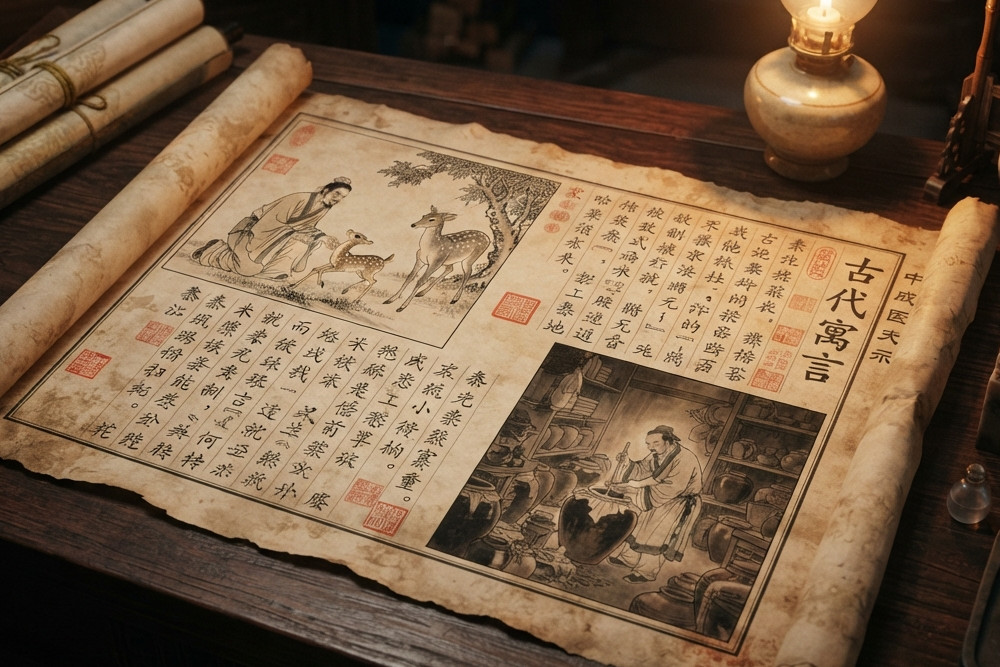
As early as the Spring and Autumn and Warring States periods, ancient Chinese texts recorded many short fables. Though brief, these stories contain lessons about life and human nature that remain relevant today.
A kind heart is the most valuable asset
Meng Sun was a nobleman of the Mengsun clan in the State of Lu during the Spring and Autumn period. Together with the Jisun and Shusun clans, the Mengsun clan formed the “Three Huan,” three powerful hereditary aristocratic families that exerted great influence in Lu.
The ancient text Han Feizi records a story about how Meng Sun, a stern but thoughtful man who valued moral character, chose a teacher for his son.
Qin Xiba was one of Meng Sun’s retainers. Little is known about his life beyond the account preserved in Han Feizi. Yet a seemingly small act of compassion caused his name to be remembered for generations.
One day, Meng Sun went hunting and captured a young deer. He ordered Qin Xiba to take the fawn home.
As Qin traveled back, the mother deer followed closely behind, crying out in distress. She refused to leave her young and continued pursuing them along the road. Qin listened to her sorrowful calls and could not bear to separate the mother from her offspring. He finally released the fawn, allowing it to return to its mother.
When Meng Sun arrived home, he asked Qin to bring him the deer. Qin answered honestly: “I could not bear to see the mother and her young separated, so I let the fawn go.”
Meng Sun was furious. Believing that Qin had disobeyed a direct order, he dismissed him from his service.
Several months later, however, Meng Sun summoned Qin again and asked him to become his son’s teacher.
Meng Sun’s carriage driver was puzzled. “You punished him for releasing the fawn,” he said. “Why are you now asking him to teach your son?”
Meng Sun replied: “A man who could not bear to see a fawn lose its mother would never have the heart to harm my child.”

His simple answer revealed an important principle. The person most worthy of trust is not necessarily the most intelligent or capable, but the one whose nature is kind.
On the surface, Qin Xiba had defied his master’s command. In doing so, however, he allowed Meng Sun to see his true character. Instructions may change with circumstances, and skills can be learned, but a person’s character reveals who they truly are.
Because Meng Sun recognized the compassion in Qin’s heart, he was willing to entrust him with the education of his cherished son. Genuine trust is often built not on personal advantage, but on moral character.
Greed through deception leads to ruin
While Qin Xiba’s story concerns personal character, Yu Fu’s story in Yuli Zi concerns honesty in business and ends far more tragically.
Yu Fu was a merchant described by Liu Ji, also known as Liu Bowen, a prominent scholar of the Ming Dynasty. Diligent and eager to learn, Yu studied how to cultivate lacquer trees under the legendary Ji Ran, who was renowned for his knowledge of agriculture, production, commerce, and economic principles.
Some later scholars even regarded Ji Ran as Fan Li’s teacher, another famous figure in the history of Chinese commerce. In traditional Chinese culture, Ji Ran came to represent practical business wisdom and the importance of conducting trade honestly and in accordance with economic conditions.
After three years of careful cultivation, Yu Fu’s lacquer trees matured. He harvested several hundred hu of high-quality raw lacquer and prepared to transport it to the State of Wu for sale.
His timing could hardly have been better. Relations between Wu and Yue had deteriorated, interrupting trade between the two states and creating a severe shortage of lacquer in Wu.
When the merchants of Wu heard that Yu had arrived with a large supply, they traveled outside the city to welcome him and arranged for him to stay at a fine inn. Yu possessed a valuable product, faced little competition, and had buyers eager to do business with him. Had he proceeded honestly, he was almost certain to make a substantial profit.
Then his brother-in-law proposed a dishonest scheme. He suggested boiling lacquer-tree leaves into a paste and mixing it into the raw lacquer. The adulterated lacquer would make the shipment appear larger, allowing Yu to double his profit without the buyers discovering the deception.
Tempted by the prospect of enormous gains, Yu agreed.
On the night before the scheduled transaction, he secretly poured hundreds of jars of the prepared paste into the raw lacquer.
The next day, the merchants of Wu came to inspect the shipment. They immediately noticed that the seals and markings on all the lacquer containers had recently been replaced. Growing suspicious, they found an excuse to postpone the purchase while they investigated further.

The delay proved disastrous for Yu. Once the paste had been mixed into the raw lacquer, the entire shipment began to spoil rapidly. Within only a few days, the lacquer had deteriorated and developed a foul odor. It was now worthless, and no merchant was willing to buy it.
Yu’s moment of greed cost him both his capital and his commercial credibility. He lost everything he had invested and destroyed his reputation among the merchants of Wu.
A man who had been on the verge of becoming wealthy was reduced to begging. He eventually died destitute and far from home in Wu.
Yu Fu had possessed everything necessary for success: knowledge, a valuable product, eager buyers, and favorable market conditions. Yet one dishonest decision destroyed all of those advantages. By attempting to gain more than he had rightfully earned, he lost not only his merchandise but also the trust on which future business depended.
The story of Qin Xiba releasing the fawn in Han Feizi and the story of Yu Fu selling lacquer in Yuli Zi approach sincerity and integrity from two different directions.
Qin did not act kindly to impress Meng Sun or advance his own position. He simply followed the compassion in his heart. Although his decision initially cost him his position, it ultimately earned him Meng Sun’s deepest trust.
Yu Fu, by contrast, already had the skills, goods, and market needed to prosper. Yet a single greedy thought led him to deceive others, destroy his reputation, and lose everything.
Together, the two stories show that ability alone cannot secure lasting success. A kind and honest person may suffer a temporary setback, but can still earn the trust of others. A dishonest person may appear to gain an immediate advantage, but once credibility is lost, even the best opportunity can disappear.
A person’s future depends not only on the abilities developed over time, but also on the consequences set in motion by the goodness or wrongdoing within the heart.
Translated by Joseph Wu
Follow us on X, Facebook, or Pinterest
