

Mainland China and Taiwan share deep roots in Chinese culture, yet the educational philosophies expressed in their laws have developed in radically different directions. On one side, education is placed under the leadership of the Chinese Communist Party and used to cultivate socialist “builders and successors.” On the other, education begins with individual rights and seeks to develop independent thought, judgment, creativity, and self-realization.
The contrast could hardly be clearer. One system treats education as a means of shaping people to serve a political system; the other treats education primarily as a means of helping individuals develop their own abilities and become responsible members of society.
This difference is not merely academic. It reveals something fundamental about communist rule: When the interests of the Party and the state are placed above the individual, education itself becomes a tool for shaping people into the kind of citizens the political system requires.
Two education laws
1. Why establish an education law?
Mainland China’s Education Law states that the law exists to develop education, improve the quality of the population, and promote the development of socialist material and spiritual civilization. This basic purpose, contained in Article 1, remains largely unchanged from the law adopted in 1995.
Taiwan’s Fundamental Act of Education begins from a different point. Its first article states that the law was enacted to protect people’s rights to learning and education, establish fundamental educational principles, and improve the education system.
One begins by describing what education should accomplish for national development; the other begins by identifying education as a right belonging to the people.
2. What is the purpose of education?
Mainland China’s current law states that education must serve socialist modernization and the people, and that it must be combined with productive labor and social practice. Its goal is to cultivate people who develop morally, intellectually, physically, and aesthetically, and through labor, so they become socialist builders and successors.
Taiwan’s law explicitly declares that “People are the subject of education rights.” It then describes education as a means of developing sound character, democratic literacy, respect for the rule of law, humanistic values, physical fitness, and the ability to think, judge, and create. The current law also includes patriotic education, concern for one’s local community, and information literacy, while calling for respect for basic human rights, environmental protection, and understanding of different countries, ethnic groups, genders, religions, and cultures. The stated goal is to develop modern citizens who possess both national consciousness and an international outlook.

The contrast is not that Taiwan rejects national identity or civic responsibility. It plainly does not. Rather, its law places those goals alongside the individual’s development, rights, judgment, and potential.
3. What guides education?
Here the difference becomes even more pronounced.
Mainland China’s current Education Law says that the state “upholds the leadership of the Communist Party of China.” It further places education under the guidance of Marxism-Leninism, Mao Zedong Thought, Deng Xiaoping Theory, the Theory of Three Represents, the Scientific Outlook on Development, and Xi Jinping Thought on Socialism with Chinese Characteristics for a New Era. Education is to develop in accordance with the basic principles established by the Constitution as socialist education.
Taiwan’s law provides that education should be available without discrimination and adapted to individual differences. It calls for humanistic and scientific approaches, respect for human values, development of individual potential, cultivation of the ability to live in society, and assistance to individuals in pursuing self-realization.
Thus, on one side, the law identifies a specific political leadership and ideological framework to guide education. On the other, the guiding principles center on human dignity, individual differences, personal potential, and self-realization.
4. What is the content of education?
Mainland China’s law requires education to strengthen students’ understanding of socialist core values and develop their sense of social responsibility, innovation, and practical ability. It further calls for education in patriotism, collectivism, and socialism with Chinese characteristics, as well as ideals, morality, discipline, the rule of law, national defense, and ethnic unity. The law also requires education to inherit and promote traditional Chinese culture, revolutionary culture, and advanced socialist culture.
Taiwan’s law begins from a “principle of impartiality.” Schools may not promote specific political groups, and education authorities and schools may not force administrators, teachers, or students to join political groups or participate in political activities.
Its provisions concerning religion are more nuanced. Public schools may not promote a particular religion or belief, nor may public education authorities or schools compel participation in religious activities. Private schools, however, may conduct religious activities consistent with the purpose or character of the school, provided participation is voluntary and those who decline are not discriminated against.
The distinction is striking. Mainland China’s law specifies political and ideological values that schools are expected to instill; Taiwan’s law places limits on the use of schools to promote particular political organizations and protects individuals from compulsory political participation.
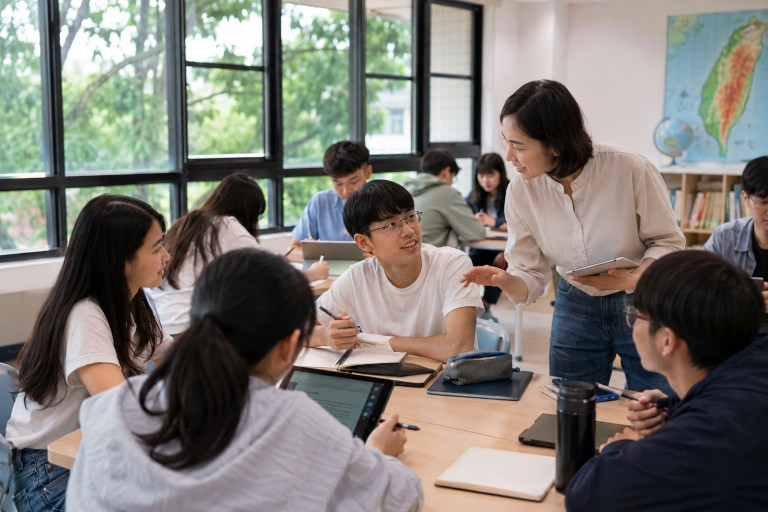
Education for the individual or for the Party-state?
Mainland China and Taiwan inherited much of the same Chinese cultural tradition, yet decades of separation under very different political systems have produced sharply different ideas about education.
Taiwan’s law recognizes patriotic education, civic responsibility, and national identity, but it places these alongside individual rights, independent judgment, creativity, human dignity, and self-realization.
Mainland China’s law goes much further in the opposite direction. It explicitly places education under the leadership of the Chinese Communist Party and requires schools to cultivate socialist values and produce “builders and successors” for the socialist cause.
That is the bigger difference.
Education should help students develop literacy, logic, independent thought, judgment, creativity, and the ability to shape their own lives. Schools naturally teach culture, values, and civic responsibility, but there is a profound difference between preparing young people to participate responsibly in society and molding them to serve a ruling political ideology.
Under a communist system, education can cease to be primarily about developing the individual and instead become a means of molding people into obedient cogs in the machinery of the state.
That brings us back to the question at the heart of the original comparison: If education’s purpose is to manufacture the people the state requires, who decides the mold?
The National People’s Congress?
The government?
Or ultimately, the Communist Party?
Translated by Cecilia
Follow us on X, Facebook, or Pinterest
