
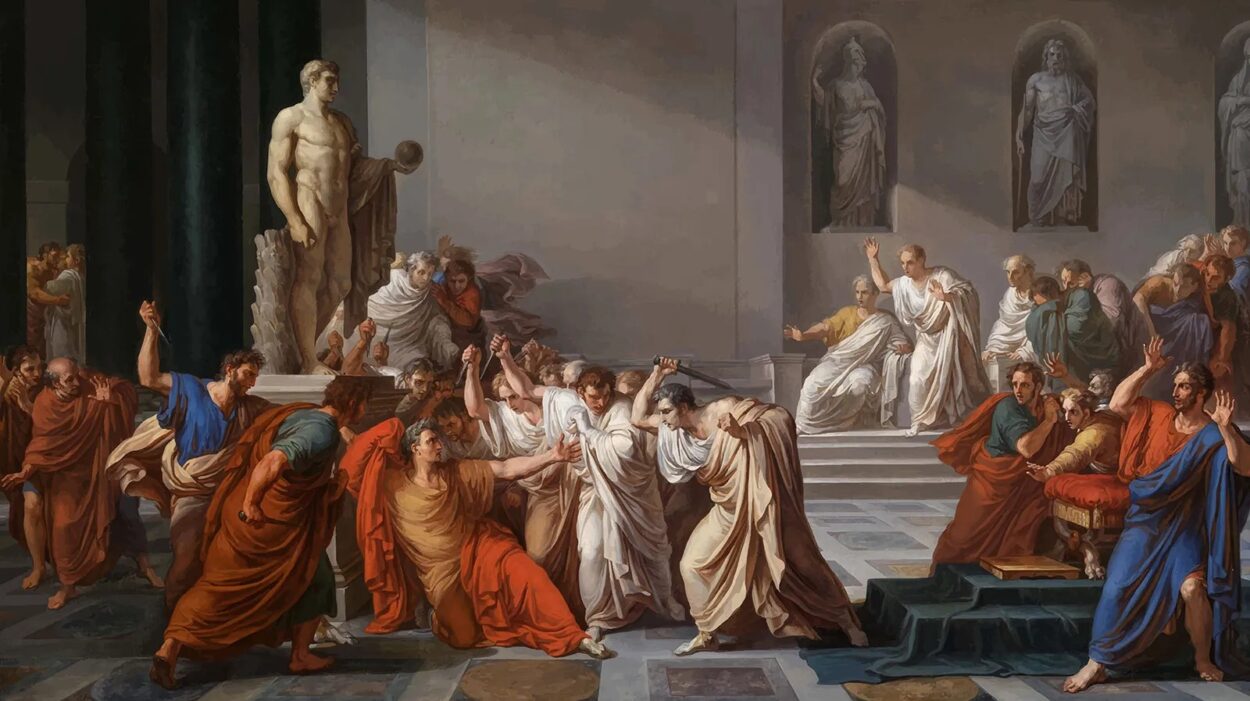
Beyond the unlucky 13 or Friday the 13th, Westerners have regarded March 15th — the Ides of March — as an ominous day for more than two thousand years. The reason is simple: On this very day in 44 B.C., Julius Caesar was assassinated, stabbed repeatedly by a group of conspirators as he sat in the Curia of Pompey, where the Roman Senate was meeting. William Shakespeare dramatized this event into the famous line in his timeless tragedy, The Tragedy of Julius Caesar.
Ancient wisdom suggests heavenly signs reveal approaching misfortune
The ancient Chinese said, “Heaven displays signs to reveal good or bad fortune,” which is also known as “interaction between heaven and humanity.” The ancients believed that whenever major disasters or upheavals occur in human society, Heaven gives warnings. The assassination of Caesar seems to illustrate this ancient idea. In the days leading up to his death, a series of strange phenomena and ominous signs appeared — as though the final chapter of his life had already been written somewhere beyond the sight of man.
Gaius Julius Caesar’s greatness needs no further elaboration; he was one of the most prominent military commanders and statesmen of the ancient world. He personally led the Roman legions in the conquest of Gaul, a vast region encompassing much of modern-day France and Belgium, as well as parts of Switzerland, Germany, and the Netherlands. When the Senate ordered him to relinquish his military command, Caesar refused. Instead, he led his army across the Rubicon River into Italy, violating Roman law and setting the stage for civil war. According to the ancient accounts, he declared, “The die is cast.”
The ensuing civil war brought Caesar into direct conflict with his former ally and most formidable rival, Pompey the Great. In 48 BCE, Caesar decisively defeated Pompey at the Battle of Pharsalus. Pompey fled to Egypt, where he was assassinated shortly afterward. Caesar then returned to Rome and steadily consolidated power in his own hands. In 44 BCE, he was appointed dictator perpetuo — “dictator for life” — giving him extraordinary and effectively unlimited political authority.
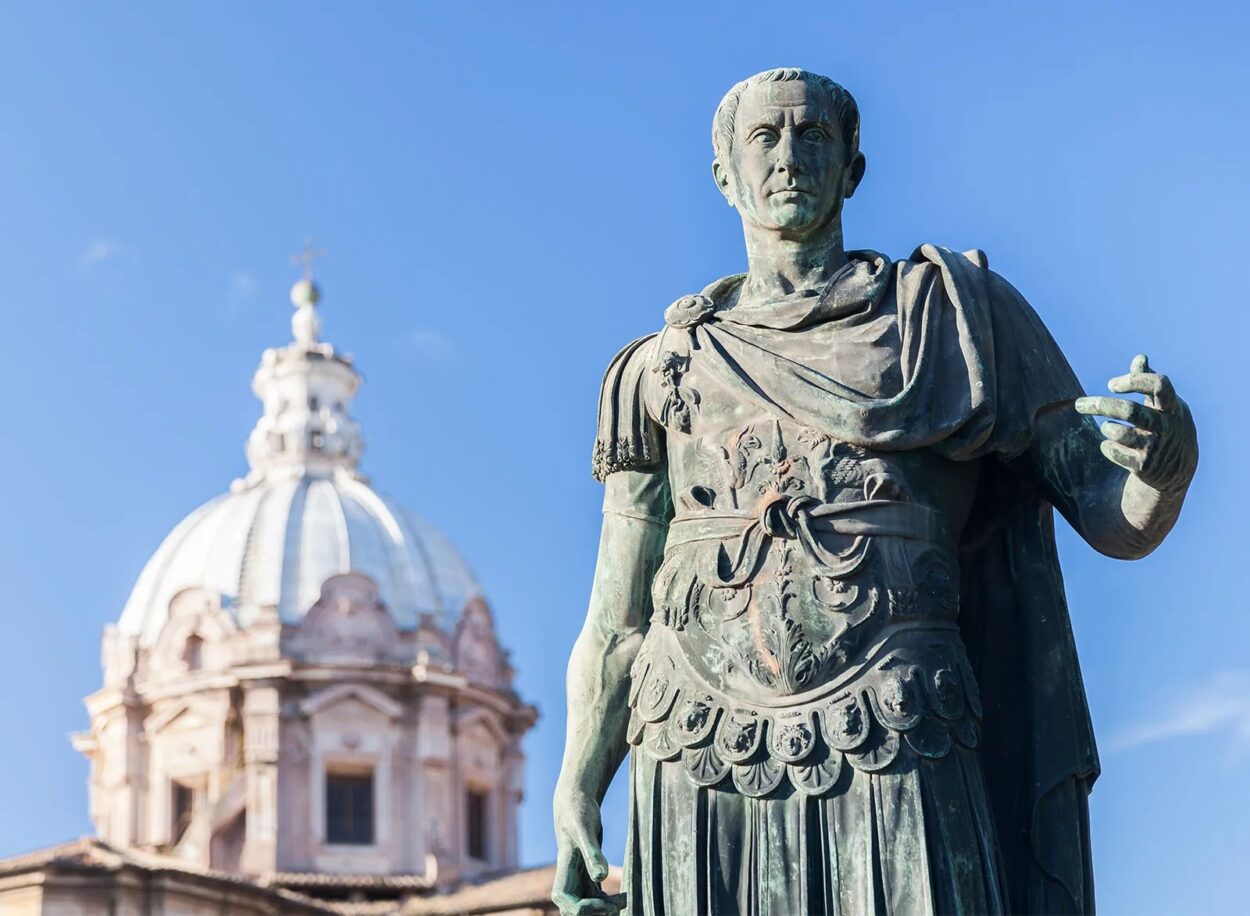
Caesar was not only a brilliant military commander, but also enormously popular among the Roman people. He radically reformed the Roman calendar, establishing the Julian calendar, which remained in use for more than 16 centuries and became the foundation of the calendar we use today. In fact, the month of July was named in his honor. He was generous toward the common people, granting favors, distributing land and other benefits, and winning their deep affection. Wherever he went, he was often greeted with enthusiastic cheers and demonstrations of popular support. To many ordinary Romans, Caesar was not merely a powerful ruler — he was a beloved and extraordinary figure who had risen to the highest level of power an ordinary Roman could attain.
Public rituals escalated fear of royal tyranny in Rome
However, Rome was originally a republic, and what it loathed above all else was the word “king.” The more Caesar’s power grew, the colder the hearts of the old aristocrats in the Senate became. They feared he would crown himself king, abolish the republic, and turn the Rome of their ancestors into his personal domain. To make matters worse, another event added fuel to the fire.
During the festival of Lupercalia, a celebration associated with purification and fertility, in February of that year, Caesar’s close ally and general, Mark Antony, publicly offered him a diadem — a headband symbolizing royal authority. He offered it to Caesar three times before the assembled crowds. Caesar refused it three times, and each time he declined, the crowd cheered. Although Caesar did not accept the diadem, the spectacle deepened the anxiety of those who already feared his ambitions. He had refused it today — but what about tomorrow? He was already dictator for life. How far, they wondered, was he from becoming king?
Fear spread like wildfire. And so, a conspiracy was secretly woven among a group of senators and other Roman elites. At its center were Marcus Brutus, renowned for his reputation for integrity and republican virtue, and Cassius, an equally determined opponent of Caesar’s growing power. Before long, the conspirators had drawn dozens of men into their plot. According to ancient accounts, more than sixty were ultimately associated with the conspiracy. The daggers were sharpened and concealed. The conspirators had only to wait for the right moment.
Unusual nature signs portended impending disaster before the attack
However, it seems that Heaven sensed the bloodshed even before Caesar himself. The first to feel uneasy was a herd of horses. When Caesar crossed the Rubicon, he offered a herd of fine horses to the river god, letting them roam freely on the riverbank, unattended. But shortly before his death, these horses suddenly changed their behavior. They stubbornly refused to eat grass, kept their heads down all day, and tears streamed down their faces, as if they had foreseen some terrible misfortune.
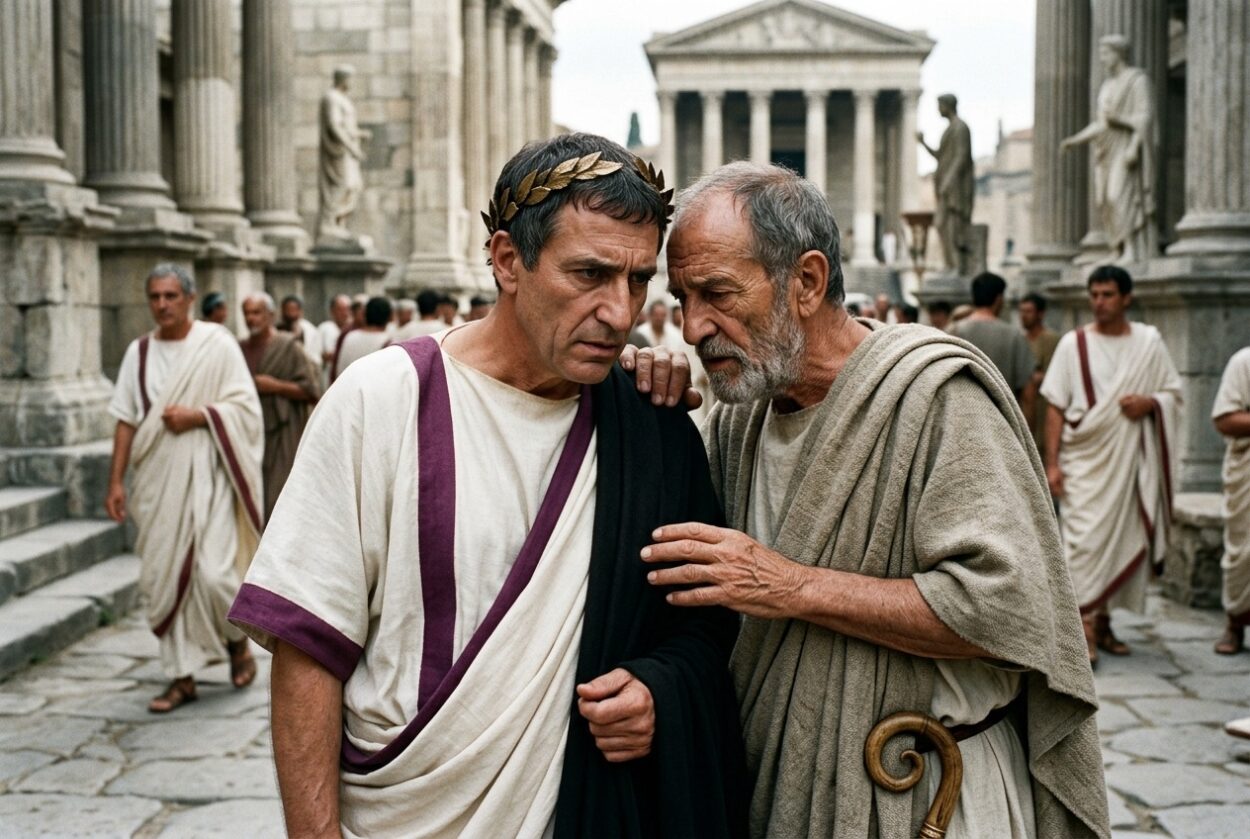
The next warning came from a soothsayer. His name was Spurinna, a renowned seer in Rome. Once, while Caesar was performing a sacrifice, Spurinna examined the entrails of the sacrificial animal. His expression reportedly changed dramatically — the animal appeared to have no heart. To Romans, such an extraordinary sign was a grave omen, suggesting the gods had withdrawn their protection. Spurinna pulled Caesar aside, lowered his voice, and solemnly warned him that great danger loomed.
According to the ancient accounts, this danger would not pass until the Ides of March. Caesar was warned to be especially cautious as that day approached — and above all, on March 15 itself. The ominous signs did not stop there. On the very day before March 15th, a small bird carrying a laurel branch (which Romans called the “Kind Bird”) flew into the Curia of Pompey, the exact place where Caesar would meet his end. Immediately afterward, a flock of other birds swooped in from unknown woods, chased down the little bird, and tore it to shreds before everyone’s eyes.
Where blood and feathers fell, another shadow of fate was cast. That same evening, Caesar dined at the home of his general, Lepidus. During the feast, the guests chatted casually until, somehow, the topic shifted to a strange question: What is the best way to die? Amid a flurry of differing opinions, Caesar put down his pen and casually uttered that “he wished for a sudden death.” Hearing this, the entire table felt an eerie chill.
That night, an ominous dream arrived. In his sleep, Caesar vaguely envisioned himself soaring into the clouds, hand in hand with Jupiter, the king of the gods — a sign traditionally signifying ascension. His wife, Calpurnia, slept even more restlessly. She dreamt that the gable of their house collapsed with a crash, and her husband, covered in blood, died in her arms. At that moment, the tightly shut doors of their bedroom creaked open on their own, without any wind.
The historian Plutarch recorded even more strange phenomena: in those days, the night sky over Rome flickered with firelight and eerie sounds. Some saw people walking in the streets engulfed in flames, yet somehow unharmed. In the squares, unusual birds gathered and did not disperse. An indescribable gloom seemed to descend upon the entire Eternal City. The signs were everywhere. The will of Heaven seemed so clear, yet people are often the least willing to believe what is placed before their eyes.
Fatal hubris guided Caesar’s final step into the trap
When the morning of the 15th arrived, Calpurnia, still reeling from her nightmare, clung tightly to her husband, tearfully pleading: “Do not go out today, do not go to the Senate!” Stirred and unsettled by the succession of ominous signs, Caesar considered staying home. At this critical moment, one of his trusted associates arrived — Decimus Brutus. He had long been a close ally of Caesar and had served as one of his generals. Yet, unbeknownst to Caesar, Decimus was also a key member of the conspiracy. He earnestly urged Caesar to go. He reminded him that the senators had been waiting for him, and that abandoning the meeting at the last moment would disappoint them and invite public criticism. He even appealed to Caesar’s sense of duty and dignity, persuading him that he could not simply disregard the Senate’s expectations.
In the end, Caesar yielded. Brushing aside his wife’s desperate pleas, he turned away and set out for the Senate—step by step, unknowingly walking toward the trap already laid for him. Along the way, Caesar still had two opportunities to be warned.
A man rushed forward and pressed a scroll filled with warnings into Caesar’s hands, urging him to read it immediately. Caesar accepted it, but before he could unfold it and read its contents, the crowds and commotion carried him onward. A few steps later, he caught sight of the soothsayer Spurinna among the crowd. With a hint of mockery, Caesar greeted him with a smile. “See? The Ides of March has come, and I am still perfectly safe.”
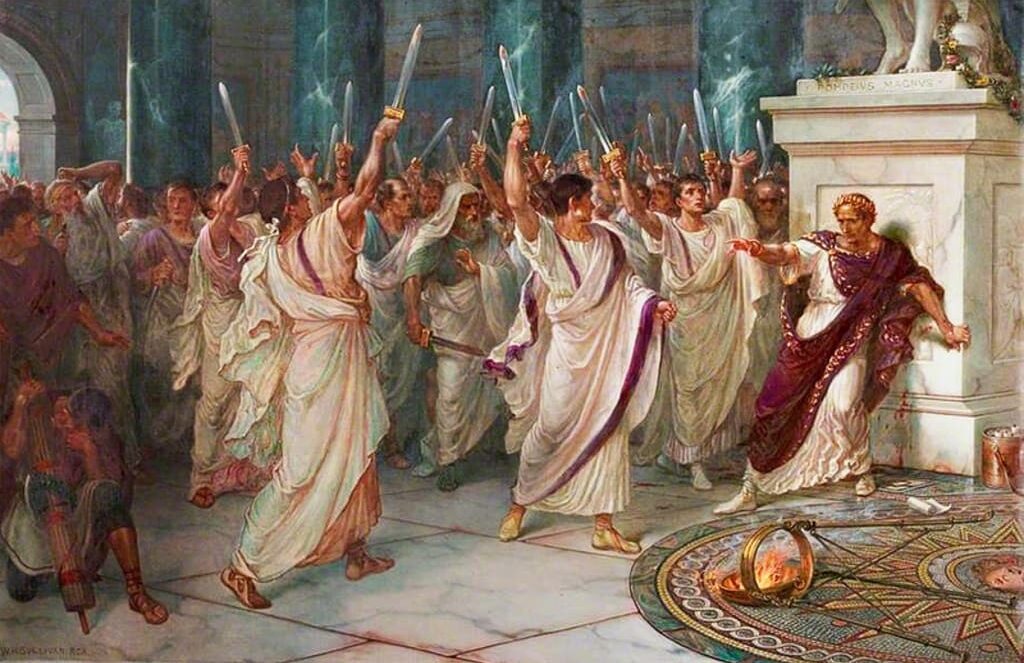
Spurinna did not smile. He looked at Caesar and replied: “Yes, the Ides of March has come — but it has not yet passed.” The prophecy was fulfilled almost immediately. Caesar stepped into Pompey’s Curia. He had barely taken his seat when the conspirators surrounded him and drew the daggers hidden beneath their robes. As the first blade struck, Caesar jolted to his feet and fought back, even grabbing his writing stylus and attempting to defend himself against his attackers. But a lone pair of fists was no match for so many hands.
Et tu, Brute?
Daggers rained down upon him, striking his body again and again. The vast assembly hall instantly erupted into chaos as senators shrieked and scattered in all directions. Amid the frenzy, robes were torn, blood splattered, and daggers clashed. In the confusion, some of the conspirators even accidentally wounded their own allies. In the midst of his struggle, a familiar face came into view — Marcus Junius Brutus, the young man Caesar had long cherished and treated almost like a son, now clutching a blood-stained dagger. At the time, rumors circulated in Rome that Brutus was not merely Caesar’s protégé, but Caesar’s own son. The moment Caesar saw Brutus, the pain in his heart was said to have been far sharper than any blade could inflict.
As for Caesar’s last words, the most famous version is the line immortalized by William Shakespeare in his play: “Et tu, Brute?” — “You too, Brutus?” Ancient Roman historians, of course, give different accounts of Caesar’s final moments. Plutarch wrote that when Caesar saw Brutus among the conspirators, he stopped struggling. Without uttering a word, he pulled his toga over his head and covered his face. Suetonius, meanwhile, recorded another tradition: that Caesar said to Brutus in Greek, “You too, my child?” Whichever version one believes, the heartbreak of being betrayed by someone so close is undeniable. Caesar finally ceased resisting, and after 23 stab wounds, his life slipped into darkness.
Thus, a great ruler fell in a pool of blood. Yet the very place where he fell seemed to be almost orchestrated by fate. The Senate had met at the Curia of Pompey that day only because the usual meeting place was undergoing renovation. And so, when Caesar collapsed, his blood-soaked body fell at the foot of a statue of Pompey — the old rival he had defeated in civil war, the man who had ultimately died in exile.
Plutarch wrote that Caesar’s blood splattered the statue, creating an image almost too fitting to be imagined: Pompey, in stone, towering over the fallen Caesar as though his long-dead rival were silently witnessing his final revenge. The powerful clashed, each refusing to yield. Yet in the end, the victor died at the feet of the vanquished.
Modern reflection reveals endless human pride in the face of danger
The shadow of the Ides of March still lingers today. Even after two thousand years, the date carries with it a strange sense of unease. The ancient warning Shakespeare placed in the soothsayer’s mouth reminds us of something far greater than a calendar date. It points to a timeless truth: Heaven gives warnings; the question is whether humanity will bow its head and listen.
Sometimes the signs are already before our eyes. The warning has already been given. The path ahead has already been revealed. Yet human beings, caught up in pride, denial, or the certainty that they know better, may still choose to turn away. Caesar was warned again and again. The signs appeared, the words were spoken, and the danger was placed directly before him. Yet he continued toward the fate that awaited him.
Perhaps this is the enduring lesson of the Ides of March: Heaven may show us the way, but whether we recognize the warning — and whether we are willing to heed it — remains our choice.
Translated by Chua BC and reviewed by Tatiana Denning
Follow us on X, Facebook, or Pinterest
