
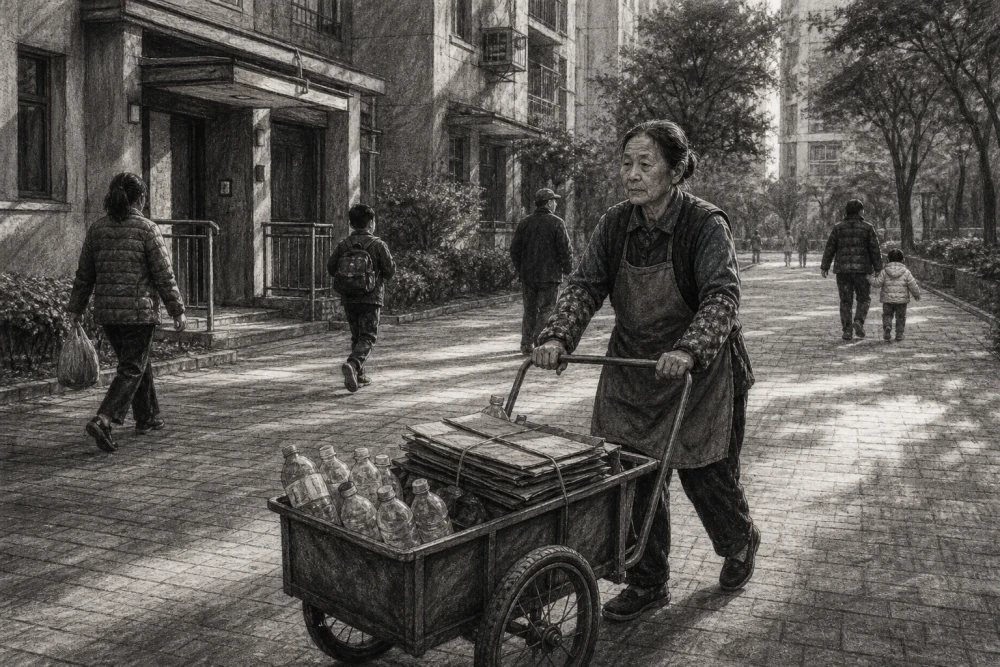
People kept asking: Why would a woman who isn’t short of money go through the trash? The answer is less about trash than about self-respect and a lifetime of work that does not stop when the work is gone.
I was this close to kneeling before her
Last month, her son broke down again. He pulled dozens of plastic bags from under her bed — wrinkled, in every color and size, some already blackened and brittle — and sent photos to his niece with one exasperated line: “What kind of home is this?” When he wanted it all thrown out, his mother cried.
He first discovered her habit a little over a month after she moved to the city, when he found a pile of cardboard boxes hidden behind the sofa and finally understood where she went every day. He felt sad and angry at once: sad because he hadn’t done enough to make her feel secure, and angry because their nice new home was turning into a storeroom for scrap. Later, the family found something bigger. A flat the granddaughter’s parents rented out in the same complex had become her secret depot, and when an agent opened the door for a prospective tenant, the rooms were packed with what she had collected. From then on, it became a game of cat and mouse. On weekends, when her son was home, she stayed in. Whenever he went back to his workplace dormitory, she was out every morning.
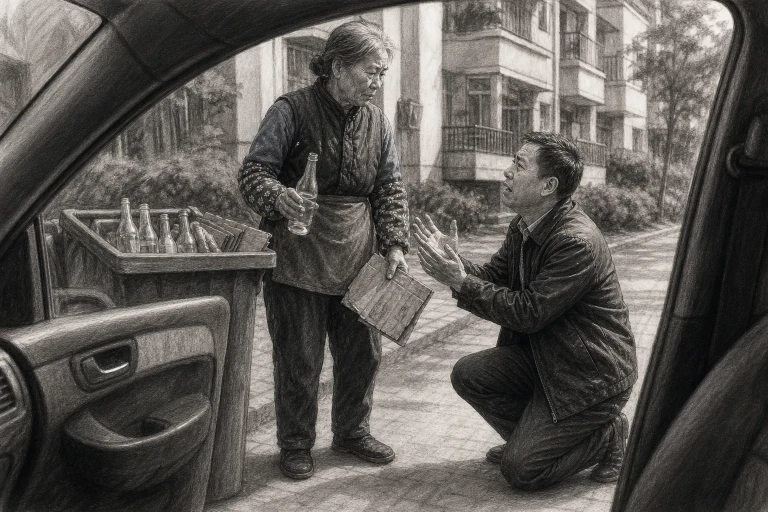
One morning, as he drove to work, he spotted her before he had even left the complex: the elderly woman by the bin, in her grease-stained apron and flowered arm warmers. She stood only slightly taller than the bin, and as she sorted through it, she was practically leaning over the rim. Halfway to work, he couldn’t hold back any longer. He called her, crying, and begged her to stop. Years later, his voice still carries the helplessness of that moment:
“I was this close to getting down on my knees in front of her!” On this matter, though, she never gave ground. Another elderly woman in the neighborhood collected recyclables too, she pointed out, and that woman’s child was a civil servant. “Even mothers from government families are out collecting!” And she insisted, again and again, that she only took clean bottles and cardboard.
The phone that never rings
Twenty years ago, her husband died, and she was left living alone high in the mountains of China’s southwestern frontier, a 2-hour hike from the foot of the slope. Her granddaughter, who has been there only twice, remembers the cold — cold enough that you need an electric blanket at night. Her grandmother couldn’t bring herself to spend money on electricity, so she simply piled on quilt after quilt.
She came to the city at about 70. Her son spent most nights in his work dormitory, so she was usually alone in the apartment. He remembers her first night there. When he opened the door, every light was off except the television. Its flickering glow fell on her, curled up on the sofa in the corner, neither asleep nor moving. She could sit there all afternoon. She had gone to school only through second grade and couldn’t read many characters, and she knew only how to switch the new TV on and off, so she watched whatever channel happened to be on. During the pandemic, when her son was assigned to contact tracing and didn’t come home for three months, she watched the same channel for dozens of days straight.
Later, he taught her to use Douyin, the Chinese version of TikTok. One winter day, he checked her phone: total screen time, 5 hours and 3 minutes, all on Douyin. When she accidentally tapped into an ad and couldn’t find her way back, she waited days for him to come home and fix it. Without the TV and the voices of short videos, the apartment was so quiet that she could hear the refrigerator hum. She never used her 30-yuan monthly phone plan; she rarely called anyone, and the phone rarely rang. Her son saved the numbers of all four of her children on the bracelet’s one-touch emergency button. She has hardly ever pressed it.
It was not always this lonely. In the first city she lived in, she met other elders on her walks — people who, like her, had come from the countryside to spend their later years near their children. They took her to the market and taught her to play dice, and it was by following them that she learned to collect recyclables, her “means of survival” in the city.
“We’d play dice together, pick through the bins together — we’d laugh all day long,” she says of those days. Then her son was transferred to the provincial capital, and she had to leave her friends behind. The elders there, she says, kept to their own circle and “didn’t mix with outsiders.” “They have their own lives. They have to take their grandchildren to school and pick them up. So I rarely get to have any fun.”
What loneliness in old age looks like for China’s drifting elders
She is far from the only one living this way. China even has a name for people like her: laopiao zu, the “drifting elders,” who leave their hometowns to live in the cities where their adult children work. According to the China Migrant Population Development Report 2016, nearly 18 million people aged 60 and over were living away from their registered hometowns in 2015, and 43 percent had moved mainly to look after younger family members. Sociologist Chen Hui of Northwest A&F University interviewed many such families for his book Silver-Haired Ferrymen (Yinfa Baiduren), whose preface argues that rural elders pay the highest price for adjusting to city life.
Dialect turns small talk into hard work, and social circles shrink to a handful of other out-of-towners. In one survey cited by China News Service in 2022, more than seven in ten such elders said their circle was narrow and that they felt lonely. Smartphones help less than one might hope. China counted about 161 million internet users aged 60 and over by mid-2025, but a screen full of strangers’ voices is not a neighbor who knows your name.
The granddaughter is candid about the distance between them. They meet about once a year, and every visit follows the same script: her grandmother asks where she is studying and when she will graduate, praises her grades, and then neither of them can think of much else to say. Raised in the city, the granddaughter can barely understand her grandmother’s dialect. So the older woman does what she can, bringing out snacks and fruit and urging her to eat, over and over, almost stubbornly.
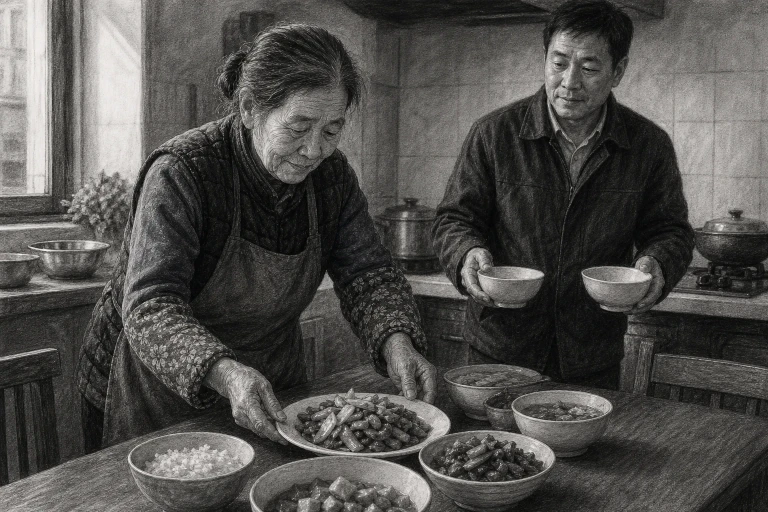
At Lunar New Year, the granddaughter always found an excuse to eat at a restaurant. Last year, when her grandmother offered to cook for her, she declined yet again. Her grandmother asked, crestfallen, whether she thought her cooking was dirty. Not wanting to hurt her, the granddaughter said it just wasn’t very tasty. “In reality, I couldn’t stand the sticky film that always coated the dishes at home,” she admits. To save water, her grandmother catches the running water from washing up in a plastic basin and reuses it, and a layer of grease always floats on top. Even during the Spring Festival, the liveliest time of the year, the grandmother seems far away, sitting alone on the sofa with her phone. On the family’s first day home, she stayed behind to finish the leftovers while the others went out to eat. By the time they returned, she had gone to bed alone.
Only those with a pension dance
In Chinese cities, the evening square dance, guangchangwu, is one of the most familiar sights of retirement: rows of older residents moving in time to music from a portable speaker. The granddaughter once asked why her grandmother didn’t join the dancers instead of collecting. The answer came without hesitation: “Only people with a retirement pension dance. I’m from the countryside. I don’t have a retirement pension, so this is my rare chance to have some fun!”
The line marks a real divide. Urban retirees from formal jobs draw a monthly retirement wage. Rural elders of her generation rely mainly on the far smaller basic pension for urban and rural residents. Its national minimum has risen by 20 yuan a year since 2024 to 163 yuan a month in 2026, and official statistics put the average actually paid in 2024 at 246 yuan a month, to about 180 million people. When she says she has no pension, she means she has no retirement wage, and in that sense she is right. She calls collecting fun, not work, and Chen Hui’s book files it the same way, under social life and leisure. For a woman who never learned to rest, the bins downstairs may be the nearest thing to a village path.
The woman who couldn’t stop
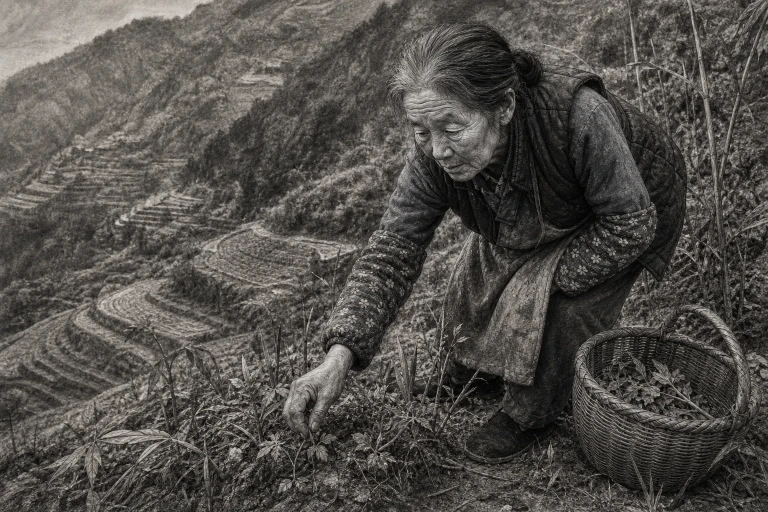
Before the city, her days belonged to the fields. She left around seven or eight each morning and came home after dark. With a large family and a lot of allotted land, she had to farm every plot. When the fields didn’t need her, she went up into the mountains to dig medicinal herbs. Asked whether farm work had been tiring, she just smiled: “Only people who’ve never done it think it’s hard. You get used to it as you go.” She also insisted she was the least capable, slower than everyone else.
Her family remembers it differently. Her son says she produced the most grain in the commune and raised the fattest pigs: when other families’ pigs reached 400 jin, about 200 kilograms, she kept feeding hers until they reached 600 jin, about 300 kilograms. The granddaughter’s father calls her competitive. In the work-point era, when collective farms tallied each person’s labor in points, she raced the other villagers to earn the most. After farmland was contracted back to individual households from the late 1970s onward, she competed to see whose family could farm the most land, tilling every slope and corner to feed the family.
Even so, it was barely enough. The granddaughter’s father became the village’s first college student, and the day before he left, his grandfather was still walking him from house to house to borrow money for tuition. She hadn’t wanted to leave the countryside; she moved to follow her children’s plans. “Your uncle said he wouldn’t feel easy leaving me alone back home — he wouldn’t even know if I got sick.”
Last year, when the medicinal herbs that had been growing for years on the mountains near home were ready to harvest, she went back and stayed two months. “It was so much fun,” she says. She climbed the slopes for hours at a time, picked fruit from the trees her eldest daughter’s family had planted, and dug bamboo shoots. When villagers saw the 75-year-old still working the steep hillsides, they phoned her son. By the time he heard, she had already sold every shoot.
Why “useless” is the word she fears most
Both her sons know she does not want to be “useless,” a burden on her children. For decades, she has never once asked them for money. Her son gives her more than 1,000 yuan at a time, about 3,000 yuan over the past two months alone, and whenever he asks, she tells him she has money.
Chen Hui lists the familiar reasons older people collect recyclables: income, exercise, a way to relax. But he adds another, xian bu zhu, roughly “can’t sit idle.” Elders born in the 1950s and 1960s, he argues, grew up with no real concept of leisure, so they need something to do. The grandmother says much the same in her own terms: sitting all day makes her back ache, and walking the bins keeps her moving.
Her son sees fear of poverty instead. Her mind is always on money and on her children, and she wants to earn what she can while she still has the strength. “If she hadn’t been so poor when she was young,” he says, “she’d be downstairs square dancing by now.” She herself says plainly that she “wants money.” When her granddaughter asked why she would go to such lengths for a few coins, she found the question absurd. “Even a three-year-old knows to reach for the big bills. Who doesn’t love money? If you don’t care about money, why work so hard?”
Her son is paying off a mortgage, she reasons, so he can’t spare money. She only wants a little extra for medicine and groceries. There is good reason to take her fear of uselessness seriously. In a national study of older adults in China, published in BMC Public Health in 2017, those who persistently felt useless had about an 80 percent higher risk of death over the following years than those who seldom felt that way. The link weakened once researchers accounted for health, income, and family support, but it did not disappear. An earlier American study of people in their seventies pointed the same way. Neither proves cause and effect, but for many older people, being needed is part of being well.
Chinese tradition has long honored the habit she embodies. In a letter of family instruction to his son, the Song dynasty statesman Sima Guang quoted the old saying that frugality is the virtue all virtues share, and recounted the reasoning of an earlier chancellor who kept living as plainly as he had as a junior official: going from thrift to luxury is easy, while going from luxury back to thrift is hard. The grandmother is the saying’s quiet exception. A lifetime of thrift did not leave her the moment she reached a comfortable apartment. The basin of dishwater, the unspent electricity, and the leftovers she will not waste are the same discipline that once raised the commune’s fattest pigs. What looks like a quirk in the city was a virtue on the mountain.
What filial piety asks of the children who love her
None of this makes her son the villain. He gave her a home, money, and a safety bracelet, and he wept on the phone because he could not bear to see her bent over a bin. The granddaughter, too, tells the story with a candor that includes her own part in the distance.
Confucius named this gap more than two thousand years ago. When his disciple Ziyou asked about filial piety, he observed that people now take it to mean providing for one’s parents, yet without reverence, provision alone falls short (Analects 2.7). When Zixia asked the same question, Confucius answered with two characters, se nan: “The countenance is the hard part” (Analects 2.8). Doing the chores and serving parents food and wine is not yet the whole of it. The harder thing is the warmth in one’s face, which has to come from within.
Reverence for a woman like her might mean seeing the bottles not as an embarrassment but as the last field she still knows how to work. It might mean sitting down to the meal she wants to cook, or walking the complex with her in the early morning. For anyone with aging parents, the lesson travels well beyond China. Many older people do not want to be served; they want to be needed. Sometimes the kindest question is not “What can I do for you?” but “Could you help me with this?” Loneliness in old age is not only the absence of company. Often, it is the absence of a role.
After last month’s argument, the grandmother says she stopped going out to collect. She is getting old and no longer wants to argue with her children. She has started talking again about going back to her village. But she knows she can’t. She is too old to farm now. And up in the mountains, fewer and fewer people are left who can talk to her.
Follow us on X, Facebook, or Pinterest
