

In the mountains of Nara, Japan, stands Hase-dera, an ancient Buddhist temple dedicated to the Eleven-Faced Kannon, the Bodhisattva of Compassion. During Japan’s Heian period (794-1185), pilgrims journeyed there from the capital, and visits to Hase-dera became a familiar subject in Japanese literature.
Among the stories associated with the temple is an unusual account of a poor man whose fortunes changed through a single stalk of straw. Recorded in the Konjaku Monogatari-shū (Tales of Times Now Past), it became known as The Straw Millionaire, or Warashibe Chōja in Japanese.
The man, who lived in Kyoto, had no parents, wife, or children, and no one to depend on for support. With little hope of escaping poverty, he went to Hase-dera and appealed to Kannon for help.
A dream and a single stalk of straw
Kneeling before Kannon’s image, the man vowed that he would remain at the temple until he received some guidance, even if he starved to death there. Concerned for his welfare and fearful of a death within the temple, the monks took turns feeding him. Still, he refused to leave.
Twenty-one days passed. Just before dawn, he dreamed that a monk emerged from behind a curtain. The figure was Kannon, appearing in human form.
Kannon first reprimanded him. He did not know what wrongs he might have committed in previous lives, yet he was demanding an end to his present suffering. According to the Buddhist understanding of karma expressed in the tale, his poverty could be connected to the consequences of those earlier actions.
Nevertheless, Kannon took pity on him and offered a seemingly simple instruction: When he left the temple, he must keep whatever first came into his hand, however insignificant it appeared, and regard it as a gift.
After waking, the man obtained some food from the monks and departed. At the temple gate, he stumbled and fell. As he rose, he noticed he held something in his hand: a single stalk of straw.
He wondered whether something so ordinary could really be the promised gift. Remembering his dream, however, he kept it and continued toward Kyoto.
Three oranges and an act of kindness
As daylight spread, a horsefly began buzzing around his face. He tried to drive it away with a twig, but the insect kept returning. Finally, he caught it and used the straw to tie it to the twig. The fly fluttered at the end, making an odd little toy.
Before long, he encountered an ox-drawn carriage carrying a noblewoman on her way to Hase-dera. A child inside noticed the fluttering horsefly and wanted it. A servant approached the man and asked him to hand it over.
The man explained that he regarded the straw as a gift from Kannon. Even so, he agreed to give the child the toy. In thanks, someone in the carriage presented him with three mandarin oranges to relieve his thirst along the road.
He tied the fruit to his twig, rested it across his shoulder, and walked on.
Soon he came across another party of pilgrims. One traveler, apparently a person of high standing, had become so exhausted and thirsty that he could hardly continue. His attendants searched desperately for water, but found none nearby.
When the man learned what was wrong, he offered all three of his oranges. The traveler ate them, recovered his strength, and expressed his gratitude. He said he might have collapsed along the road without the fruit.
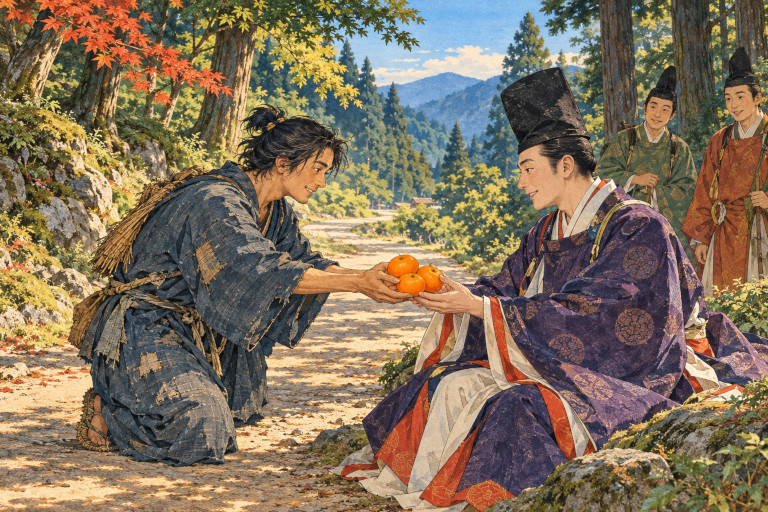
The grateful traveler had food brought from his supplies and invited the man to eat. Then he gave him three bolts of fine cloth and an address in Kyoto, urging him to visit someday.
The man was astonished. The stalk of straw he had almost discarded had led first to three oranges and now to valuable cloth. He believed Kannon was guiding him, but his willingness to part with what he had received had also helped bring about these unexpected exchanges.
That evening, he found lodging at a small roadside house. Early the next morning, he resumed his journey.
A prayer brings a horse back to life
Along the road, the man saw a rider approaching on a magnificent horse. He was admiring the animal when it suddenly collapsed and died. Distraught, its owner removed the saddle, mounted another horse, and rode away, leaving a servant to deal with the body.
The servant explained that the horse had come from Mutsu, in northeastern Japan, and had been prized so highly that its owner had refused generous offers for it. Now the servant hoped to salvage at least its hide, though doing so while traveling would be difficult.
The man began to wonder whether Kannon might restore the horse to life. He told the servant that he lived nearby and could make use of the hide, then offered one bolt of cloth in exchange for the dead animal. The servant accepted and left.
The man washed his hands, rinsed his mouth, and turned reverently toward Hase-dera. He prayed that, if his recent good fortune truly came through Kannon’s help, the horse might live again.
According to the tale, the horse opened its eyes, raised its head, and struggled to stand. The man helped it up and led it to a secluded place to rest. After a while, the animal recovered its strength.
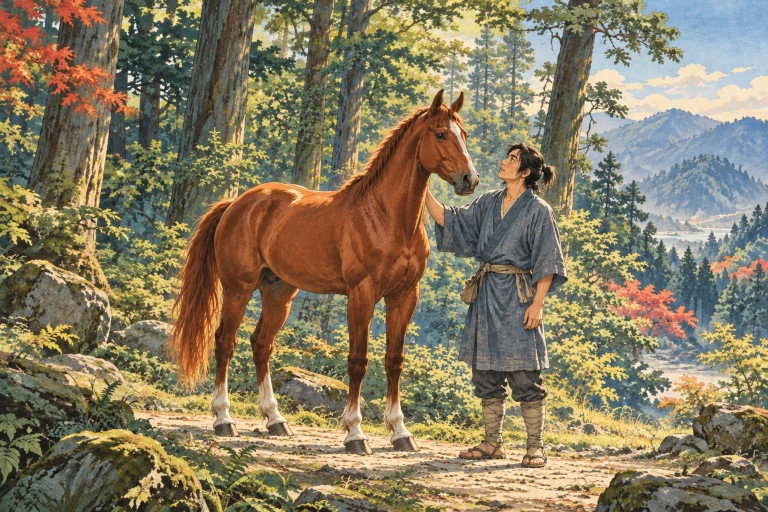
Of his remaining two bolts of cloth, he exchanged one for a saddle. Later, he used the other to obtain fodder for the horse and food for himself. Riding the horse, he continued toward Kyoto.
As he neared the city, however, he grew uneasy. A poorly dressed traveler on such a fine horse might be accused of theft, particularly if someone recognized the animal. He decided to sell it before entering the capital.
Near Kyoto’s Ninth Avenue, he found a household preparing for a journey. The family needed a horse and was delighted after trying his. They had no cloth or silk to offer in payment, but proposed exchanging a nearby rice field and a quantity of rice for the animal.
The man accepted. He secured the deed to the field, lived on the rice he had received, and arranged for someone else to cultivate the land in return for a share of the harvest. With a dependable source of food and income, his circumstances steadily improved. In time, he was able to establish a home of his own.
Prosperity without forgetting gratitude
The story appears as Tale 28 in Volume 16 of the Konjaku Monogatari-shū, under a title meaning “The Story of a Man Who Visited Hase and Became Wealthy Through Kannon’s Help.” Hase-dera still shares the tale with visitors today.
Its Japanese name, Warashibe Chōja, combines warashibe, a stalk of straw, with chōja, a person of wealth or prosperity. The man in the story never receives a name, but his actions make the account memorable. He follows guidance that initially seems absurd, gives away an object a child admires, and offers his only fruit to someone in distress. He also recognizes opportunities and acts on them, trusting that Kannon’s assistance has not ended with the first gift.
The tale is not simply about trading something worthless for something valuable. It reflects a Buddhist understanding of compassion, karma, and the help that may come through faith. The man’s fortune grows through a series of encounters in which he both receives assistance and offers it to others.
After becoming prosperous, he continued to visit Hase-dera to pay his respects. He did not forget the guidance he believed he had received there.
When he was poor, he prayed for help. When fortune finally came his way, he remembered to give thanks.
His circumstances had changed, but his gratitude had not.
Translated by Katy Liu
Follow us on X, Facebook, or Pinterest
