
For nearly a decade, a Chinese merchant managed a business whose owner had gone home and could not return. War disrupted travel, and no one knew when someone would arrive to take over. Yet when the owner’s son finally reached Chongming Island, near Shanghai, he found the business thriving and its accounts carefully preserved.
The man responsible was Zhan Gu (詹谷), a merchant from Wuyuan, now in China’s Jiangxi Province but historically part of the Huizhou region. The late Qing-era Wuyuan County Gazetteer (《婺源縣志》) recorded his conduct among accounts of people remembered for their integrity.
A business entrusted to his care
During the Ming and Qing dynasties, merchants from Huizhou traveled throughout China, building trading businesses far from their hometowns. Their commercial relationships depended heavily on reputation, especially when an owner had to rely on someone else to manage his affairs. Zhan Gu came from this merchant tradition.
According to the gazetteer, he went to Chongming, an island near the mouth of the Yangtze River, and worked for a businessman associated with Jiangwan, a village in Wuyuan. The record does not identify the owner’s full name or specify the type of business. It says that the owner, now elderly, returned home, leaving Zhan Gu to oversee the operation.
Then conditions changed dramatically. The Taiping Rebellion spread through eastern and southern China in the mid-19th century, bringing widespread warfare and interrupting established routes of travel and trade. Chongming’s island location added to the difficulties. According to the historical account, roads and transportation links were obstructed for nearly ten years.
Zhan Gu nevertheless remained at his post. He managed the business through years of uncertainty, keeping it operating despite the surrounding turmoil. More than merely surviving, the enterprise prospered under his management.

It would have been easy for a person in his position to take advantage of the owner’s absence. Zhan Gu had been entrusted with another man’s livelihood, while distance and war made ordinary supervision difficult. But the account records no attempt to enrich himself at the owner’s expense. Instead, he continued to safeguard what he had been entrusted with.
An unexpected test of honesty
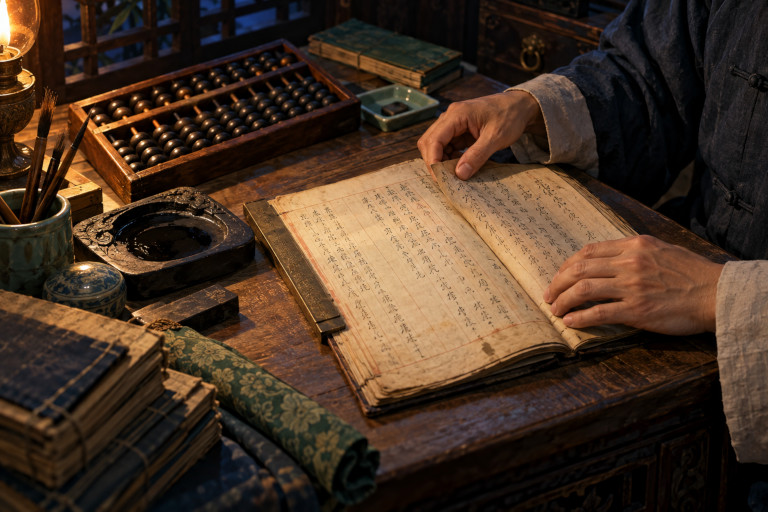
Nearly ten years later, the owner’s son arrived in Chongming to assume responsibility for the business. Zhan Gu presented the account books and handed over the records of money received and spent during his years in charge.
The gazetteer describes his handling of the accounts as juandi wusi (涓滴無私), meaning he took nothing for himself. The people of Chongming, it says, admired his fairness and integrity.
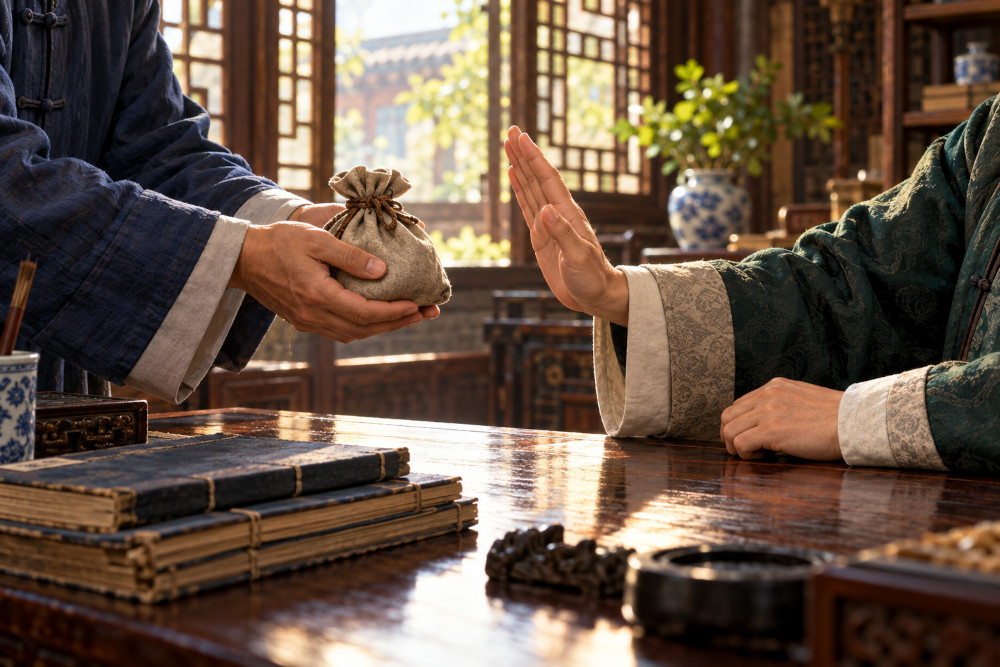
The son was deeply grateful. In addition to Zhan Gu’s wages, he offered a substantial reward for his years of service. Zhan Gu declined the extra payment. He had fulfilled the responsibility entrusted to him, and he asked for nothing beyond what he was owed. His actions made the principle clear: being entrusted with someone else’s property was a responsibility to honor, not an opportunity to seek an unexpected reward.
Even then, Zhan Gu did not leave abruptly. Before returning home, he carefully explained the business’s affairs and arranged for its continued management. He wanted to ensure the work entrusted to him was properly handed over.
Integrity when no one is watching
What distinguishes Zhan Gu’s conduct is how long he maintained it. Honesty in a single transaction can be admirable. Remaining honest through nearly a decade of separation, uncertainty, and disrupted trade requires a steadier commitment. His employer’s son returned to find an enterprise that had prospered, records that could be examined, and a manager willing to give up control without claiming anything beyond what he was owed.
Traditional Chinese culture places great importance on chengxin (誠信), a combination of sincerity, honesty, and trustworthiness. It also values shounuo (守諾), the keeping of one’s word. For merchants whose livelihoods depended on relationships across long distances, these were practical as well as moral virtues.
Zhan Gu’s story illustrates what those virtues look like in action. He could not know when his responsibility would end or whether anyone would recognize his effort. He simply kept doing what was right. By the time the owner’s son arrived to examine the books, Zhan Gu had already proved the value of his word.
Historical source: The account of Zhan Gu appears in the Guangxu-era Wuyuan County Gazetteer, volume 35, “Exemplary Conduct” (義行), as reproduced in Selected Historical Materials on Huizhou Merchants of the Ming and Qing Dynasties (《明清徽商資料選編》).
Translated by Patty Zhang
Follow us on X, Facebook, or Pinterest
