
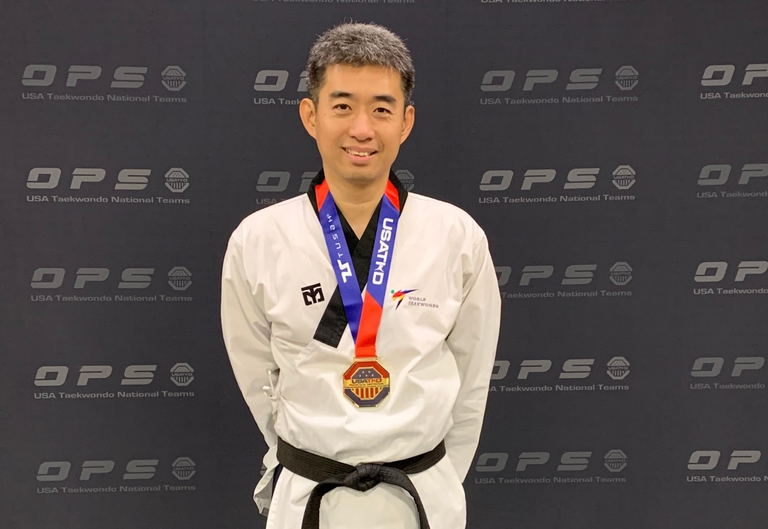
At this year’s World Masters Games in Taiwan, all eyes were on 44-year-old Taekwondo athlete named Justin (Shenghao) Wang. This soft-spoken, Taiwanese-American man stunned spectators by taking double gold in both the men’s individual and team poomsae competitions. But what captivated people wasn’t just the medals. It was his story: how a shy, musically trained boy — who once feared sports — transformed himself into a world-class martial artist through grit, heart, and two decades of relentless effort.
From piano keys to black belts
Born and raised in Taiwan, Justin Wang’s early years were centered around music. He played the piano and electronic keyboard and sang in a choir. Sports, he admits, were utterly foreign to him. That all changed at age 15 when a routine bus ride became a turning point. Targeted by bullies because of his frail appearance, Wang made a life-altering decision: “At first, I just didn’t want to get beaten up anymore,” he says with a laugh. With no athletic background, he began stretching, practicing splits, and building his strength. At 16, his family moved to the U.S., where he began formal training — first in karate, then Taekwondo. That’s when his journey truly began.
A late bloomer with an unstoppable drive
In a sport where most athletes start training in early childhood, Wang was a clear outlier. He joined a dojo at 16 — older, weaker, and less experienced than his peers. But he didn’t let that stop him. “Being older meant I understood why I was learning,” he explains. “I had clarity and purpose, and that helped me progress faster.”
His hard work paid off. By 28, Wang had earned a place on the U.S. national team for the World Taekwondo Poomsae Championships. “That was the turning point in my life,” he says. “I started ten years later than most — but I reached my goal in ten years just the same.” Poomsae, in Taekwondo, refers to a defined set of patterns of attack and defense movements, serving as a crucial aspect of training and competition.
Since 2009, he’s represented the U.S. 12 times and competed in six world championships. He describes poomsae — the precise, non-combative discipline of Taekwondo — as a global competition dominated by countries like South Korea, Taiwan, and those across Southeast Asia. “Back then, the U.S. trailed behind Asia in poomsae,” Wang recalls. “But we’ve been working hard to catch up.”
Aging with grace: The endurance of poomsae athletes
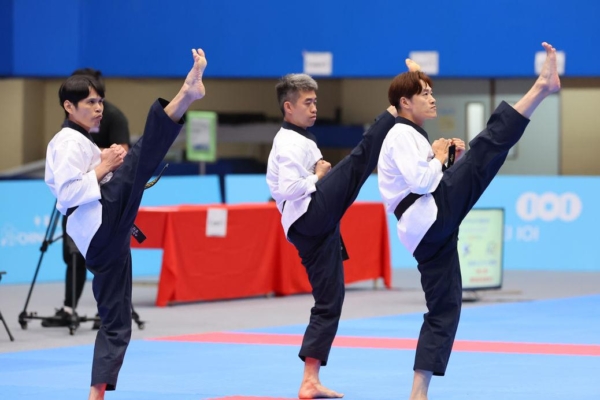
Unlike Taekwondo sparring, which divides athletes by weight class, poomsae competitions are separated by age. This allows practitioners like Wang to remain competitive well into their 40s and beyond. “After 30, it’s not about being the fastest or strongest — it’s about who ages the slowest, who can maintain their form the longest,” he says.
In poomsae, every movement must be precise, and every transition must be smooth. It’s a battle of endurance, focus, and balance — more like martial arts ballet than a brawl. The sport, which became an official Olympic event in 2000, continues to evolve worldwide, narrowing the skill gap between countries.
The cost of commitment — and the lessons within
Though Wang eventually dedicated himself entirely to Taekwondo, he doesn’t recommend his path to everyone. “I’m an exception,” he says candidly. He emphasizes that while passion and persistence are vital, so are education, family support, and balance. “I always tell young students: prioritize school first.” Wang himself completed his basic education and only pursued Taekwondo full-time after discussing it thoroughly with his family. He attributes his success to a combination of hard work, opportunity, and the unconditional support of his parents.
Coming home with gold: A dream realized in Taiwan
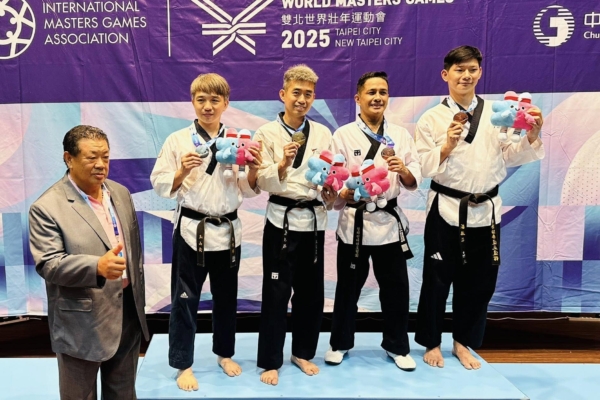
This year’s World Masters Games in Taiwan was more than a competition — it was a homecoming. The event allowed for the formation of cross-national teams, enabling Wang to partner with two Taiwanese athletes — something he had long hoped to do but had never had the chance to do in formal tournaments.
“Teaming up with my old ‘rivals’ from international competitions felt like a class reunion,” he says, smiling. For him, the friendships and camaraderie carried as much weight as the medals. Still, winning mattered. “Of course, we still wanted to win,” he says. “But getting to compete alongside them, here in Taiwan, meant more.”
From bullied teenager to gold medalist, from piano recitals to global championships, Justin Wang has built a life that defies expectations. Now a seasoned coach and mentor, he’s passing on his discipline, experience, and belief that it’s never too late to start chasing a dream. “You just have to stick with it,” he says. “Whatever your dream is — don’t let go.”
Follow us on X, Facebook, or Pinterest
