
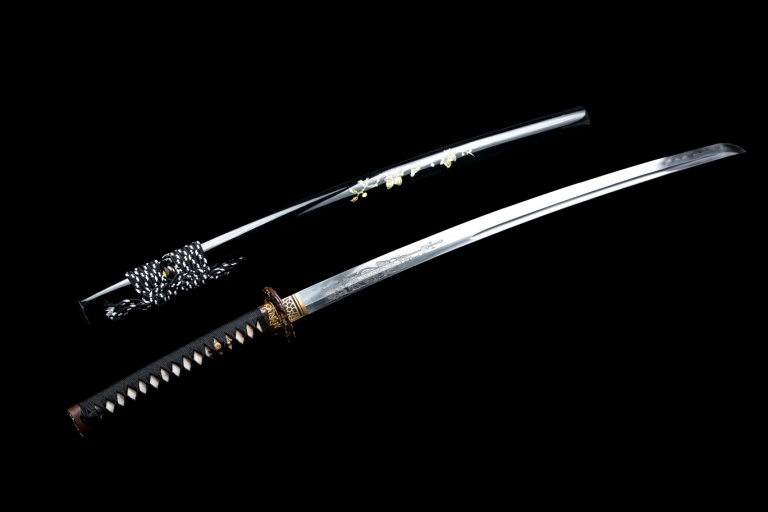
In recent years, Japanese swords have become renowned worldwide not only as weapons, but also as works of art, pieces of history, and symbols of honor. Among these swords, most people are familiar with the katana, also known as the “soul of the samurai.” It is famous for its curved shape, sharp edges, and graceful lines. But what makes it so special, and how were such formidable weapons made without modern tools, machines, and lasers?
Swordsmiths, broadly known as the katana-kaji in ancient Japan, crafted their swords using a step-by-step process that combines fire, steel, and centuries-old skills. They spent weeks, even months, shaping raw materials into blades that could cut through things in a single swing. Every manufacturing step required patience, skill, and a deep sense of purpose.
In this article, you’ll learn the history and craft of Japanese sword-making. We explore how these legendary weapons were forged from sand and why the process was almost like a sacred ritual.
The origins of Japanese sword-making
The story of Japanese swords goes back over a thousand years. Before the “modern” sleek katana, the Japanese had weapons like the chokutō, which were simple variations of Korean and Chinese swords. These early weapons were straight and double-edged iron blades.
However, during the Heian period (794-1185), these early, simple weapons, mainly used for stabbing, began to transform into blades for fast strikes, especially on horseback. The first precursor of the katana was called nihontō. But as Japan began facing more battles and unrest, especially during the Kamakura period (1185-1333), sword-making transformed rapidly. Samurai warriors needed swords that were reliable and designed for a quicker draw due to the changing nature of close-combat warfare. Thus, the curved katana became the ideal choice for samurai.
From that period until 1876 — when Japanese citizens were banned from carrying swords — sword-making became the way of life. Each region refined its sword-forging techniques, and there were five famous sword-making schools across Japan. Some regions were renowned for their durable swords, while others were celebrated for their elegant patterns or sharpness. katana makers became highly regarded and spoken with the same respect as emperors or great warriors.
Over the next few centuries, swords played different roles besides weaponry, such as symbols of status and spiritual objects. During the later Edo period (1603-1868), when Japan enjoyed peace under the Tokugawa shogunate, they were mostly worn as a mark of honor. However, this stopped altogether after the 1876 edict, which only allowed police and military personnel to carry swords.
Many swordsmithing schools closed, and traditional swordsmithing techniques were on the verge of disappearing. What was once a living tradition suddenly became a fading memory until later generations brought it back.
Tamahagane: The metal used in Japanese sword-making
The process of making Japanese swords begins with a special kind of iron called tamahagane, which translates to “jewel steel.” Modern steel is made in factories, but Japanese steel was produced in traditional furnaces called tatara.
Unlike Europe, which had rich iron ores, the key raw material in ancient Japan was iron sand (satetsu), a black sand rich in iron, found in rivers and coastal regions. For three days and nights, skilled workers heat the sand in the tatara, carefully controlling the temperature. They end up with a rough, glassy block of steel with different properties — both low-carbon and high-carbon areas.
Swordsmiths then break the block apart, sorting the pieces by texture and color. High-carbon areas (the whiter, shinier parts) will become the hard, cutting edge of the sword. The darker, low-carbon pieces are softer and will become the inner core of the blade, giving it flexibility. Blacksmiths had to be skilled because choosing the right steel needed a trained eye. Only the best blocks of tamahagane were used in the tedious process.
Folding, shaping, and hardening the blade
Once the swordsmith has chosen the best pieces, the real work begins. The steel is heated until it turns orange, then hammered flat and folded over and over again. Sometimes, it was folded as many as 15 times. The folding process was meant to spread out carbon evenly, remove impurities, and create thousands of tiny layers inside the steel. If you’ve seen a katana up close, you can see these layers forming a wood-grain or wavy pattern called hata.
Besides beauty, folding helps balance two important things: hardness and flexibility. Make it too hard, and it will break; make it too soft, and it will bend. That’s why swordsmiths combined high-carbon (hard) and low-carbon (soft) steel. The soft steel forms the core while the hard part wraps it, giving it the characteristic “U” shape. It was a clever design that gave the katana a razor-shape edge and the ability to flex slightly without snapping.
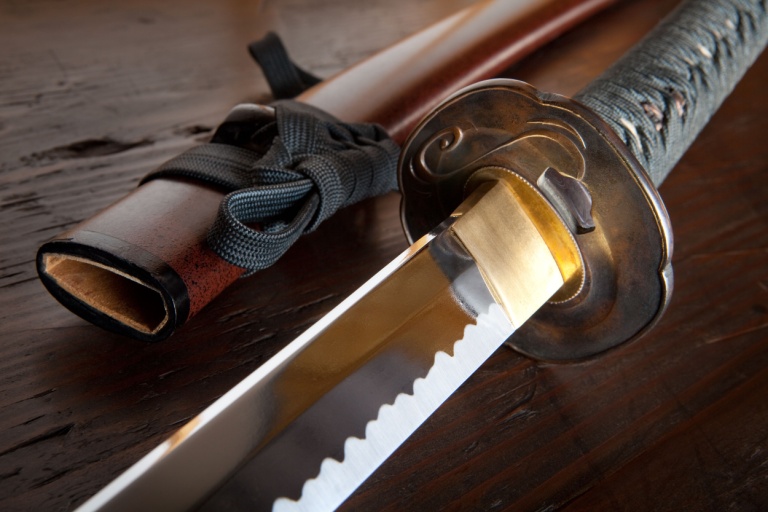
After shaping the blade with a hammer, the smith heats it one last time to prepare for quenching, or yaki-ire. A special clay and charcoal mixture is painted on the blade. It’s applied thick along the spine and thin along the edge, and then the blade is heated and plunged into the water. This sudden plunge hardens the edge while the thicker clay protects the rest, keeping it softer. Most of the time, this was the moment of truth because the blade might crack or warp.
But when done right, it creates the sword’s natural curve and its famous hamon, the cloudy line that shows where the steel changed during quenching.
Polishing, sharpening, and assembling the sword
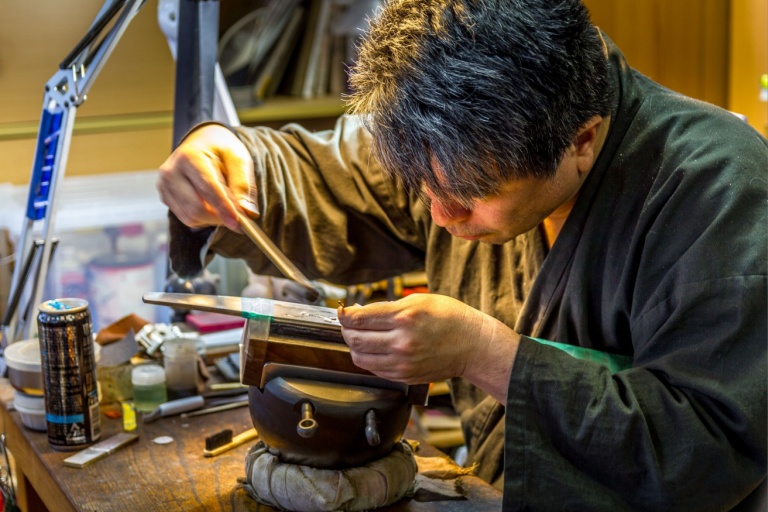
Forging and hardening the blade is just half the process. After it’s done, the blade must be carefully polished and sharpened. This step is so crucial that it has a specialist called togishi. This specialist uses a series of fine stones, which not only give the sword its oomph but also grind and smooth the blade to reveal its final shape. It’s a process that can take several weeks.
The more the togishi polishes the blade, the more its beauty begins to show. The grain pattern (hada) becomes clearer, and the faint line (hamon) glows faintly along its edge. These features not only enhance its elegance but also show the sword’s quality.
After polishing and sharpening, the swordsmith begins assembling the other parts. The handle (tsuka) is made of wood, then wrapped in ray skin and a braided silk cord for grip. They then add the tsuba, a metal guard between the blade and handle that protects the user’s hands. Finally, the sword is placed in its saya, which is a lightweight wooden scabbard or sheath often lacquered and hand-painted.
Conclusion
The Japanese sword, especially the katana, has become a symbol of balance, discipline, and beauty. From the gathering of iron sand to the final polish, every step of the process reflects patience, purpose, and pride. Swordsmiths are renowned in Japan for creating something that embodies the spirit of the samurai and knowledge passed down through generations.
Some of these katana-makers became legends in their own right. Masamune is often called Japan’s greatest swordsmith. He is known for perfectly balanced and elegant blades that were as beautiful as they were deadly. His rival, Muramasa, crafted swords that were incredibly sharp and powerful, so much so that they were believed to carry a dangerous spirit. Whether peaceful or feared, the works of these craftsmen are still cherished today.
Today, sword-making in Japan continues under the guidance of a small number of traditional swordsmiths, who adhere to strict cultural laws, treating it as both a craft and a form of spiritual devotion. Japanese swords are now treasured historical pieces, works of art, and symbols of a time when steel and soul were forged together.
Follow us on X, Facebook, or Pinterest
