
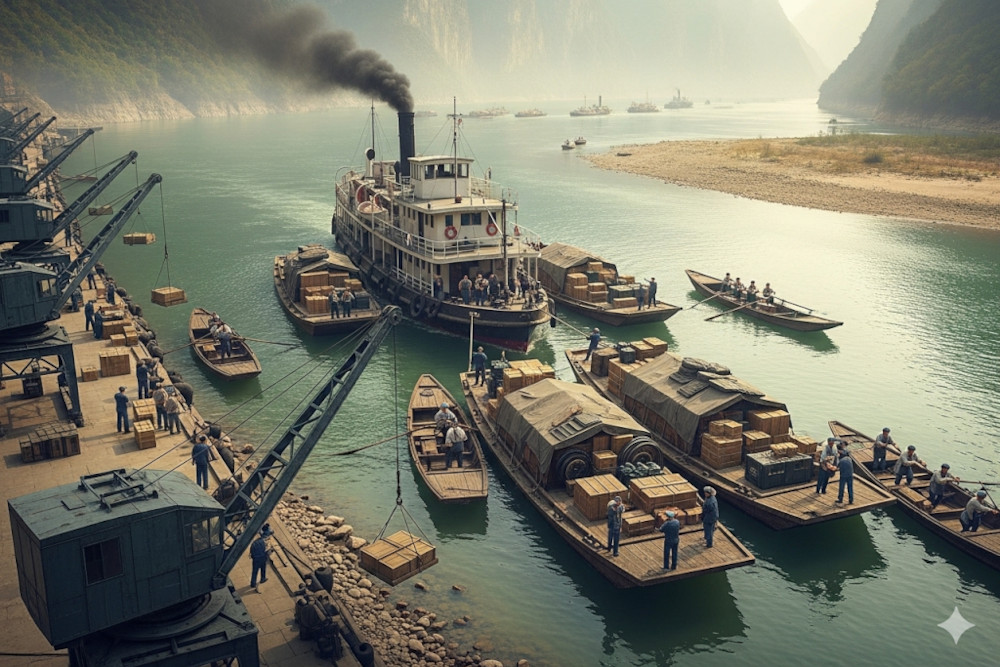
Lu Zuofu, known in the Republic of China era as China’s “Shipping King,” rose from humble beginnings to build Minsheng Company into a leading private shipper. In wartime, he became an unlikely hero: a civilian who organized a mass river evacuation that kept China’s industrial heart beating while turning Beibei, a once-dangerous village near Chongqing, into a cultural and educational hub.
China at war
The Second Sino-Japanese War (1937-1945) began when Imperial Japan launched a full-scale invasion of China. Cities such as Shanghai and Nanjing were devastated, and millions were displaced. By late 1938, much of eastern China was under occupation. Wuhan, a key industrial and transport hub, was about to fall. To survive, the Chinese government moved its wartime capital upriver to Chongqing in Sichuan. Keeping the Yangtze River routes open to Sichuan became a matter of national survival: government, industry, and arms production all depended on them.
Before Dunkirk, China faced its own race against time
In Europe, the 1940 evacuation of Dunkirk became a symbol of courage under fire. But in late 1938, a similar drama was already unfolding in China — led not by generals but by a civilian shipping magnate.
That autumn, Yichang — a strategic port at the mouth of the Three Gorges — became the last major staging point before Sichuan. More than 30,000 people and about 90,000 tons of critical cargo gathered there. All of it had to move upriver before seasonal water levels dropped too low for navigation. The window was just 40 days. In scale, what needed to move in those 40 days matched roughly a full year of regular shipping traffic on that stretch of river.
Lu Zuofu flew to Yichang to take personal command. He mobilized Minsheng’s entire fleet and coordinated scores of wooden boats. To speed turnarounds, he used a segmented transport plan: machinery and other items that couldn’t be broken down went straight to Chongqing, while other materials were offloaded at Wanzhou or inside the Three Gorges to keep vessels shuttling. Crews worked around the clock — navigating rapids by day, loading and unloading at night — with two dozen vessels cycling continuously.
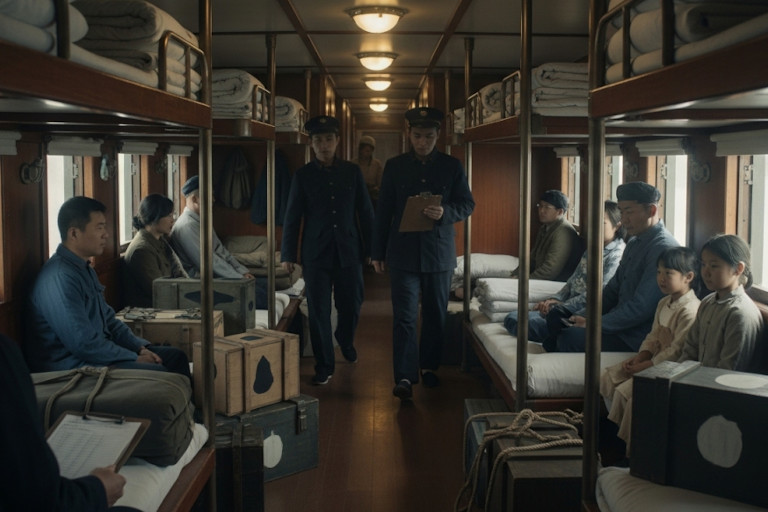
Moving people, machines, and a war economy
Within 40 days, all 30,000 people were safely in Chongqing along with roughly two-thirds of the supplies; the rest followed, and the operation wrapped up within two months. Lu Zuofu later called it “the tensest moment of wartime transport,” when the lifeline of weapons and heavy and light industries “depended on this work.” Contemporary accounts describe tug whistles echoing, cranes clanging, and crews singing while carrying heavy machines — a picture of people determined to keep the country’s industries alive.
The result was more than a headline-grabbing rescue. It preserved key factories, research units, and supply chains, allowing China to sustain a long war. Educator Yan Yangchu later called it “China’s Dunkirk in industry.” Unlike Dunkirk, which relied on military command, the Yichang operation was executed by a private company using civilian resources — an extraordinary feat of logistics under pressure.
Minsheng’s wartime ethos
Under Lu Zuofu’s leadership, Minsheng prioritized national defense. Ships played patriotic resistance songs, and even crew bedding carried the reminder “Never forget the national crisis.” Freight rates were kept to a fraction of market prices, yet service remained meticulous. Writer Hu Feng, traveling aboard the Minben, noted how orderly and clean the cabin was even in wartime.
Minsheng ferried troops to the front, evacuated the wounded, and returned the remains of fallen commanders to Chongqing for burial. The company paid a steep price: Over eight years, it lost 16 ships, 69 were damaged, and 100+ employees were killed. On August 22, 1941, the Minsu — carrying wounded soldiers and passengers — was attacked by seven Japanese aircraft, killing 70 crew. Some, despite severe injuries, kept rescuing passengers or safeguarding vital ship documents until the end—stories that came to embody Minsheng’s spirit.
From bandit-ridden outpost to ‘garden city’
Lu Zuofu’s vision wasn’t limited to shipping. In 1927, he was appointed to lead local defense in Beibei, then a bandit-troubled area with only a few hundred households. Using Qingdao — a well-planned port city known then for reliable utilities and public parks — as his template, he paired security with livelihood improvements and began a civic build-out of roads and waterworks, parks, power, schools, and libraries.
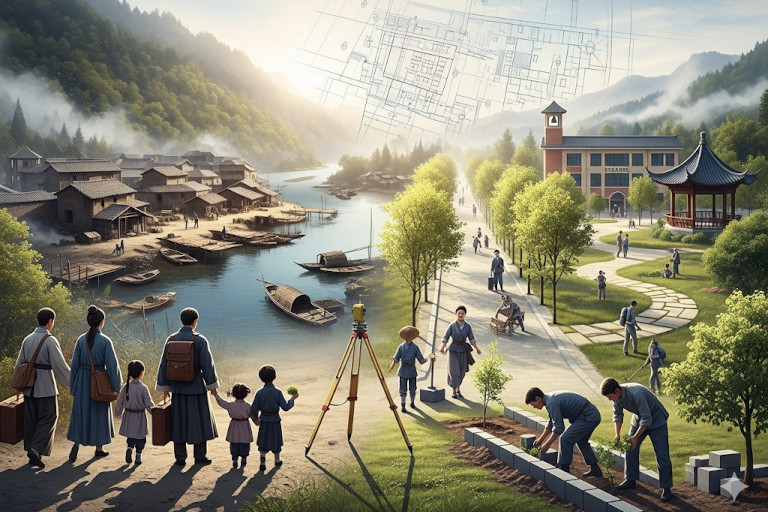
He helped found Beibei Private Jian Shan Middle School and the Western China Academy of Science (a regional research center), which opened institutes in geology, biology, and agriculture. Hospitals, factories, and banks soon followed, laying the groundwork for a “garden city.”
As the war intensified, Beibei became a relocation site for government agencies, universities, and research institutes. More than 3,000 scholars and cultural figures settled there, turning it into a center of intellectual life. Leading novelists and playwrights produced important work there; translators, historians, and scientists carried out significant projects; and daily rituals — such as bugle calls during flag-raising — reminded citizens of the national crisis.
A civilian blueprint for resilience
Lu Zuofu’s achievement lay in combining practical logistics with community building. The river evacuation kept factories and research moving upriver when China needed them most. The Beibei project protected education and culture in wartime and left a civic legacy that the region still reflects today. It’s a reminder that in times of crisis, civilian leadership and careful planning can keep a society’s most vital systems alive.
Translated by Joseph Wu
Follow us on X, Facebook, or Pinterest
