
The Three Character Classic opens with a simple truth: “At birth, human nature is good.” This timeless belief takes on new life through the story of Chen Huixian, a 92-year-old woman who immigrated to the United States after her family had lived through nearly every major political transformation of modern China. From the semi-feudal and semi-colonial late Qing Dynasty to the Republic, through decades of Communist rule, and finally into capitalist America, her family’s experiences reveal how profoundly different systems shape the lives and values of ordinary people.
A look back at her grandfather’s time
Chen Huixian’s grandfather came from Jiaxing, in Zhejiang Province. As a young man in the waning years of the Qing Dynasty, he excelled in martial arts and passed the imperial military examination. Yet before he could report for duty, his wife — worried that he might grow distant once he reached the capital — refused to let him leave home.
By chance, an American missionary working in China saw the skill of Chen Huixian’s grandfather and hired him as a personal bodyguard. The position gave him a rare opportunity: He learned English and was introduced to Christianity, which he later embraced.
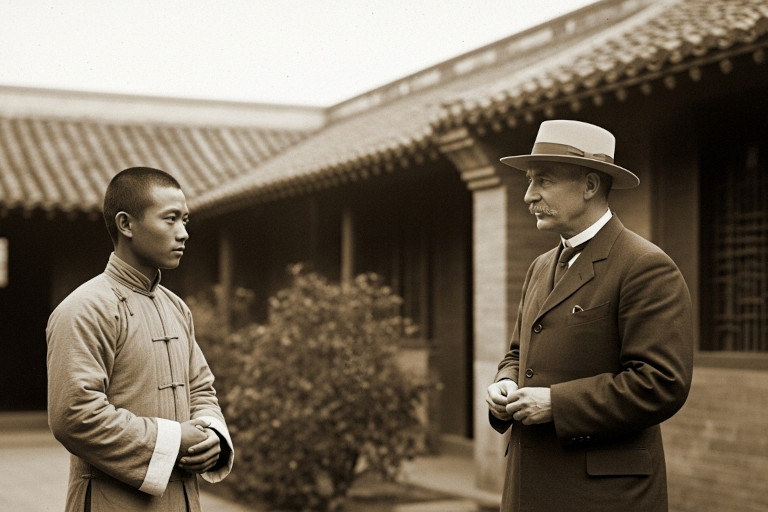
Rooted in both Chinese tradition and Christian faith, Chen Huixian’s grandfather developed a moral outlook centered on reverence and kindness. He believed that goodness was not just taught but practiced through daily conduct — a view that would guide his descendants for generations.
A lesson in compassion at the cattle farm
The missionary often traveled to other countries to preach, and Chen Huixian’s grandfather accompanied him, witnessing many ways of life. But the moment that left the deepest mark on the family came during a visit to a friend’s cattle farm.
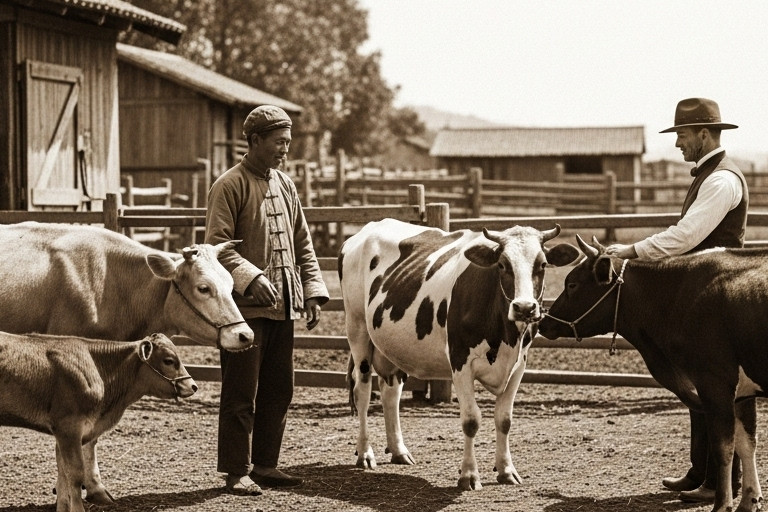
As they stepped into the yard, a calf suddenly rushed forward and dropped to its knees, tears welling in its eyes. Startled, Chen Huixian’s grandfather asked: “Why is it kneeling? Why are its eyes wet?”
The farmer sighed. “Its mother has grown old and can’t give milk anymore. She’s about to be slaughtered.”
Moved by compassion, Chen Huixian’s grandfather said: “Don’t kill her. Sell both of them to me — my family will care for them.”
He brought the mother and calf home. To everyone’s surprise, the calf grew up to produce milk, and even the old cow regained her strength and began producing milk again. The missionary, touched by this kindness, purchased two more cows for him. In time, Chen Huixian’s grandfather established his own small dairy farm — a modest enterprise built on mercy rather than profit.
A similar scene from another era
Decades later, I witnessed a nearly identical scene. In 1964, while teaching at a university, I led several colleagues and two philosophy students from Peking University to participate in the Socialist Education Movement at the state-run Changying Cattle Farm, located near Shuangqiao on the outskirts of Beijing. Our team lived among the workers, sharing their daily routine and meals.
Changying was a Hui Muslim community north of Guanzhuang. When the farm needed to cull aging cows or young bulls, the slaughter took place in the courtyard of the administrative area. A local imam was invited to recite prayers before the killing. After the recitation, he would draw a sharp knife and make the first cut, leaving the rest to the workers.
I still remember an old cow being led into the yard. It suddenly knelt, its eyes brimming with tears — as if begging for mercy. The sight pierced my heart. In that moment, I understood why Chen Huixian’s grandfather refused to let compassion be silenced, even in a world that often rewards indifference.
Continuing the family’s story
The legacy of kindness passed down through Chen Huixian’s family speaks to a moral strength that transcended dynasties, ideologies, and borders. From the martial discipline of her grandfather to her own journey across oceans, each generation carried the same quiet belief: that goodness begins not in doctrine or politics, but in the heart.
Translated by Cecilia
Follow us on X, Facebook, or Pinterest
