

As the digital race is increasingly detaching us from our organic roots, a quiet countercurrent is emerging in the most unassuming of places: the family home. Across Western societies, a growing number of young men — dubbed “trad-sons” — are choosing to remain with their parents, not in rebellion or defeat, but as an instinctive return to something older and steadier. They cook, clean, and care, inhabiting roles once dismissed as feminine or regressive. Yet beneath this domestic simplicity lies a profound cultural signal: that amid the collapse of work, identity, and belonging, the human spirit still seeks balance.
Perhaps these men are not stepping backward, but reorienting toward a forgotten truth — that real strength is not domination, but harmony with the natural order of life itself.
A quiet domestic realignment
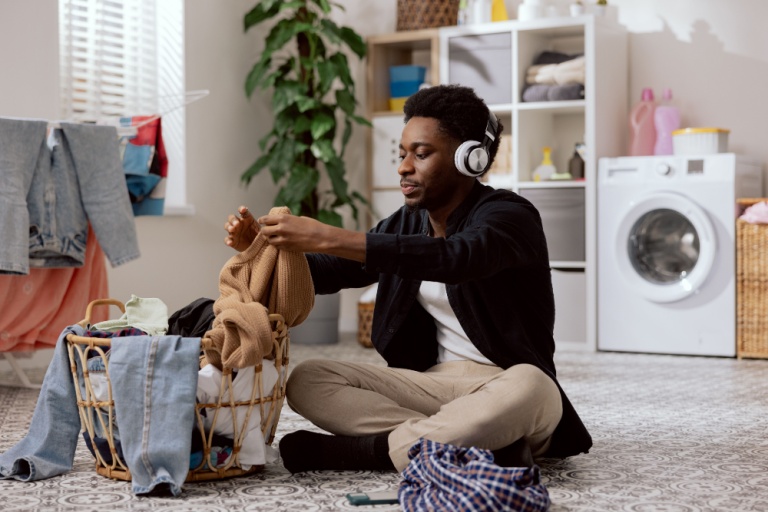
In a modest New Jersey suburb, 31-year-old Luke Parkhurst starts his morning by tidying the kitchen, folding laundry, and preparing breakfast for his retired parents. Once, he’d imagined himself climbing the corporate ladder, perhaps moving to a city apartment with a view. Instead, Luke lives at home — not out of failure, but by design. “It just makes sense right now,” he told the New York Post, which recently profiled the rising number of young men dubbed “trad-sons” or “hub-sons.” These are adult men who live with their parents and take on domestic roles — cooking, cleaning, household management — while their parents handle the mortgage and groceries.
At first glance, it seems like a curious inversion of the “tradwife” trend, in which women embrace domesticity in response to feminist modernity. But look closer, and the “trad-son” phenomenon suggests something deeper: not rebellion, not regression, but realignment. As social systems strain — housing markets collapse, corporate ladders wobble, and artificial intelligence redefines “productive” work — some men are instinctively turning inward, seeking meaning through service, family, and presence rather than ambition.
In an age obsessed with acceleration, the stillness of home life feels almost radical. But this isn’t an ideological revolution. It’s a return to equilibrium — a quiet correction, perhaps, to a world spinning too fast.

When opting out becomes the only option
The economic backdrop to this trend is undeniable. In the United States, the average rent for a one-bedroom apartment has surpassed $1,800 a month, while wages have stagnated in real terms for decades. According to Pew Research, 52 percent of young adults aged 18–29 now live with their parents — the highest rate since the Great Depression. For many, independence isn’t a moral choice but a mathematical impossibility.
The VICE article “Meet the Hub Sons, 2025’s Answer to the Tradwife Trend” frames the movement with irony, yet the undertone is serious: modern adulthood has become economically unsustainable for millions. For every “trad-son” who consciously embraces domesticity as a lifestyle, there are many who’ve found no viable alternative. But to interpret that as failure is to overlook something quietly transformative happening beneath the surface.
When an adult child contributes care, order, and emotional labor to the household, the old hierarchy — parent-provider, child-dependent — begins to blur. Men who once measured worth through external achievement are rediscovering an older, humbler form of service: devotion to the immediate and the real.
There’s dignity in this kind of care. In tending to the home, these sons participate in an unspoken restoration of the moral and emotional economy — one that values being over doing, relation over transaction.
The return of the multigenerational home
Contrary to the modern narrative of “failure to launch,” living with one’s parents isn’t historically abnormal — it’s the industrial age that made it seem so. For most of human history, the multigenerational household was the basic unit of life.
In ancient China, filial piety (xiao, 孝) was the cornerstone of social order; sons who lived near or with their parents were not dependent but honorable. In pre-industrial Europe, extended families shared land, tools, and labor under one roof, ensuring the survival of all generations. Even in early America, homesteads thrived as multi-generational ecosystems — grandparents tending gardens, sons repairing roofs, daughters managing food stores.
It was the Industrial Revolution that fractured this continuity. As factories demanded mobility and individual wages, the family became a unit of production rather than a unit of kinship. The nuclear family — father, mother, two children, each siloed — replaced the larger web of interdependence. Sociologists like Allan Carlson have long noted that this fragmentation led not only to economic isolation but also to spiritual loneliness, as home became a place of consumption rather than contribution.
In this light, the “trad-son” may not be a symptom of stagnation, but a return to a deeper rhythm of life.
When children care for aging parents, they reaffirm a bond that modernity nearly erased — a cyclical model of life in which care flows both ways. It’s a reminder that maturity is not defined by moving out, but by moving toward: toward responsibility, gratitude, and continuity.
Manhood, polarity, and the post-human temptation
But why is this trend so polarizing — even mocked online? Perhaps because it unsettles the modern West’s brittle idea of masculinity. For generations, men were measured by external success — status, salary, and strength. Now, in a world where machines outperform humans in labor and intellect, that definition is collapsing.
Some see the “trad-son” as emasculated; others, as enlightened. Yet both miss the larger truth: nature itself is built on polarity, not hierarchy. Masculine and feminine energies are not adversarial but complementary — action and receptivity, structure and nurture, sun and moon. When balance is lost, one force dominates and both suffer.
Today’s cultural experiments — from post-gender ideologies to transhumanist dreams of synthetic life — often treat difference as injustice, not as design. They aim to dissolve polarity in the name of equality. But as physicists remind us, no field can exist without tension, and no particle without charge. The cosmos itself is born from contrast.
The human body mirrors this principle. Male and female forms express distinct biological strengths, not in opposition but in cooperation. To deny that is to deny the intelligence of creation. As Carl Jung observed, every psyche contains both anima and animus — the inner feminine and masculine — and health lies not in erasing them, but in harmonizing their dance.
Seen through this lens, the “trad-son” phenomenon may represent an instinctive counterweight to the culture of dissolution — a subconscious reassertion of grounding energy amid an age of abstraction. While transhumanism seeks to transcend the body, these men are returning to it: to cooking, cleaning, and the rhythmic rituals of daily life. In their simplicity, they affirm that to care for the material world is itself a spiritual act.
Beyond ideology: A metaphysical view of balance
Both capitalism and communism — the two poles of modern economic thought — reduce human worth to material value. One measures it through profit, the other through production. In both, the soul becomes secondary, and the body a tool.
But reality, as even quantum field theory suggests, is not merely material. Physicists now describe matter as “vibrations in a field” — ripples in an invisible ocean of energy. When a particle collapses, it doesn’t vanish; it returns to the same field it emerged from. Life, too, follows this pattern of emergence and return. We are not merely bodies with fleeting roles, but expressions of a larger energetic harmony — a moral field as real as the physical one.
In this sense, what’s happening in these quiet suburban kitchens may be more profound than sociology admits. These sons are not abandoning ambition — they are recalibrating their frequency to something older and truer: service, care, and harmony with family and nature.
- Where the modern world exalts independence, they embody interdependence.
- Where ideology demands equality, they seek balance.
- Where transhumanism promises transcendence, they rediscover immanence — the sacred in the ordinary.

Restoring balance in an unbalanced age
Perhaps, then, the rise of the “trad-son” isn’t regression but renewal. In choosing to stay, these men are quietly rejecting the myth that growth is always outward, that success must be visible, and that worth lies in productivity. They are re-centering life on the smallest, most enduring unit of civilization: the home.
In many spiritual traditions, the home is not a cage but a crucible. It is where humility is learned, patience is tested, and compassion is practiced daily. To sweep the floor, to prepare food, to care for elders — these acts, when done consciously, participate in the same universal current that moves galaxies.
The physicist David Bohm once described reality as a “holomovement” — an unfolding totality in which every part contains the whole. In caring for a parent, one tends not only to another life but to the moral fabric that binds all life.
Thus, the “trad-son” may symbolize more than an economic adaptation. He represents a quiet reorientation toward what has been lost: continuity, reverence, and balance. His work, though unseen by markets or metrics, participates in the ancient rhythm of giving and receiving — the cosmic reciprocity that sustains all living systems.
- In a world seduced by speed, he slows down.
- In a culture that worships innovation, he honors preservation.
- In an age that glorifies self-expression, he rediscovers self-restraint.
And in doing so, perhaps he reminds us of something we’ve nearly forgotten: that progress is not found in severing polarity, but in harmonizing it.
Truthfulness, compassion, and forbearance
Ultimately, the future of masculinity — and of humanity — may depend not on new ideologies but on old virtues. The principles of truthfulness, compassion, and forbearance are not slogans but the moral laws that sustain equilibrium across every scale of being, from atoms to civilizations.
Truthfulness restores clarity amid confusion; compassion softens the hardness of ego; forbearance allows coexistence within difference. When embodied, these values dissolve the false dichotomies of modern discourse — male versus female, capitalist versus communist, progress versus tradition. What remains is harmony: the quiet hum of a world once more aligned with its own natural order.
So perhaps the “trad-son” is not backward-looking after all. Maybe he is simply listening to the pulse of a deeper field — one that whispers, as it always has, that balance is the only real progress.
Follow us on X, Facebook, or Pinterest
