
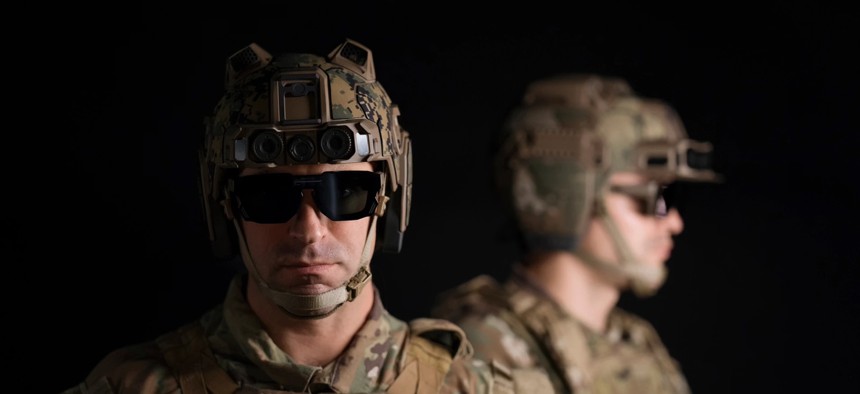
Augmented reality in warfare is revolutionizing the soldier’s experience, blurring the line between the virtual and real battlefield. When Palmer Luckey slipped a black visor over his head on The Joe Rogan Experience, the gesture felt oddly familiar — a gamer gearing up for another round. But this time, the “game” was war.
His Eagle Eye headset, an augmented-reality system that lets soldiers see through walls, share their vision, and act in algorithmic sync, blurs more than just the line between virtual and real; it blurs the boundaries of moral perception itself. What happens when the logic of gaming — instant feedback, dopamine reward, the illusion of control — fuses with the lethal precision of the battlefield?
When Silicon Valley’s “move fast” ethos meets the timeless ethics of killing? And when machines begin to see for soldiers, can humans still claim to decide? In the world Luckey is building, the future of warfare may not hinge on who has the best weapons, but on who controls the frame of reality itself.
Augmented reality in warfare: Gameplay reshaping combat
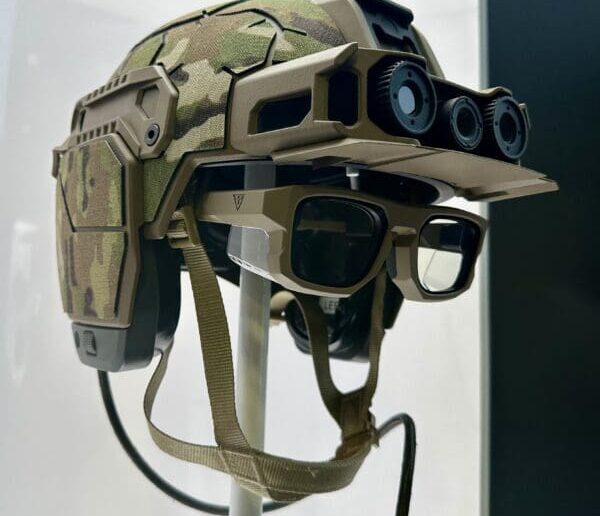
In a dim studio in Austin, Texas, Joe Rogan leans toward his guest, eyes bright with curiosity. Across from him, Palmer Luckey — boyish, brilliant, and grinning — adjusts a matte-black helmet studded with sensors. “It’s called Eagle Eye,” he says, describing how the system lets soldiers see through walls, track enemies behind containers, and share their vision across an entire squad. “Anything I see,” Luckey says, “every drone and every person now sees.”
The clip went viral not for its technical marvel but for its optical eeriness. Luckey, the same man who once built the Oculus Rift to make virtual worlds feel real, now offers soldiers the ability to make real worlds think like virtual ones. The gesture — a gamer-turned-defense-visionary, demoing a headset like a next-gen console — captured something larger: the merging of gaming culture, Silicon Valley innovation, and military ambition into a single feedback loop.
In Eagle Eye, every edge of the battlefield glows with data. Enemies pulse red; allies blue. Guns sync with HUD overlays. The chaos of war flattens into something almost gamelike — a clean interface for messy human decisions. And in that design lies the question of our age: When war looks like a video game, what happens to our sense of consequence?
Superhuman senses, diminished judgment
For the soldier of tomorrow, awareness is no longer limited to eyesight or instinct. Through augmented reality lenses, a fighter can see heat signatures through walls, drone feeds stitched into the corners of vision, and AI-generated cues highlighting potential threats. The pitch is irresistible — superhuman perception. Yet psychologists warn that more data doesn’t always lead to greater clarity. Cognitive science calls this the attention tunnel: the more your environment highlights “important” cues, the less you notice everything else. It’s the paradox of abundance — sensory overload disguised as situational awareness.
A recent ethics paper from the Lieber Institute at West Point noted that AR combat systems may “narrow the soldier’s perception to system-labeled targets,” increasing both efficiency and moral distance. When the machine highlights the enemy, the decision feels almost preordained. What was once a split-second moral choice — to fire or not — becomes a kind of reflex guided by machine confidence.
And then there’s the dopamine problem. Soldiers trained on gamelike HUDs adapt quickly — too quickly. The neurological loops designed to keep gamers “engaged” now drive focus under fire. Every hit confirmed, every objective cleared, triggers the same subtle reward pattern. As some ethicists have put it, gamification doesn’t just train reflexes; it trains morality out of them.
From startups to strike teams: The Silicon Valleyification of war
Anduril Industries, Luckey’s defense tech company, is not structured like Boeing or Raytheon. It’s structured like a startup — engineers working in sprints, testing minimum viable products, and deploying fast. Its motto: move fast and fix what’s broken in defense. When the U.S. Army’s much-hyped Microsoft IVAS headset stumbled — plagued by nausea, disorientation, and technical flaws — Anduril offered Eagle Eye as the agile alternative. Unlike bureaucratic defense contractors, it promised software-like iteration: fix it next update, patch it in the field.
But this philosophy — “ship early, learn fast” — carries strange weight when lives are on the line. In Silicon Valley, a product glitch costs a few customers; in combat, it can cost a life. The new military-industrial model borrows not just the tools of tech, but its worldview: disruption as progress, iteration as virtue. A colonel familiar with the program described Anduril’s rise as “defense’s Tesla moment” — charismatic founder, visionary tech, skeptical establishment. Yet beneath the hype lies a profound cultural shift: the militarization of startup logic, where warfare becomes another system to optimize.
What’s lost in the sprint toward innovation is not just oversight — it’s philosophy. The deliberate pace of military procurement once served as a brake on moral acceleration. Now, with “China 2027” used as a countdown clock, the language of deterrence replaces deliberation. The question is no longer whether we should build this? But can we make it before they do?
The soldier and the copilot: Who really decides?
In Anduril’s vision, the soldier is not alone. Every helmet, drone, and vehicle feeds into Lattice, the company’s AI operating system — a kind of invisible copilot that interprets sensor data, flags targets, and predicts movement. The battlefield becomes a shared consciousness: what one unit sees, all can see. On paper, this is revolutionary — no more fog of war, no more friendly fire. But the ethical tension is immediate. When a system highlights a potential combatant, and the human acts on that cue, who is accountable for the decision?
This question echoes debates in autonomous vehicles and AI-assisted aviation. When a pilot follows an autopilot’s command that turns out to be wrong, is the fault human or algorithmic? Legal scholars call this the responsibility gap: the divergence between action and intention in a human-machine network. For soldiers, this gap isn’t theoretical. Imagine a firefight where Eagle Eye identifies a heat source behind a wall and flags it red. The human fires — only to learn it was a civilian. Who bears moral weight: the soldier who trusted the system, or the engineers who built the visual frame?
Philosopher Hubert Dreyfus once wrote that human judgment “thrives on ambiguity” — the gray space machines can’t parse. In algorithmic warfare, ambiguity becomes error. And in that conversion, something essential to moral agency is quietly designed out.

Reclaiming the human in the loop
If the past century’s moral challenge was the nuclear trigger — one decision, unthinkable scale — this century’s may be its opposite: countless small decisions diffused across networks, each made faster, cleaner, less consciously. Palmer Luckey insists that Anduril’s goal is deterrence — to make war unthinkable by making readiness undeniable. His logic echoes the Cold War, but the tools are different. Then, power was measured in missiles; now, it’s measured in sensors.
Yet the deeper issue is not capability but comprehension. Technology always promises to extend our senses — to help us see further, decide faster, and feel safer. But when it rewires the act of seeing itself, it changes what we consider human. In this sense, the challenge of Eagle Eye isn’t only military. It’s civilizational. How do we preserve moral reflection in systems designed for instant action? How do we teach pause in a culture addicted to acceleration?
Some defense ethicists propose design solutions — “ethical overlays” that prompt soldiers to confirm, reflect, or double-check before lethal engagement. Others argue for embedding philosophers and psychologists alongside engineers, not just engineers. Still others point to the ancient Stoic idea of temperance — the discipline of mastering one’s perceptions before acting on them. Because the real frontier of warfare isn’t in sightlines or silicon, it’s in attention; whoever controls what soldiers see controls what they think is real.
Conclusion: Seeing clearly
In the end, Luckey’s demo on Rogan’s show wasn’t just a product reveal. It was a mirror — reflecting a world where the aesthetics of play, the ethos of startups, and the machinery of war are becoming one. The screen between gamer and soldier is thinning. And as technology continues to promise omniscience, perhaps the hardest — and most human — act left will be to look, and still choose not to see.
Follow us on X, Facebook, or Pinterest
