

Parents do not determine every part of a child’s life, but the care they give — or fail to give — can leave lasting marks. Some children are lifted by the love of those who raise them. Others spend years living with the damage caused by neglect, cruelty, or selfishness at home.
These three stories from China point in very different directions, yet they all arrive at the same truth: a parent’s choices can shape a child’s path in profound ways.
A reunion marked by gratitude
To people who know Joy Jones in the United States, her life seems full of promise and stability. She graduated from Yale University, married, and built a family of her own. Few would guess that her story began with abandonment.

According to Chinese media reports, Joy was abandoned by her biological parents shortly after birth. She was sent to an orphanage and later adopted by an American couple. In that new home, she grew up surrounded by care, support, and opportunity.
When Joy was 24, she found her biological parents through Chinese media and spoke with them by video for the first time. After more than two decades apart, many might have expected anger or painful questions. Instead, Joy remained calm.
She did not ask why she had been abandoned. She did not accuse her parents or dwell on the past. Throughout the exchange, she smiled politely and thanked them for giving her life.
It was her biological mother who became overwhelmed with emotion. Through tears, she apologized to the daughter she had once given up, grieving both the choice she had made and the distance that now separated them.
Joy’s response was simple and striking. She told her mother it was all right and said she was truly grateful.
Her words did not suggest that abandonment itself was a good thing. Rather, they reflected the life that followed. Because she was adopted by loving parents, her future took a path that led to safety, education, and a stable family life. Her story is a reminder that while a painful beginning can leave deep questions, love from those willing to raise a child can change everything.
Meng Fansen and a childhood shaped by hardship
Not every child is given that kind of chance.
Meng Fansen, widely known online as the “fish-killing boy,” first drew public attention when he was 9 years old. Photos of him squatting on the ground cleaning fish spread quickly across the internet, turning him into a viral figure.
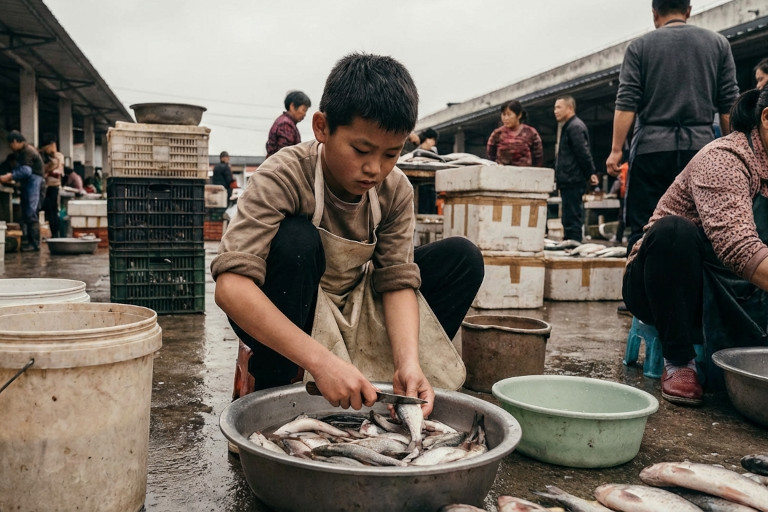
But behind the attention was a far more troubling story. According to the Chinese article, Meng’s father believed schooling was useless. As the eldest son, Meng left school early and took on the burden of helping support the family. He was denied an education and grew up under frequent physical and verbal abuse.
After Meng became known to the public, his father reportedly saw that attention as an opportunity to make money. He opened a shop in his son’s name, brought him onto television programs, and tried to cash in on his sudden fame.
A childhood shaped by pressure, exploitation, and violence left lasting scars. As Meng grew older, he returned to the public eye more than once, usually because of troubling incidents. Reports linked his name to fighting, and at one point, he was allegedly beaten so badly by his father that he nearly lost an eye.
When he was 17, a fierce argument with his father ended in a suicide attempt after he drank pesticide. After 14 days of treatment, he was finally out of danger.
Meng’s story is heartbreaking because it shows what can happen when a parent sees a child not as someone to protect, but as someone to control or use. The harm done in childhood does not simply disappear. It can persist well into adulthood.
Mao Xiaotong and the return of an absent father
Actress Mao Xiaotong’s story reveals a different kind of parental failure.
Known for her sweet public image, Mao grew up close to her mother. According to the article, her father did not take part in raising her. Yet after she became famous, he reportedly reappeared and demanded 50 million yuan (US$7.25 million) from her.

When Mao refused, he allegedly went to a television station and made threats, including the chilling remark: “Let’s go to hell together.”
What shocked many people was not just the amount of money involved, but the sense of entitlement behind it. A father who had not fulfilled his responsibilities during her childhood now seemed willing to use public pressure and intimidation once his daughter had found success.
Unlike Joy Jones’s reunion, this was not a meeting shaped by sorrow, reflection, or gratitude. It was a painful example of how some absent parents return only when there is something to gain.
Three lives, three very different outcomes
These three stories are not the same, but together they highlight an important truth. A parent’s presence alone is not enough. What matters is the kind of love, guidance, and responsibility they bring to a child’s life.
Joy Jones began life in abandonment, yet found a home where she was loved and supported. Meng Fansen and Mao Xiaotong, in different ways, were left to bear the consequences of fathers who failed them.
Children do not choose the families they are born into. But the adults around them make choices every day — choices that can protect and nurture or wound and exploit. That is what makes these stories so powerful. They show how much a parent’s actions can shape a child’s life.
Translated by Patty Zhang
Follow us on X, Facebook, or Pinterest
