
As the cold wind blows, wrapping yourself in a one-of-a-kind handmade scarf warms both body and soul. This is the DIY scarf I made during my visit to the Wu Fu-yang Sock Story Museum, which was honored as a “2023 International Spotlight Tourist Factory,” and it brought back fond memories of family.
Wu Fu-yang Sock Story Museum: A renowned tourist factory
When it comes to the everyday item known as “socks,” many people think of Shetou Township in Changhua County — the birthplace of Taiwan’s sock-weaving industry. In fact, Wu Fu-yang Knitting Co., Ltd., founded in Taipei City in 1936 during the Japanese colonial era, was the very first manufacturer to produce “Made in Taiwan” socks.
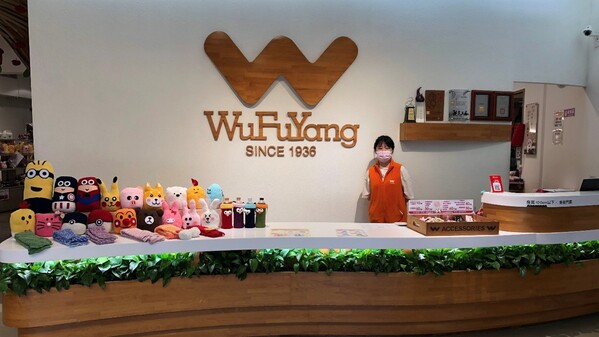
Stepping into the “small but beautiful” Wu Fu-yang Sock Story Museum, the first thing you see is a display of cotton sock plushies, scarves, and water bottle covers on the counter — it’s impossible not to exclaim, “Kawaii!” The interior of the Sock Story Museum is thoughtfully organized into diverse zones, each with its own stunning highlights. Following the friendly tour guide, I took a valuable “sock studies” lesson.
Company History Zone: Four generations of the Wu family’s remarkable achievements in the knitting industry
First, we arrived at the “Company History Zone.” In the 1930s, Taiwan had no professional sock-weaving factories. The first-generation chairman, Wu Nai-yang, imported the most advanced hand-cranked sock-weaving machines from abroad and hired master craftsmen from Shanghai to cross the sea and teach the technique of making “all-silk socks.” This marked the beginning of the Wu family’s four-generation legacy in the textile industry, which has since undergone phases of pioneering, rapid growth, internationalization, innovation, and transformation, achieving remarkable success.
Wu Fu-yang Knitting has achieved numerous firsts, including: introducing the nation’s first Japanese anti-slip machine, the first pair of anti-slip baby socks, the first pair of sound-emitting baby socks, and the first pair of seamless, wide-leg performance socks. The company has produced over 100 million pairs of socks. Such a vast quantity means that if every pair were connected end-to-end, they would be long enough to circle the Earth once.
As for the origin of the name “Wu Fu-yang,” it stems from Wu Naiyang’s gratitude toward his father, Wu Fu-tang, for raising and nurturing him. When he first started the business, he took one character from his father’s name and one from his own to form the company name, imbuing it with deep significance. Wu Ruizhe, the fourth-generation CEO, remarked, “If a factory is named after an ancestor, it is bound to endure for a long time and operate with great dedication, as there is a natural sense of mission to carry on the legacy.”
Roots in Taiwan: Committed to quality, Made in Taiwan — safe, healthy, and trustworthy
Wu Fu-Yang Knitting has been an integral part of Taiwan’s nearly century-long history in the hosiery industry, steadfastly supporting local manufacturing. Every step of the sock-making process — from yarn spinning, dyeing, and finishing, knitting, and printing to packaging — is Made in Taiwan, ensuring products that are “safe, healthy, and trustworthy.”
Following the rise of China’s hosiery industry, the Taiwanese market faced significant challenges, including depressed unit prices and the proliferation of counterfeit products. The Taiwanese hosiery industry suffered a severe blow, leading to massive industrial relocation and widespread unemployment, leaving many workers in dire straits.
Third-generation owner Wu Hong-zhou knew he could make a fortune by moving to mainland China, but considering the livelihoods of Taiwan’s many long-time employees and long-standing upstream and downstream partners, he insisted on keeping the business rooted in Taiwan. Wu Rui-zhe has also never considered setting up a factory in mainland China, because “producing in Taiwan feels solid — you can see every step of the process — but in China, it’s hard to maintain control. “What if we can’t ensure quality?”
Knitwear Knowledge Zone: A matter of health — The big science behind tiny socks
“The feet are the human’s second heart, and socks are the feet’s second skin.” How much do you know about socks? Though a pair of socks may seem unremarkable, the science behind them is far from trivial.
The “Knitwear Knowledge Zone” provides a detailed introduction to sock construction, knitting techniques, length classifications, toe-seam methods, the sock knitting and shaping process, steps for inspecting sock quality, as well as explanations of terms such as face yarn, back yarn, stitch count, and “seamless toe” technology.
Additionally, there is practical information relevant to consumer health, including the benefits of wearing socks, which sock styles are best for different demographics, how to wash socks, and how to assess the quality of odor-control socks.
Sock History Section: Illustrated and detailed explanations of Eastern and Western sock history
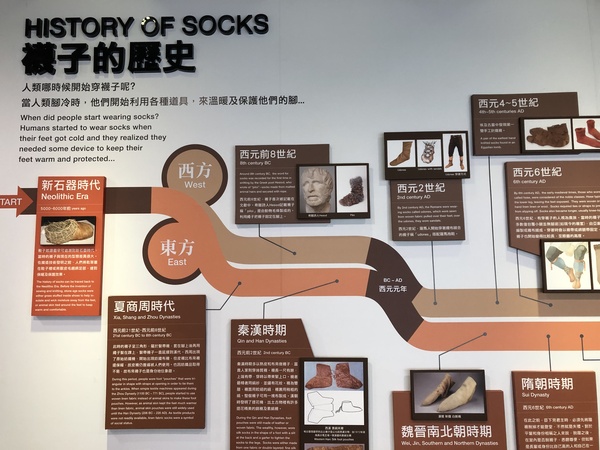
The “Sock History Section” is richly illustrated and provides a detailed account of sock history in both the East and the West. It is surprising to learn that the origins of socks can be traced back to the Neolithic Age. At that time, people would tie dry grass or animal fur around their feet to keep warm and protect their feet. Through the Xia, Shang, Zhou, Qin, Han, Wei, Jin, and the Northern and Southern Dynasties… as history unfolded, socks from different eras each had their own unique characteristics, making for a fascinating journey.
In the 8th century BCE, socks made from animal hair were first recorded in Western literature, where they were referred to as “piloi.” The Romans wore woven, sewn socks paired with sandals, and the first pair of hand-knitted socks was discovered in ancient Egyptian tombs… It wasn’t until 1589 that William Lee of England invented the knitting machine, enabling rapid production and replacing manual labor. Visiting this area was truly an “educational experience.”
Production Area: An open production line showcasing large-scale sock-making machinery
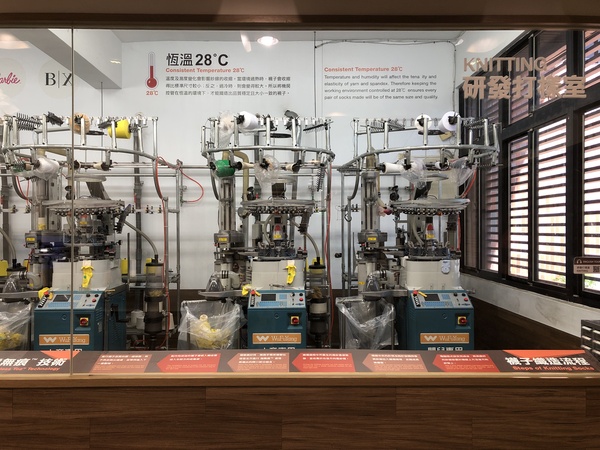
The “Production Area” is a research and prototyping room showcasing multiple large-scale sock-making machines, arranged in an open production line that is truly eye-opening. There are also sock size charts on the floor in various sizes, allowing visitors to measure their feet and determine which size fits best.
Through written explanations and the tour guide’s narration, everyone gained a basic understanding of the sock-making process. The most critical point is that during production, the temperature must be strictly maintained at 28°C to prevent fluctuations that could cause yarn shrinkage, which would distort sock dimensions. A striking slogan is displayed on the large transparent glass windows: “Wu Fu-yang Insists on Doing the Right Thing.” This embodies the company’s integrity and represents Taiwan’s hope.
DIY Classroom: Learn by doing, create memories, and experience a sense of accomplishment
In addition, the museum features a diverse range of exhibits, including the “Machinery Development Zone,” which showcases the evolution of sock-knitting machines across different eras; the “Experiment Zone,” where visitors can distinguish between natural and synthetic fibers through simple experiments; and the “Yarn Zone,” which displays a variety of yarn materials.
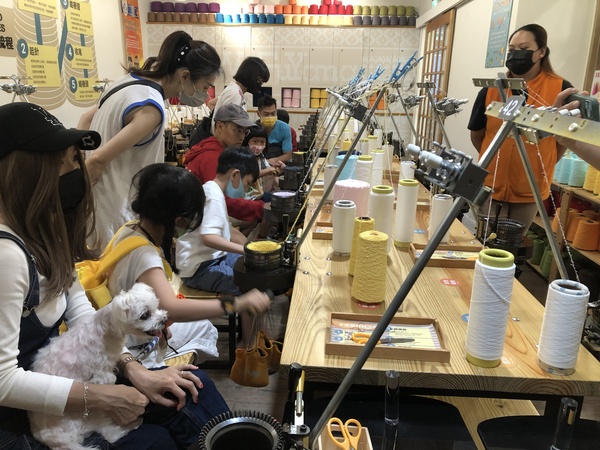
After the guided tour, filled with anticipation and excitement, we entered the “DIY Classroom,” which houses many modified, century-old hand-cranked sock-knitting machines. The 100-yuan admission fee can be applied in full toward purchases at the museum, while participation in DIY courses is charged based on the specific finished product. With such a rare opportunity, we certainly couldn’t miss out on the hands-on experience of making our own scarves or sock dolls.
Following the friendly and professional “Sock Sister’s” instructions step by step — from preparing the yarn to casting on — the colorful cotton threads gradually took shape as the machine spun round and round to weave the sock tubes. The visitors were having a wonderful time. One by one, warm and beautiful creations are completed to the sound of admiration, bringing a great sense of accomplishment. It’s not just “learning by doing,” but also a heartwarming and unforgettable memory for parents and children alike.
A visit to the Wu Fu-yang Sock Story Museum offers a delightful experience — it’s fun to explore, the socks are comfortable to wear, and the activities are engaging. Visitors can also learn about the history of socks spanning thousands of years, broadening their horizons through an educational yet entertaining experience. What’s even more touching is the Wu family’s four generations working together in unity to overcome challenges, passing down a commitment to “integrity” and a steadfast dedication to “keeping our roots in Taiwan” — truly a model for businesses.
Translated by Eva and edited by Amanda
Follow us on X, Facebook, or Pinterest
