

I had always thought of Venice as the pinnacle of canal cities. In some ways, it still might be. But there is a quieter, dreamier town tucked into the north-west corner of Belgium that, once you visit, refuses to leave you alone. Its name is Bruges, capital of the province of West Flanders, and the world has long called it the “Venice of the North.”
What I found on my first visit to Bruges was not a smaller imitation of Venice. It was something rarer: a fully intact medieval city of canals that has been quietly tended for nearly nine centuries. Walk its cobbled streets at dawn, when mist rises off the water, and the bells of the Belfry tower drift across red-tiled roofs, and you understand why this place earned UNESCO World Heritage protection. Bruges is not preserved like a museum. It is lived in, prayed in, sailed through, and loved. This is the story of the canals, the people, and the centuries that made it.
Why Bruges is called the ‘Venice of the North’
Bruges is called the Venice of the North because, like Venice, it grew rich on water. A network of canals known locally as the Reien threads through the historic center, connecting the city to its medieval port and to one another in a web of waterways that once carried wool, wine, silk, and silver between Mediterranean Italy and the Baltic North. Where Venice has its grand palazzos rising from the lagoon, Bruges has its tall, gabled merchants’ houses leaning over the canals, their stones reflected in dark, slow-moving water.
The comparison is fair, but it can also undersell what Bruges is. Venice astonishes through grandeur. Bruges enchants through stillness. There is an intimacy to its scale, a hush that settles over its smaller bridges and lesser-known canals, that you do not find in the larger Italian city. As one writer put it, you do not so much sightsee in Bruges as you slow down to its rhythm.

The Reien: From trade lifelines to living heritage
The canals of Bruges were never decorative. They were dug in the early 12th century as inner and outer defenses and as the working arteries of a young trading city. Bruges had been settled since the 9th century, and on 27 July 1128, it received its city charter, with new walls and new canals built into the bargain.
Six years later, in 1134, a great storm did Bruges a favor. It tore open a natural sea channel called the Zwin, giving the city a direct waterway to the North Sea by way of its outpost at Damme. With that, Bruges had everything it needed: protected inland waterways, an ocean route, and a position halfway between the Hanseatic ports of the Baltic and the trading houses of Genoa, Venice, and Florence.
By the 13th century, Bruges held a near-monopoly on English wool and was one of the most important trading cities in northern Europe. Italian merchant-bankers opened permanent offices there. Mediterranean spices, silk, citrus, and wine flowed in; Flemish cloth and Baltic furs flowed out. For a brief, brilliant century, Bruges was a place where the East and the West did business through the same canal water.
That golden age ended quietly. The Zwin began to silt up in the 15th century, and the sea slowly withdrew. Trade migrated to nearby Antwerp. Bruges grew poor and was largely forgotten, which paradoxically saved it. While other European cities tore themselves down to make room for railways and factories, Bruges had nothing to tear down. Its citizens chose, in the 19th century, to preserve what remained rather than industrialize it. The medieval streets, the Belfry, the canals, and the Beguinage all stayed. In 2000, UNESCO recognized the historic center of Bruges as a World Heritage Site.
Walking through a living medieval city
The best way to enter Bruges for the first time is on foot, with no map and no plan. Streets that look as though they will dead-end at a stone wall always seem to twist sideways toward another bridge, another small square, another reflection of a gabled house in still water. You can explore more of Nspirement’s travel inspiration for similar slow-paced destinations, but Bruges may be the easiest city in Europe to wander without getting lost; eventually, every street leads back to the Markt.

The Markt and the Belfry tower
The Markt is the city’s beating heart and has been since the 10th century. Open on three sides, lined with cafés and gabled merchant houses painted in soft ochres and reds, it is dominated by the medieval Belfry tower. The Belfry rises 83 meters above the square, and 366 narrow stone steps spiral up inside it. The climb is steep, and the staircase is tight, but the view across the russet rooftops to the green polders beyond is one of the great views of northern Europe. The bells in the tower still chime the quarter-hours, as they have done for more than 700 years.
Rozenhoedkaai: The most photographed view in Belgium
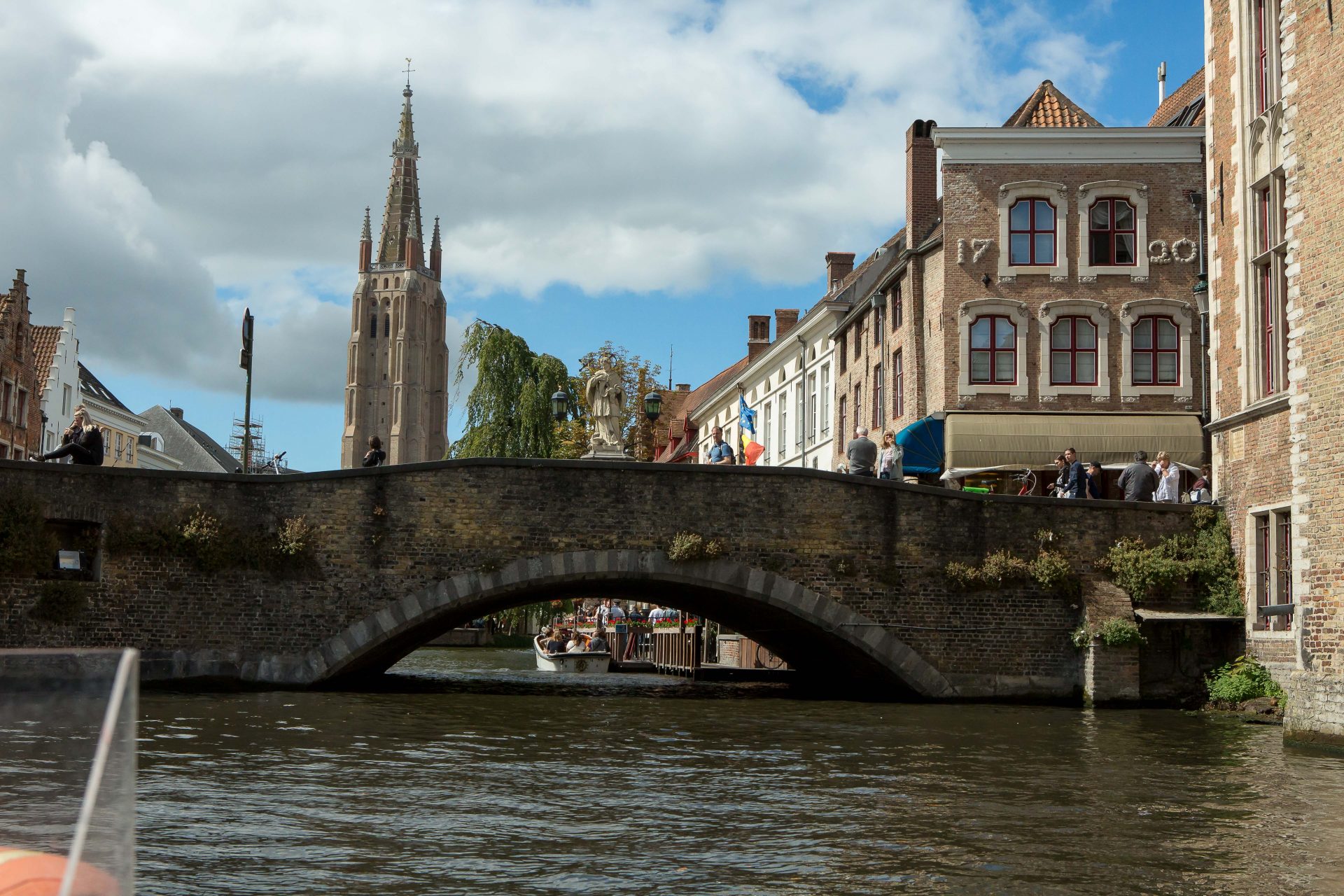
A short walk from the Markt brings you to the Rozenhoedkaai, the Quay of the Rosary, named for the rosaries once sold here. It is a small bend in the canal where two waterways meet beneath a low stone bridge, with the Belfry rising in the distance. At sunrise and sunset, the light slips along the water and gilds the brickwork, and the scene composes itself like a painting. It is the most photographed spot in Bruges, and even on a busy summer afternoon, it earns attention.
The Basilica of the Holy Blood
Tucked into a corner of the Burg, a smaller square next to the Markt, the Basilica of the Holy Blood is a quiet 12th-century chapel that holds, according to long-standing tradition, a relic said to be a few drops of the blood of Christ, brought to Bruges from the Holy Land in the years after the Second Crusade. Each year on Ascension Day, the city gathers for the Procession of the Holy Blood, a tradition stretching back to the Middle Ages and recognized by UNESCO as intangible cultural heritage. Whether one shares the faith or not, the procession is a window into a continuous thread of devotion that has run through this city for nearly 900 years.
The Beguinage and Minnewater
At the southern edge of the historic center, you cross a small bridge into the Beguinage, a walled enclosure of whitewashed houses ringing a quiet courtyard. It was founded in 1245 as a community for beguines, lay religious women who chose contemplation, charity, and self-sufficiency without taking permanent vows. Today, Benedictine sisters live there, and visitors are asked simply to be quiet. In spring, daffodils bloom in great drifts around the trees. It is one of the stiller places in Europe that invites reflection, the kind of place that, after a noisy morning in the Markt, restores something you did not realize had been worn away.
Just outside the Beguinage gate sits Minnewater, the “Lake of Love.” Swans glide across its surface in pairs, a tradition said to date back to the 15th century, when the people of Bruges were ordered by Emperor Maximilian of Austria to keep swans on their canals in perpetuity.
Riding the Reien: What a canal cruise reveals
A boat ride along the Reien offers a view of Bruges that no walking tour can. From the water, you see the backs of the merchants’ houses, with hidden gardens that spill flowers down to the canal, mossy stone arches that reach almost to your head, and the Beguinage rising from the water like a small white island.
Cruises depart from one of five landing stages in the city center. There is no advance booking; you simply walk up, queue for a few minutes, and pay at the dock. As of 2026, Bruges canal tours cost about €15 for adults and €9 for children. The ride lasts roughly 30 minutes, and the boats run from around 10:00 a.m. to 6:00 p.m., daily except in January and early February when they pause for the season. If you can, take the last boat of the afternoon. The light leans low, the crowds thin out, and the city seems briefly to belong to you.
Art, faith, and the Flemish primitives
Bruges’ wealth in the 14th and 15th centuries did something else for the world: it paid for some of the most extraordinary paintings in European history. The cloth merchants who grew rich on Flemish wool wanted altarpieces, devotional panels, and portraits, and they could pay the very best to have them made. So Jan van Eyck and, a generation later, Hans Memling came to Bruges to live and to paint.
The result was a school we now call the Flemish Primitives. The name is misleading: there is nothing primitive about these works. They were among the first paintings in Europe to use oil as a medium, and the precision is astonishing. Faces glow as if lit from within. A pearl looks heavy enough to weigh in your hand. Behind the saints and Madonnas, you can see, through a tiny painted window, the towers of medieval Bruges and the green countryside beyond.
The best place to see these paintings is the Groeninge Museum, which holds six centuries of Flemish art on the site of a former medieval abbey. Stand in front of Van Eyck’s Madonna with Canon van der Paele, and you are, in a real sense, standing in front of the same craftsmanship, the same devotion, and the same patient eye for detail that built the city outside the door. As Nspirement has explored in other stories about history and the human spirit, the art and culture a society leaves behind tell you what it loved.

A Quieter Bruges: Hidden corners worth the detour
The Markt and the Rozenhoedkaai will be busy in any season. The good news is that the city is small enough that quiet corners are only a few minutes’ walk away.
- Augustijnenrei. A canal in the north of the center, lined with low bridges and old merchant houses, is often empty even in summer.
- The four windmills on the eastern ramparts. All that remains of the 25 to 30 windmills that once stood along the city walls. A footpath connects them, and on a windy day, they still turn.
- Sint-Janshospitaal. A medieval hospital turned museum, with a small Memling collection and quiet cloisters that almost no tour groups visit.
- The Chapel of Our Lady of the Blind. Tiny, rarely visited, deeply atmospheric. Even many residents do not know it.
These are the kinds of places that reward an unhurried day, and they are part of why writers as different as travel bloggers and Britannica’s editors describe Bruges as a city to be felt rather than ticked off.
Belgian cuisine in Bruges: Chocolate, waffles, beer, and mussels
Bruges takes its food seriously, and it expects you to do the same. The city has more than 50 chocolate shops in the historic center, many of them family-run for generations, where pralines are still hand-rolled, and the smell of melted chocolate drifts into the street.
Belgian waffles come in two forms: the soft, rectangular Brussels waffle dusted with icing sugar, and the denser, sweeter Liège waffle with caramelized pearl sugar baked into the dough. Try one of each.
Mussels, served in a tall blue pot with golden frites and mayonnaise, are the classic local dinner. Order them with white wine, with cream and leeks, or simply with celery and onion, and take an hour to eat them.
For beer, the Brewery De Halve Maan, in the heart of the city, offers tours that end in a glass of their Brugse Zot in the rooftop tasting room. The brewery famously runs a 3-kilometer underground beer pipeline beneath the cobbles to its bottling plant outside the historic core.
When to visit and how to plan
Two to three days is the sweet spot for a first visit to Bruges. That allows time for the canal cruise, a slow morning in the Beguinage, an afternoon in the Groeninge Museum, the climb up the Belfry, and a good unhurried meal or two.
Spring and autumn bring the gentlest weather and the smallest crowds. The Christmas market, which transforms the Markt into a constellation of wooden chalets, ice skaters, and the smell of mulled wine, is worth braving the cold for. Summer is busy but long-lit; the canals stay beautiful until late.
Bruges is just over an hour by train from Brussels and easy to reach as a day trip, but if your schedule allows, stay at least one night. The city changes after the day-trippers leave. The streets are empty, the canal water goes glassy, and you have, for a few hours, something close to the medieval Bruges that the Beguines and the Hanseatic merchants would have known. For more of the kinds of journeys Nspirement loves, see our wider discoveries and journeys from around the world.
A window on a living world
Bruges is more than a beautiful place. It is a quiet argument, made over nine centuries, that beauty is worth keeping. When the sea withdrew and the trade moved on, the people of this small city did not pull down their old buildings to chase the new century. They mended the roofs, kept the bells ringing, swept the cobbles, and let the canals do what canals do, which is to carry the world by, slowly, on their dark surface.
In an age that tends to confuse speed with progress, Bruges offers a different lesson. Slow is not the opposite of alive. The Beguines knew this; the painters knew it; the boatmen on the Reien still know it. To stand on the Rozenhoedkaai at dusk, with the bells of the Belfry tolling across the rooftops and the swans of Minnewater settling for the night, is to feel, for a moment, that the world might still be worth tending carefully.
That, more than the canals or the chocolate or the medieval skyline, is what Bruges has to offer. It is the same gift that drew us to it in the first place: a window on a quieter, kinder, more carefully lived world. It is still there, waiting, every time you step off the train and stay in one of the many hotels. The tour itself is very affordable and worth every penny spent.
Follow us on X, Facebook, or Pinterest
