

When Jensen Huang and Lori Mills married in 1985, he was still years away from founding NVIDIA. The famous black leather jacket, the packed keynote speeches, and the global attention around artificial intelligence were all far in the future.
What they had then was much simpler: a marriage that had begun in a college classroom, a shared background in engineering, and a belief that the young man who once promised to become a CEO by age 30 might someday make good on his words.
The world she helped steady
After their marriage, Lori gradually stepped back from her own career and focused more on the family. It was not a small decision. She had studied engineering and worked in chip design at Hewlett-Packard. She understood the world Jensen Huang hoped to enter, and the kind of focus his work would demand.
Jensen Huang was intensely committed to his career, but in daily life, he could be careless about ordinary details. He disliked shopping and did not want to spend time thinking about clothes. Even wearing a watch felt unnecessary to him. He once explained that he did not wear one because he liked to live in the present.
Lori, however, saw the practical side of things. She noticed that he was particular about comfort and that many clothes bothered him. If they found something that worked, the simplest solution was to buy more of it.
So his wardrobe became simple: rows of similar black tops, arranged almost like a uniform.
Later, the black leather jacket entered the picture. Whether it was Lori’s idea or a suggestion from their daughter, Madison, Jensen Huang has said he no longer remembers clearly. But once the look appeared, it stayed. He wore it on stage. He wore it in interviews. Over time, the jacket became one of the most recognizable personal images in the technology world.
“I’m glad my wife and daughter dress me,” Jensen Huang has said.
There is no embarrassment in that statement. Rather, it sounds like the gratitude of a man who knows he has been well cared for.
Jensen Huang has also jokingly described the look as a kind of “revenge of the nerds.” Engineers, perhaps, were not expected to look cool. Yet the jacket worked because someone close to him understood how to make simplicity memorable.
The morning the promise came due
On April 5, 1993, Jensen Huang sat in a booth at a Denny’s restaurant in East San Jose, California, with two engineer friends, Chris Malachowsky and Curtis Priem. On a piece of paper, they worked out the initial steps for a new company. With a few hundred dollars to cover legal paperwork, NVIDIA was born, and Jensen Huang became its CEO.

He was 30 years old.
The bold promise he had made to Lori when he was 20 had come true almost exactly as he had said it would.
But founding the company was only the beginning. NVIDIA’s early years were difficult, and the company came close to failure more than once. Jensen Huang later admitted that if he had been an outside investor looking at NVIDIA in those days, he might not have chosen to invest.
During those years, he poured nearly all of his energy into the company. That kind of commitment often comes at a cost. A founder burns through his own strength, while the family carries much of the waiting, worry, and uncertainty.
Lori carried that weight. She had been there when Jensen Huang was only a young student with a daring promise. She remained there as that promise became a company, and as the company struggled to survive.
Their shared life did not begin after success arrived. It had already been tested long before the world started paying attention.
A family story
Jensen and Lori Huang have two children, Spencer and Madison. As adults, both eventually joined NVIDIA. Spencer has worked in product management related to robotics and simulation, while Madison has worked in marketing.
In that sense, NVIDIA is not only a corporate story. For the Huang family, it also became part of family life. The children grew up watching their father build the company through uncertainty and pressure. Later, they chose to enter the same world and contribute to it themselves.
Madison’s care for her father’s public image also echoes Lori’s quiet attention to his daily life. The black leather jacket may appear to be a small matter, but small things often reveal larger patterns. In Jensen Huang’s case, the jacket became a public symbol, yet it also points back to the private care of his wife and daughter.
In 2007, Jensen and Lori Huang established the Jen-Hsun and Lori Huang Foundation, supporting charitable work in health care, science, and education. It was not merely an extension of his business career, but something the couple chose to do together. Over the years, the foundation has supported research and educational projects, including work connected to universities on the West Coast.
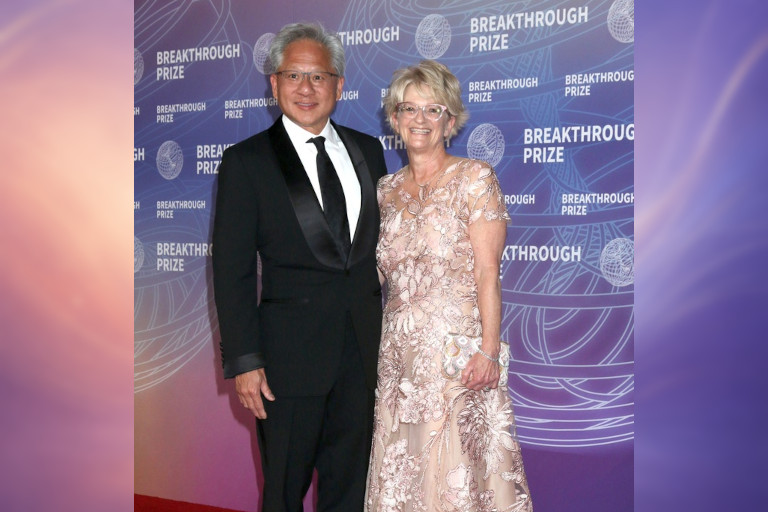
Looking back, Jensen Huang’s declaration at age 20 sounds almost impossible: “When I am 30, I will be a CEO.”
Yet it came true.
More than four decades have passed since Jensen and Lori first met in an engineering classroom. Their marriage has remained part of the quieter background behind a very public career. There has been no public story of marital scandal or dramatic rupture, only the steady presence of a woman who knew him before the company, before the fame, and before the black leather jacket became a global image.
When Jensen Huang walks across a stage today, the lights often fall on the jacket. The audience sees a founder, a CEO, and one of the central figures of the AI age.
But behind that image is a longer story: a college classroom, a Sunday homework routine, a young man’s unlikely promise, and a woman who heard it at the beginning and stayed long enough to see it fulfilled.
See Part 1 here
Translated by Joseph Wu
Follow us on X, Facebook, or Pinterest
