

Look closely at two of the oldest symbols in written Chinese, and you will find them separated by almost nothing at all. The character for king, 王 (wáng), and the Chinese character for jade, 玉 (yù), are nearly twins. A single small stroke is all that sets them apart. Yet inside that tiny dot lives one of the most enduring ideas in Chinese culture: that the truest measure of a person is not the crown they wear, but the quiet, unbreakable virtue they carry within.
For more than 7,000 years, China has treasured jade above gold, above silver, above every other precious thing. It has been carved into ritual discs and buried with emperors, worn against the skin of newborns, and pressed into the great seal of a unified empire, and it remains just as treasured today. To understand this small green stone is to glimpse the Chinese heart itself.
In this piece, we will read the character 玉 the way the ancients did, as a map of virtue, and follow the stories that turned a stone into a symbol of everything a good life could be.
What does the Chinese character for jade (玉) mean?
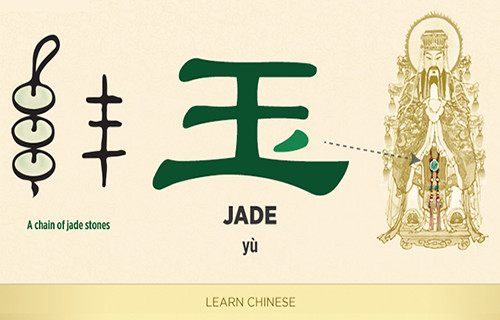
The Chinese character for jade, 玉 (yù), means jade, the beautiful and durable stone long revered as the “Stone of Heaven.” Pictured in the earliest writing as flat discs threaded on a single cord, the character came to represent purity, moral integrity, and the link between Heaven and earth. To call someone “jade-like” is to praise their character, not their wealth. That last point matters. In Chinese, jade has always been used to describe who a person is, not what they own. A daughter named with a jade character, a scholar wearing a jade pendant, a proverb that ranks jade above gold: each carries the same quiet message, that inner worth outlasts every outer fortune. This is the heart of jade symbolism in Chinese culture.
A single dot: How 玉 (jade) differs from 王 (king)
The resemblance between 玉 and 王 is not an accident. In the oldest forms of Chinese writing, the two characters looked quite different, but over the centuries their shapes drifted toward each other until they became nearly identical. Today only a single dot distinguishes them. That dot has a story. In the character for jade, it sits at the lower right like a small ornament, and traditional teachers described it as an amulet hanging from a king’s robe. Read this way, 玉 is the king’s stone, the gem worthy of the one person believed to link the human world to Heaven above, an idea echoed in centuries of Chinese imperial symbolism. The character’s roots reach back to the oracle bone script of the Shang Dynasty, more than 3,000 years ago. There, 玉 was drawn as pieces of jade strung together, a picture of the polished discs that nobles wore and that families treasured across generations. What began as a simple drawing of jewelry slowly became one of the most meaning-rich characters in the language.
The jade radical: Why so many beautiful words wear jade
Jade left its mark on far more than a single character. As one of the traditional building blocks of written Chinese, the jade radical appears in a whole family of words for precious and beautiful things. When placed to the left side of a character, as in 珍 (zhēn, “precious”), that familiar three-stroke shape signals jade. Its presence is especially loved in names. Characters such as 瑜 (fine jade), 琼 (exquisite jade), 琳 (beautiful jade), and 璐 (precious jade) have adorned Chinese given names for centuries, particularly for girls. To carry jade in your name is to carry a wish: that you will grow into someone as pure, as strong, and as quietly radiant as the stone itself.

Jade and the five virtues of a noble person
Long before jade was worn for beauty, people studied it for meaning. Chinese thinkers looked at the stone’s physical qualities and read in them a portrait of the ideal human character. This reading made jade a quintessential symbol of social values. Confucius is said to have counted the virtues of jade this way: its warm glow suggested benevolence; its firmness, righteousness; its clear tone when struck, wisdom; its readiness to break rather than bend, courage; and its flawless purity, integrity. Centuries later, the Han Dynasty scholar Xu Shen echoed the idea in his great dictionary, describing jade as the embodiment of wisdom, justice, compassion, modesty, and courage.
The five virtues most often named are:
- Benevolence (ren): jade’s gentle warmth, the kindness a good person extends to others.
- Righteousness (yi): its solid, honest substance, doing what is right even when it costs.
- Wisdom (zhi): the clear, unhurried note it makes when struck, the mark of a clear mind.
- Courage: its refusal to bend, breaking before it will yield to corruption.
- Integrity: its purity all the way through, the same within as it appears without.
This is why Confucius so often compared jade to the junzi, the noble or virtuous person. A gentleman, the reasoning went, should be like jade: strong yet gentle, refined yet unbreakable, valued not for show but for substance. An old proverb folds the whole philosophy into a single line: “Gold has a value; jade is invaluable.”
The stone of Heaven: Purity, immortality, and harmony
If jade described the ideal person, it also described the ideal cosmos. The Chinese called it the Stone of Heaven, and they used it to reach toward the sacred. In ancient ritual, people carved flat jade discs known as bi to honor Heaven, their round shape mirroring the sky. Jade was thought to hold and balance the energies of yin and yang, bringing opposites into harmony, a principle at the center of ancient Chinese cosmology. Because it neither rusted nor decayed, it became a natural emblem of immortality and of the enduring soul.
That belief shaped even how the powerful were buried. During the Han Dynasty, the highest nobles were laid to rest in astonishing suits sewn from thousands of small jade plaques, stitched together with gold or silver thread. The living hoped the incorruptible stone would preserve the body as it had preserved so many meanings, a final wish for permanence carved in green. Centuries later, archaeologists would unearth these jade suits intact, thousands of plaques still bound in gold thread.
The legend of He Shi Bi: Loyalty carved in jade
No story captures jade’s power over the Chinese imagination like the legend of He Shi Bi (和氏璧), the most famous piece of jade in history.
During the Spring and Autumn period, a man named Bian He found a rough, unremarkable stone and recognized the treasure hidden inside. He carried it to the king of Chu as a gift. But the court jewelers saw only a plain rock, and the king, believing he had been deceived, ordered Bian He’s left foot cut off as punishment. When a new king took the throne, Bian He tried again, and lost his right foot as well. Still he would not give up. Weeping at the foot of a mountain with the stone in his arms, he was at last noticed by yet another king, who ordered the rock cut open. Inside lay a flawless disc of perfect jade. In honor of the man whose loyalty had cost him so much, it was named He Shi Bi, “the jade of Bian He.”
The disc became China’s most coveted object. A powerful rival state once offered fifteen walled cities in exchange for it. And when the First Emperor, Qin Shi Huang, united the warring kingdoms in 221 BCE, he had the legendary jade carved into the imperial seal, inscribed with the words, “Having received the Mandate from Heaven, may the emperor lead a long and prosperous life.”
For more than a thousand years, that seal passed from dynasty to dynasty as the very symbol of the right to rule. Then, sometime amid the turmoil between the Tang and the Song, it slipped from history and was never seen again. To this day, the lost imperial seal remains one of China’s great unsolved mysteries, a reminder that even the most precious jade cannot outlast the tides of fortune, only the virtue it was meant to represent.
Two stones, one name: Nephrite and jadeite
For most of Chinese history, the jade so prized by emperors and scholars was nephrite, a tough, silky stone quarried above all from Hetian in the far western region of Xinjiang. Softer to the touch and often the color of mutton fat or river water, nephrite was the classic imperial jade, the material of ritual discs, seals, and burial suits. A second stone entered the story much later. Jadeite, harder and capable of a vivid emerald green, began arriving from the mines of Burma (modern Myanmar) and rose to fashion during the Qing Dynasty. Most people now picture jadeite, with its glassy translucence, as “Chinese jade,” and it most often gleams on a modern bangle. The Chinese language combines both stones into a single character, 玉. To the traditional eye, what mattered was never the mineralogy but the meaning: the warmth, the clear ring, the quiet strength that made either stone worthy of the name jade. Whether nephrite or jadeite, it remained the Stone of Heaven.
Jade in everyday life today
Jade never retreated into museums. Walk through any Chinese community today, and you will still see it worn close to the skin, most often as a smooth bangle slipped over the wrist. These bracelets are far more than ornaments. In a belief still shared across China, Taiwan, and much of Southeast Asia, a jade bangle quietly watches over its wearer. If it cracks or shatters in a fall or an accident, many will tell you the jade “broke to protect you,” absorbing the misfortune that might otherwise have struck its owner. In traditional thinking, jade is also linked with calm, balance, and well-being, worn to steady the emotions as much as to guard the body.
Jade also marks life’s milestones. A smooth disc might be pressed into a baby’s palm at a first-month celebration, or tucked into a bride’s dowry as a blessing for the years ahead. Many wearers believe that jade deepens in color and luster the longer it is worn against the skin, as if the stone slowly takes on the warmth and character of its owner, growing more beautiful the more life it shares. Jade still passes between the generations, too: a grandmother’s bangle slipped onto a granddaughter’s wrist, a pendant handed from mother to child. Each time, the old meanings travel with it: protection, purity, and the hope that the wearer will grow worthy of the stone.

The quiet wisdom in a single character
The Chinese character for jade is a small marvel of compression. In a few strokes, it holds an entire worldview: a stone lifted above gold, a king’s amulet, a map of the five virtues, a bridge between Heaven and earth, and the memory of a loyal man who lost everything to reveal a hidden treasure. What makes 玉 endure is not its beauty alone but its lesson. Jade teaches that real worth is inner worth, that strength and gentleness belong together, and that the qualities most worth having- benevolence, honesty, wisdom, courage, and integrity- are the ones that outlast every fortune. In a world that so often measures people by what they own, it is a quietly radical and hopeful idea.
The next time you notice a jade bangle on a wrist or the character 玉 on a page, you might remember what the ancients knew: that the finest thing a person can become is not a king, but jade.
Follow us on X, Facebook, or Pinterest
