
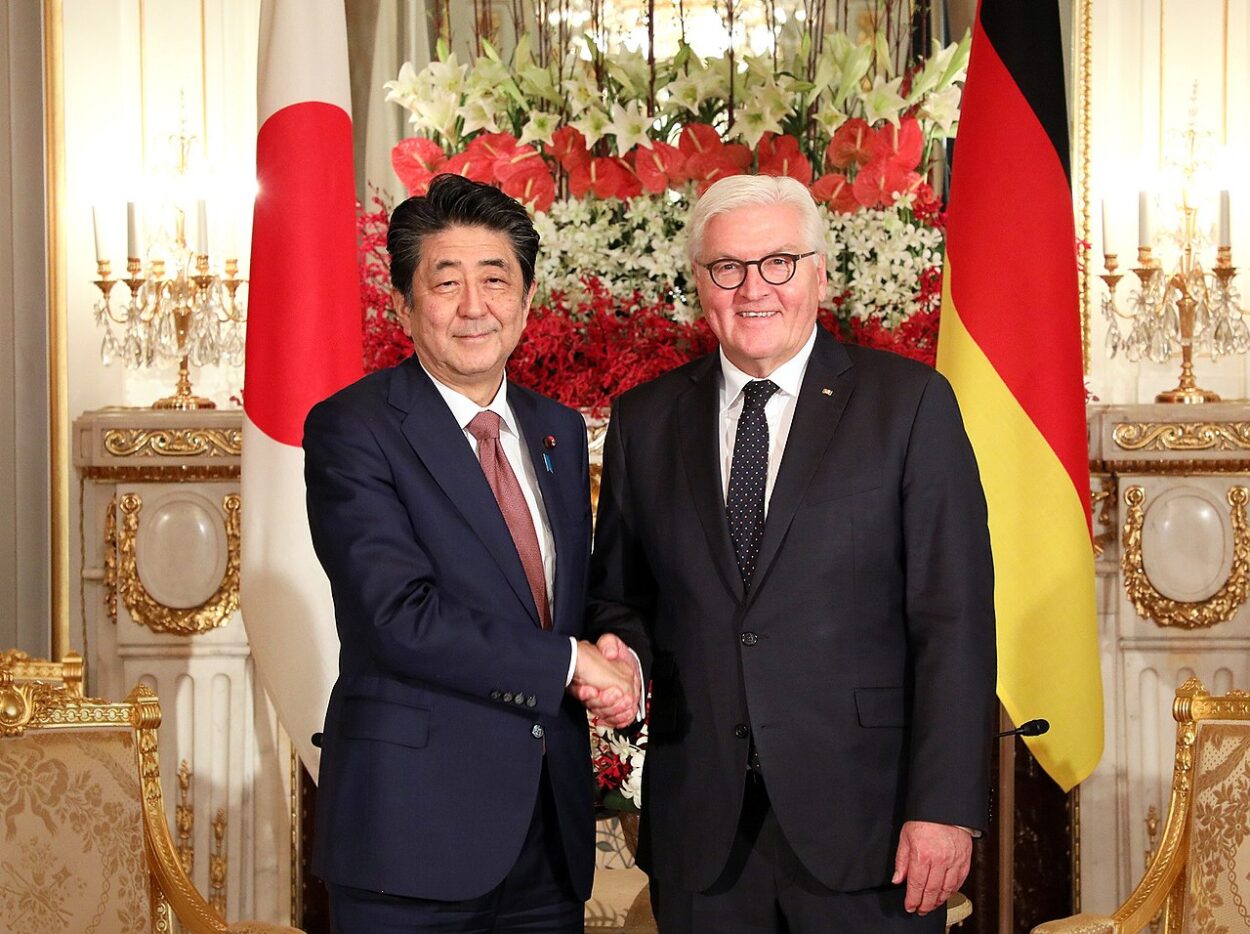
Being conquered is not necessarily detrimental to a nation; when conquered by more civilized countries, it enters a new stage of development and becomes a civilized people.
In modern times, after West Germany, Japan, and South Korea were occupied by the United States, they finally shed barbaric militarism and truly embarked on the path of constitutional democracy.
By contrast, the tragedy of a nation is exemplified by the many countries conquered by Soviet Russia after World War II. The gap between East and West Germany, visible in the 1980s, and the gap between North and South Korea, apparent today, are precisely the enormous disparities created when different civilizations conquer people from the same country.
Consider the cases of Germany and Japan, administered by Western democracies after WWII. It was precisely through the forceful transformation imposed by the American occupation that militaristic Germany and Japan embarked on the path of constitutional democracy, integrating into the mainstream of global development and becoming essential members of the world’s dominant civilizations.
At the end of WWII, Germany was divided into four Allied occupation zones: Britain, France, the U.S., and the Soviet Union. Neither power was willing to cede its occupied zone to the other, nor could they reach an agreement.
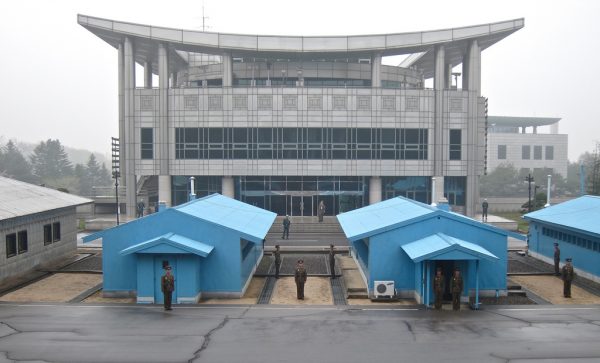
Ultimately, the three Western zones unified their administration to form the Federal Republic of Germany (West Germany), while the Soviet Union established the German Democratic Republic (East Germany). Following the collapse of the Soviet Union, Germany was reunified, and East Germany was incorporated into West Germany.
Merkel’s historic address to the U.S. Congress
On November 3, 2009, German Chancellor Angela Merkel delivered a speech to a joint session of the U.S. Senate and House of Representatives in the House Chamber of the U.S. Capitol. This marked the first time in 50 years that a German chancellor addressed the U.S. Congress, a speech regarded as historic.
Merkel stated that 20 years earlier — before the Berlin Wall fell — she could not even have imagined traveling to the United States, let alone delivering an address before the U.S. Congress. She remarked:
“For a long time, reaching this land of boundless opportunity seemed impossible to me. That wall, barbed wire, and the order to shoot those who tried to escape kept me from the free world.” Merkel recalled that as a teenager, like many others her age, she loved jeans. An aunt in West Germany regularly sent her a brand unavailable in East Germany.
She said she learned about America only through films and books, many smuggled into East Germany by relatives from West Germany. “I was passionate about the American dream,” she said, “where every person could succeed, where dreams could come true through personal effort.”
Merkel worked as a researcher at the Academy of Sciences in East Berlin. After the fall of the Berlin Wall, she decided to enter politics. In 1990, the year following the Wall’s collapse, Merkel and her husband flew to the United States for the first time — “a land that nurtures the spirit of freedom and independence” — arriving in California.
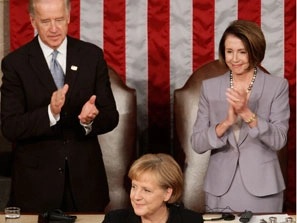
In her speech, Merkel expressed gratitude to the United States for helping Germany achieve reunification. She said the German people would never forget the support given by the American people in the years leading up to and following November 9, 1989, when the Berlin Wall fell.
Before and after the fall of the Berlin Wall on November 9, 1989, and in the years that followed, the German people will never forget the support given to them by the American people. In an emotionally charged speech, Merkel thanked several U.S. presidents – Kennedy, Reagan, and George H.W. Bush – for standing with West Germany during the Cold War and jointly resisting communism. She said, “We know we owe you a great deal, and I will never forget it.”
This is how a conquered nation responds to its conquerors — not with hatred, but with gratitude.
Translated by Audrey Wang and edited by Helen London
Follow us on X, Facebook, or Pinterest
