
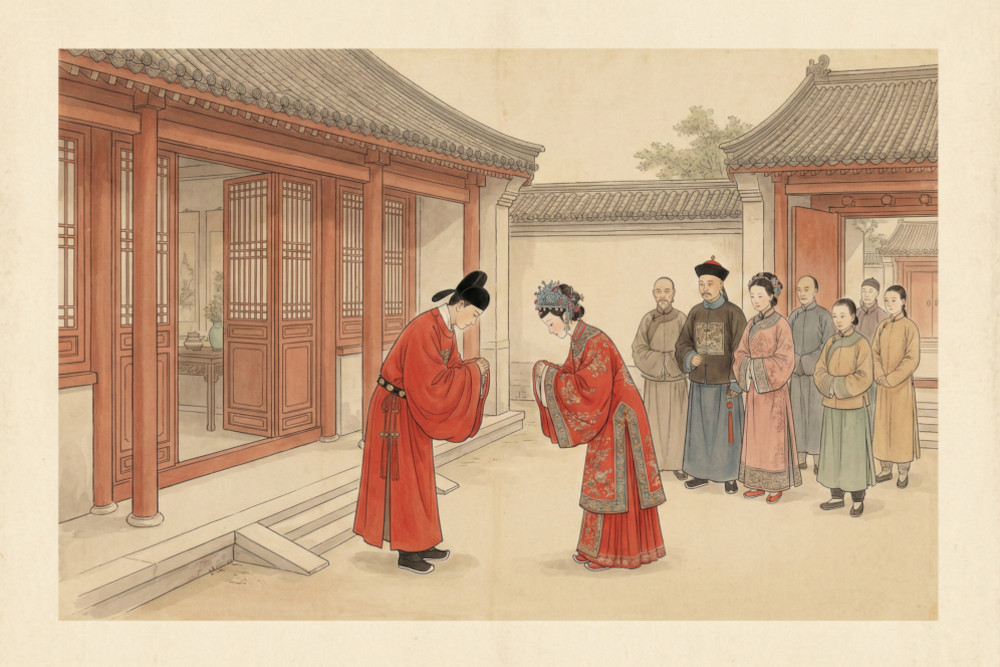
During the Qing Dynasty, a poor scholar surnamed Ding lived in Tianjin. His family circumstances were modest, and he spent his days studying at home. Years earlier, his family had arranged an engagement for him, and the betrothal gifts had already been exchanged, though the marriage itself had not yet taken place.
His prospective father-in-law came from a wealthy household. Seeing that Ding remained impoverished and without prospects, the man began to regret the match. Eventually, he sent an invitation for Ding to visit his home, where he prepared a lavish banquet in his honor.
Ding had a fondness for drink and did not refuse the wine that was offered. Before long, he became thoroughly intoxicated. At that point, his host spoke plainly. He claimed that his daughter had a physical impairment and would not be able to serve Ding properly as a wife. He then offered one thousand taels of silver as compensation, suggesting that once Ding achieved success, he could marry someone else. He asked Ding to write a document dissolving the engagement on the spot.
Inflamed by drink and pride, Ding replied passionately: “Selling one’s wife is not something I would ever do. How could silver sway my heart? Does a man truly fear that he will never find a wife? But if you insist on ending the matter, then I will write the document now.”
Delighted, the father-in-law immediately produced paper and a brush. In his drunken state, Ding wrote the document without hesitation and left the house.

On his way home, Ding encountered a former classmate, a man from a wealthy family, who invited him in and asked where he had been. Ding recounted the entire episode without embellishment. His classmate was indignant on his behalf, but Ding himself appeared calm and unconcerned.
A matchmaker proposes a marriage
Not long afterward, the classmate quietly sent a matchmaker to the household of Ding’s former father-in-law to propose marriage. Judging the families to be well matched, the father readily agreed, and a wedding date was set. A few days before the ceremony, the classmate informed Ding of the arrangement, saying with a smile: “The woman you cast aside is now to be my wife. Since we are such close friends, why won’t you come and congratulate me?”
Ding answered with his usual nonchalance. “I have already ended the engagement. She and I are strangers now. What harm is there in it?”
On the day of the wedding, Ding attended the celebration and offered his congratulations. His classmate invited him to see the bride. When Ding caught sight of her, he was struck by her exceptional beauty. Though his heart stirred, he knew there was nothing to be done. He returned to the banquet and drank heavily. Urged on by his host and the other guests, he soon drank himself into a deep stupor.
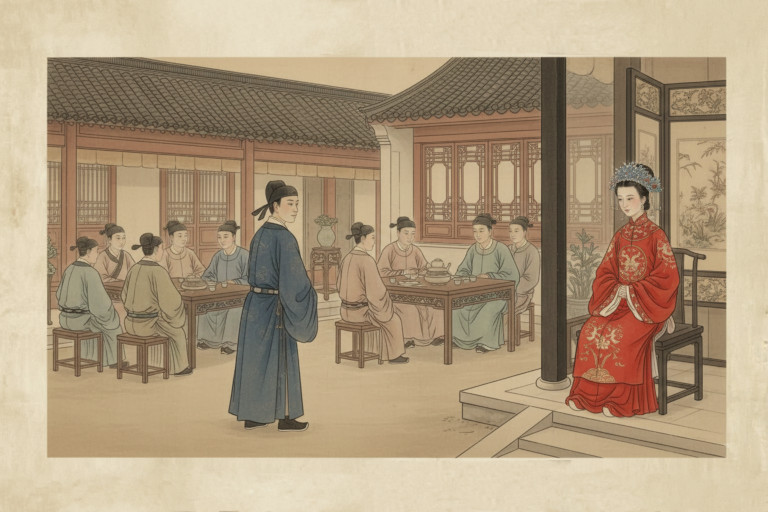
(Image: via Google Whisk)
Taking advantage of this, the classmate ordered servants to carry Ding into the bridal chamber and locked the door from the outside. At dawn, Ding awoke to find himself lying inside the wedding room. Before him sat the bride, fully adorned, waiting in silence.
Startled, Ding shouted for the door to be opened, but it remained locked. Only after he raised his voice again did the door finally open. His classmate entered and said calmly: “You have now completed the marriage. You may take her home with you.”
Ding pointed to the heavens and swore an oath, insisting with great urgency that he was innocent of any wrongdoing. His classmate replied: “This was my decision alone. If your former father-in-law objects, I will take the matter to court.”
By then, the bride had also recognized Ding as her original betrothed and agreed to return with him. When someone told her father the truth, he was overwhelmed with shame and dared not protest.
In later years, both Ding and his classmate were selected as Filial and Upright Scholars through the imperial examinations. To preserve another’s marriage is no small merit, and the classmate’s decisive intervention was an act of rare courage. Heaven rewards those who act with integrity, though the names of such people often fade with time, leaving behind only the quiet weight of their deeds.
Translated by Audrey Wang
Follow us on X, Facebook, or Pinterest
