

There’s an interesting fact that many people might not know: the roofs of the Imperial Palace in the Forbidden City are almost completely free of bird droppings. Despite being centuries old and exposed to the elements, this remarkable palace shows virtually no signs of the damage that birds often cause to historic buildings.
The Forbidden City in Beijing, built during the Ming Dynasty, celebrated its 600th anniversary in 2019. This vast complex served as the home to the emperors of the Ming (1368-1644) and Qing (1644-1912) Dynasties, spanning nearly 500 years of imperial history. At its center, the Imperial Palace contains the main residential and ceremonial buildings.
Preserving such historic architecture is never easy. Many treasured structures suffer not only from wind and rain but also from bird droppings, which can gradually damage even the most magnificent roofs. Yet remarkably, the Imperial Palace shows almost none of these marks.
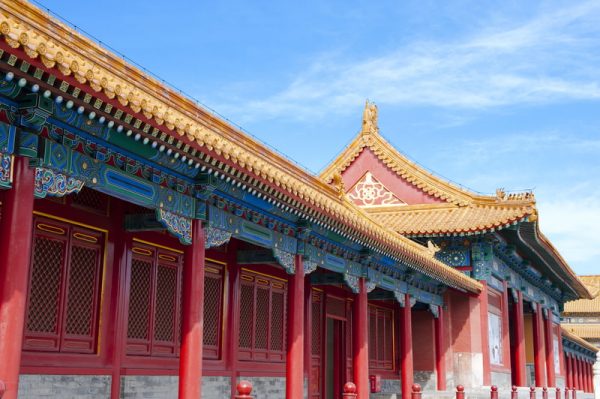
But why?
When the palace was being built, its architects had already considered this problem. As the emperor’s residence, it was meant to remain sacred and pure, and allowing birds to defile it was unthinkable. For this reason, they designed the palace with extraordinary care.
First, the building’s roofs were covered with high-quality glazed tiles, whose exceptionally smooth surfaces make it difficult for birds to perch. Second, the designers chose yellow-glazed tiles and red walls — colors traditionally believed to deter birds from approaching. Third, from the Ming through the Qing dynasties, dedicated personnel maintained the grounds, regularly cleaning and driving away birds and other animals. In addition, modern experts suggest that the ancient builders may have used a special type of paint that emitted subtle scents unpleasant to birds, further discouraging them from lingering near the buildings.
Thanks to these thoughtful choices, the Imperial Palace has remained remarkably well-preserved for centuries, a testament to the foresight and ingenuity of its early architects. One cannot help but admire the skill and vision of these ancient builders.
History, architecture, and legacy of the Forbidden City
The Forbidden City has been open to the public as the Palace Museum since 1925, following the final departure of the last emperor, Puyi, from the Inner Court. The museum’s collections are largely based on the imperial treasures of the Ming and Qing dynasties, and it is often ranked alongside the Hermitage in Russia, the Louvre in France, the Metropolitan Museum of Art in the United States, and the British Museum in the United Kingdom as one of the world’s five great museums.
Construction was ordered in 1406 by the Yongle Emperor (Zhu Di), with the chief architect being the imperial craftsman Kuai Xiang. The original construction required roughly 230,000 craftsmen and more than a million laborers and soldiers, and took 15 years to complete. From its completion in 1420 until the abdication of the last Qing emperor in 1911, 24 emperors resided there.
Located at the center of Beijing’s central axis, the palace complex covers approximately 720,000 square meters, with about 150,000 square meters of building space. It remains the largest surviving palace complex in the world. The palace measures 961 meters from north to south and 753 meters from east to west, surrounded by a 9.9-meter-high wall, 8.26 meters thick, and is protected by a moat.
Four main gates mark the complex: the Meridian Gate to the south, the principal entrance symbolizing the emperor’s central authority; the East Prosperity Gate to the east and the West Prosperity Gate to the west, representing growth, fortune, and abundance; and the Black Tortoise Gate (Shenwu Gate) to the north, named after the protective celestial creature of Chinese cosmology, which is now the main entrance to the Palace Museum.
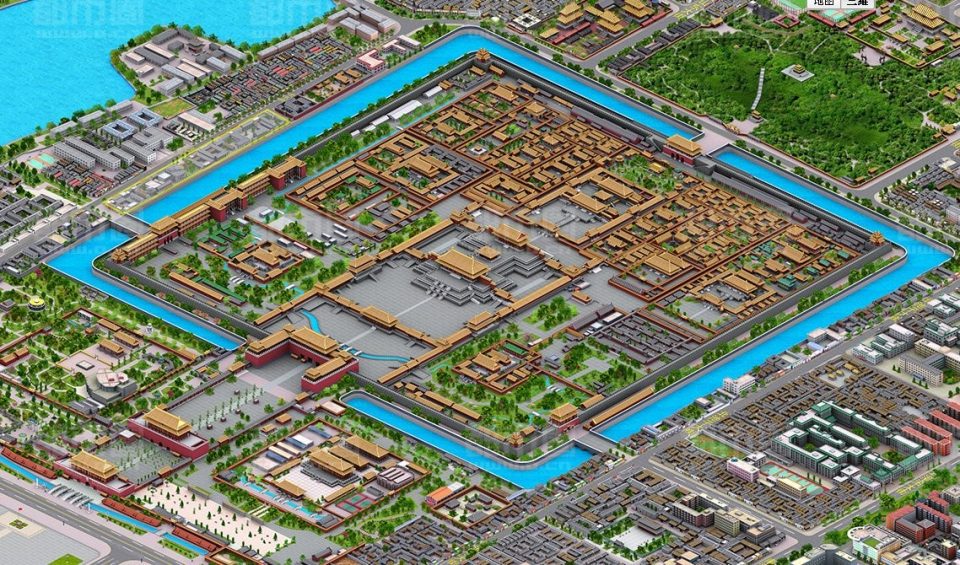
During the early Ming Dynasty, there were more than 1,630 halls. By the Qianlong period of the Qing Dynasty, the number had grown to over 1,800, and today, 2,631 halls still exist. Legend says the palace has 9,999.5 rooms—symbolically just shy of the mythical 10,000 rooms of Heaven. On-site measurements by experts in 1973 recorded more than 90 courtyards and 980 surviving buildings, totaling 8,704 rooms, with a “room” referring not to a modern enclosed space, but to the area framed by four structural pillars.
Before the 1911 Revolution (also known as the Xinhai Revolution), which ended imperial rule in China, it was known as the “Purple Forbidden City.” The name comes from ancient Chinese astronomy: scholars divided the heavens into three enclosures, four symbols, and twenty-eight constellations. The central enclosure, the “Purple Star Enclosure,” was believed to be the dwelling place of the Heavenly Emperor. The earthly emperor, calling himself the “Son of Heaven,” adopted the color purple for his own palace — hence, the “Purple Forbidden City.”
The palace’s architectural palette includes yellow-glazed tiles, red walls, golden ornaments, and white marble foundations. The yellow glazed tiles symbolized the emperor’s supreme authority. Today, the Forbidden City stands not only as a marvel of architecture but also as a symbol of the vision, skill, and foresight of its builders. From its carefully maintained roofs to its grand halls and sprawling courtyards, it continues to inspire awe centuries after its completion, leaving an enduring legacy for the world to admire.
Translated by Katy Liu and edited by Tatiana Denning
Follow us on X, Facebook, or Pinterest
