
Generally speaking, it seems that every city has its own pilgrimage site for lovers — such as Rome’s Trevi Fountain, Paris’s Pont des Arts, or New York’s Empire State Building.
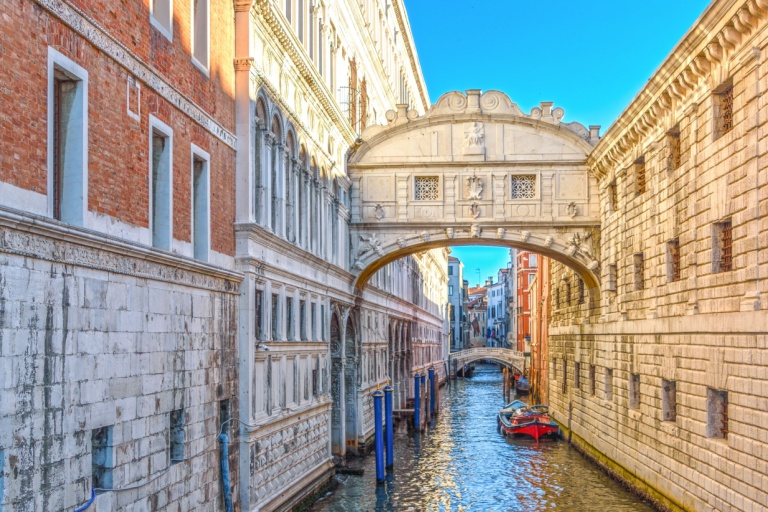
Amid the shimmering waters and stone reflections of Venice, Italy’s romantic water city, the Bridge of Sighs stands as a sacred site that captivates lovers’ hearts. Originally an unassuming Baroque-style stone bridge, it lies quietly across the canal. Yet, a beautiful legend of romance has transformed this small stone bridge into one of the most romantic bridges in the world.
A romantic legend about a kiss
If you visit Venice, the locals will tell you this legend: If you wait patiently until sunset, and lovers kiss each other on a gondola beneath the Bridge of Sighs, they will be granted eternal love that lasts forever. This legend was brought to life in the 1979 romantic comedy film A Little Romance.
In the film, Roland, a 13-year-old American girl living in Paris, and Daniel, a 13-year-old French boy, meet by chance and immediately fall in love. However, their relationship faces fierce opposition from Roland’s mother, who tries to tear them apart. Ultimately, Roland and Daniel decide to elope to Venice.
Driven by this call of love, the young lovers were determined to fulfill their wish at any cost. Thus, they traveled all the way from Paris to Venice, solely to kiss beneath the Bridge of Sighs at sunset — just as the bells of St. Mark’s Campanile rang in the distance — so that they might attain eternal love. World-renowned American director George Roy Hill brought this romantic legend to life, transforming Venice’s Bridge of Sighs into a sacred site of love and shaping the romantic ideals of a generation of young people in Europe and America.
Who exactly uttered that famous ‘sigh’?
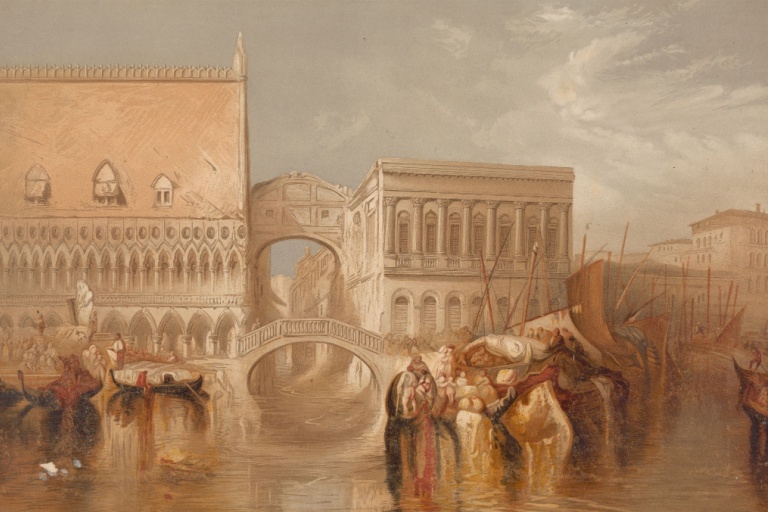
Venice’s Bridge of Sighs (Ponte dei Sospiri) was built around 1600, during the twilight of the Venetian Republic. Its chief architect, Antonio Contino, was the nephew of the designer of the Rialto Bridge. The family’s innate appreciation for opulence ensured that even as an extension of a prison, the bridge was imbued with intricate Baroque aesthetics. Another crucial point: this is a covered arch bridge.
Yet this beauty is ironic. At one end of the bridge stands the Doge’s Palace, the heart of power in the Mediterranean world at the time, adorned with gold, marble, and masterpieces by Titian; at the other end lies the Prigioni Nuove, a dungeon capable of striking fear into even the toughest of men. Why is it enclosed? Precisely to prevent prisoners from escaping or jumping into the river, the entire bridge is tightly encased in limestone, with only two small carved stone windows left to peer out from the inside.
So, whenever a condemned prisoner was being led to the dungeon or the execution site, they would peer through the small openings in the stone windows to catch one last glimpse of Venice’s shimmering waters, the free citizens, the gliding gondolas, and the distant church spires.
Through the windows, they beheld the city’s final glimmer of daylight and freedom; a thousand unspoken words welled up within them, ultimately dissolving into a single, long sigh. Over time, the bridge came to bear a poetic name: the Bridge of Sighs (Ponte dei Sospiri). In that moment, that long sigh was both a lament for the life left behind and an eternal farewell to freedom.
Another legend tells a story quite the opposite: A prisoner walked onto the Bridge of Sighs, and the jailer allowed him one last glimpse out the window. On the river below, a slender gondola was gliding beneath the bridge; a couple on board were passionately kissing, and the woman was none other than the prisoner’s beloved. The prisoner roared in fury, frantically banging his head against the stones of the bridge, but those below heard nothing.
Later generations transformed this tragedy into a comedy, bordering on myth. The legend goes that at sunset, if two people who truly love each other kiss beneath the bridge, their love will remain steadfast forever. And there we have the scene from the movie mentioned at the beginning of this article.
A historical legend of escape
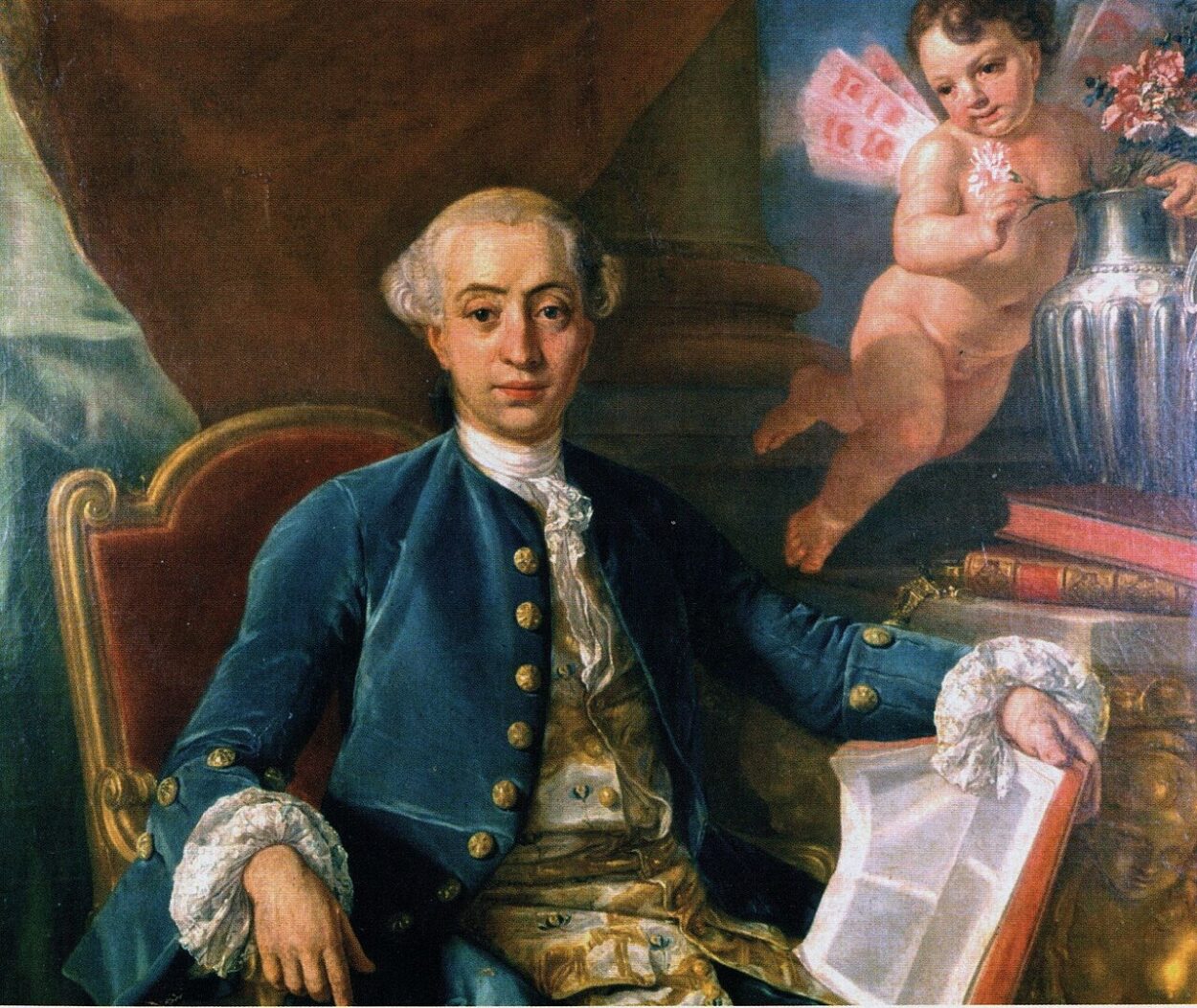
However, the most legendary night in Venetian history was not portrayed through the romantic lens of a Hollywood film, but was actually staged by a real-life womanizer. In European history, there was a Venetian “womanizer” named Giacomo Casanova, renowned far and wide. Born in Venice, Casanova was a legendary adventurer and writer, a “womanizing playboy” and the most famous womanizer in 18th-century Europe. In 1755, this man of letters — known for his chaotic private life and suspected of practicing divination and possessing banned books — was imprisoned in Venice’s infamous San Marco Prison for “offending religion.”
Despair beneath the sighs
Casanova was held in the upper levels of the prison known as the “Piombi” (Lead Cells), where summers were as scorching as an oven and winters as bitter as an ice cellar. After their trials, prisoners had to cross the enclosed Bridge of Sighs to reach this place. In his memoirs, Casanova wrote that as he crossed the bridge and peered through the small slits in the stone windows at the shimmering canal below, he too let out a heavy sigh. However, it is said that his sigh on the bridge was not for the vicissitudes of fate, but rather because he “had not yet had the chance to bid farewell to all the young women of the city.”
On the eve of Halloween in 1756, Casanova collaborated with a priest to chisel a hole in the ceiling using a sharp iron bar. They climbed onto the lead-covered roof of the Doge’s Palace. The roof was extremely slippery and steep; the slightest misstep could have sent them plummeting into the deep sea.
A surprising turn of events
After escaping onto the roof, Casanova did not scale the wall like a common thief. Instead, he donned a set of elegant silk garments and strode confidently through the governor’s palace hall. The guards, impressed by his dashing demeanor, mistook him for an early-rising councilman and actually opened the gates for him! He immediately jumped into a gondola and fled the country.
Later, in his twilight years, Casanova devoted himself to writing an autobiographical novel titled Histoire de ma vie (The Story of My Life). He included this legendary escape in the book, leaving behind a romantic legend in literary history. This escape not only made him famous, but also imbued the “Bridge of Sighs,” which connects to the prison, with a touch of legendary defiance against authority, adding to its already eerie atmosphere.
Many people compare Casanova to Lord Byron’s novel Don Juan, as both men had countless lovers throughout their lives. However, Don Juan is a work of fiction, while Casanova was a real historical figure. What further distinguishes him from Don Juan is that Casanova deeply loved all his women and maintained long-term, amicable relationships with them.
Byron’s influence: From realism to romanticism
However, despite the romantic legends surrounding the “Bridge of Sighs,” the truth is that, prior to the 19th century, the bridge did not have a single, established name. It was the British Romantic poet Lord Byron who truly bestowed upon it the literary label of “Bridge of Sighs.” In the fourth canto of Childe Harold’s Pilgrimage, he wrote: “I stood in Venice, on the Bridge of Sighs, a palace and a prison on each hand.”
It must be said that Byron’s ability to “sell” a place was nothing short of terrifying. After reading his poetry, Victorian gentlemen flocked to Venice. The stone bridge, which originally symbolized harsh justice, was instantly transformed — through the lens of Romanticism — into a synonym for “melancholy, gloom, and desolation.” In an instant, a single line turned it into a must-visit destination for bohemians. Once suffering is aestheticized, it becomes art.
Venice’s wine and elegies ultimately converge in that arching stone silhouette. As Borges said, the world is a labyrinth, and the bridge is the gentlest exit within it. Whatever you may be sighing over at this moment, please remember: even on the most enclosed stone bridge, there remain two stone windows looking out into the world. As long as there are windows, there is light.
Translated by Eva and edited by Helen London
Follow us on X, Facebook, or Pinterest
