

High in the misty mountains of ancient China, Taoist monks once tended temples they called “the abode of mushrooms.” Among the sacred fungi growing on gnarled tree trunks and weathered logs, one stood apart from all others: the lingzhi mushroom, a glossy, reddish-brown fungus that ancient healers believed held the key to immortality itself.
For over 2,000 years, this remarkable mushroom, also known as the reishi mushroom in Japanese tradition, has captivated emperors, monks, physicians, and storytellers across East Asia. Its legends speak of physical transformation, spiritual awakening, and the timeless human desire to transcend the limits of ordinary life.
What is it about the lingzhi mushroom that inspired such devotion? The answer lies not in one story, but in many woven together across centuries of Chinese culture, traditional medicine, art, and folklore. Here, we journey through the legends, wisdom, and enduring significance of this sacred fungus.
What does ‘lingzhi’ mean? The name behind the legend
The name lingzhi itself reveals the depth of reverence this mushroom has commanded for millennia. In Chinese, the word is composed of two characters: “ling,” meaning spirit, divine, or sacred, and “zhi,” meaning plant of longevity or mushroom. Together, they form a name often translated as “the divine mushroom” or “the herb of spiritual potency.”
Scientifically classified as Ganoderma lucidum, the lingzhi mushroom is known by different names across Asia. In Japan, it is called reishi. In Korea, it is yeongji. Each name carries a similar weight of respect and wonder. The oldest Chinese pharmacopeia, the Shen Nong Ben Cao Jing, classified lingzhi as a “superior” herb, the highest category reserved for substances believed to nourish life itself without harmful side effects.
This classification was no small distinction. In a medical tradition spanning thousands of years, the lingzhi mushroom earned a place alongside ginseng and other legendary tonics as one of the most valued herbs in Chinese medicine. Its very name tells us that the ancient Chinese saw in this humble fungus something far beyond ordinary nourishment; they saw a bridge between the physical and the spiritual.
The lingzhi mushroom in Taoist tradition
Taoist temples: The abode of mushrooms
The connection between the lingzhi mushroom and Taoism runs so deep that Taoist temples themselves were called “the abode of mushrooms.” Monks who dedicated their lives to spiritual cultivation prized lingzhi not only for its health-strengthening properties, but for its reputed ability to help practitioners access heightened states of awareness and insight.
In the fourth century, the Taoist scholar Ge Hong wrote extensively about lingzhi in his treatise Baopuzi. He described the mushroom as essential to the pursuit of immortality, not merely a longer lifespan, but a state of spiritual liberation. For Ge Hong and the Taoist traditions of Wudang Mountain and beyond, consuming lingzhi was part of a holistic practice that included meditation, fasting, and living in harmony with nature.
The three treasures: Jing, qi, and shen
In traditional Chinese medicine (TCM), lingzhi holds a rare distinction as a “three treasure” herb, one that harmonizes all three of the body’s essential energies. These three treasures are jing (life essence), qi (vital energy), and shen (spirit or consciousness).
The lingzhi mushroom is particularly revered as a shen tonic. Shen, in TCM, refers to the spirit housed in the heartencompassing emotional balance, mental clarity, and inner peace. A person with strong shen radiates presence and vitality. A person with disrupted shen may experience restlessness, anxiety, or disconnection. By nourishing shen, the lingzhi mushroom was believed to calm the mind, steady the emotions, and open the door to deeper spiritual understanding.
This framework helps explain why monks and scholars sought the lingzhi mushroom so fervently. It was not simply medicine for the body. It was nourishment for the soul.
Legends of the sacred lingzhi mushroom
The lingzhi mushroom has inspired some of the most vivid and beloved folk tales in Chinese tradition. These stories share a common thread: the mushroom appears at moments of transformation, offering those who encounter it a chance to transcend their ordinary lives.
The tale of Mr. Ambition and the spiritual vegetable meat
A long time ago in a small Chinese village, there lived a dedicated student with a great ambition to pass the imperial examinations and become a government official. The villagers knew him simply as Mr. Ambition.
He failed the examinations a dozen times. Humbled and weary, Mr. Ambition decided to redirect his life entirely. He would become a Taoist monk, he reasoned, and pursue longevity and spiritual cultivation instead of worldly status. So he left the mundane world behind and went to live in a temple on the mountain, where he devoted himself to fasting and eating only vegetables.
Less than a year into his monastic life, Mr. Ambition caught sight of himself in a mirror. He was shocked. His body had grown thin as a stick, his complexion was pale, and his vitality had drained away. Frightened for his health, he abandoned the temple and returned to the city.
Back in the mundane world, Mr. Ambition built a thriving construction business and made a considerable fortune. Yet his wealth could not restore the health he had lost. One day, while his workers were digging the foundation for a large building, they unearthed a strange object from the earth, thick-fleshed and soft-bodied, which resembled a huge human hand. Everyone was unsettled. Mr. Ambition, especially, worried that it was a bad omen. He consulted a fortune-teller.
“This object signals a real disaster for you,” the fortune-teller warned. “How can I prevent it?” Mr. Ambition asked. “I will do anything.” After a long pause, the fortune-teller replied: “You could turn the upcoming disaster into good luck if you have the courage to eat the strange object.” Mr. Ambition was shocked at the suggestion, but desperation gave him courage.
That night, he ate the fleshy object at dinner. To his surprise, it did not taste bad at all. He even found it somewhat pleasant. Within days, dramatic changes swept through his body. His complexion brightened considerably. He put on a healthy weight. His grey hair returned to its original dark color, and he looked far younger than his years. He felt truly renewed.
Later that week, a wandering Taoist monk passed by the construction site. Spotting Mr. Ambition, he stopped abruptly and said, “Sir, you look different from other people. May I take your pulse?” After examining him, the monk asked: “Did you perhaps eat something that looked like a large human hand?”
Mr. Ambition told him the whole story. The monk nodded slowly and said, “That object is a rare herb called ‘spiritual vegetable meat.’ Since you have eaten it, you no longer belong to this mundane world. Come with me to the temple on the mountain, where you can live as a Taoist monk and enjoy immortality on Earth.” Mr. Ambition took his advice. He returned to the mountain temple and stayed for good this time, transformed in body and spirit alike.

The White Snake and the celestial herb
In one of China’s most beloved legends, the Legend of the White Snake, lingzhi plays a pivotal role. The heroine, Lady White Snake, learns that her husband has fallen gravely ill. Desperate to save him, she embarks alone on a perilous journey to Mt. Emei a sacred mountain to steal the celestial lingzhi, a herb guarded by the gods themselves.
Her courage and devotion were so profound that they moved the heart of the heavenly guardians, who allowed her to take the sacred lingzhi mushroom. She brought it home and used it to revive her husband from the brink of death. In this tale, the lingzhi mushroom represents not just physical healing but the transformative power of selfless love.
Emperor Shi Huang Di’s quest for immortality
Long before the lingzhi mushroom appeared in folk tales and medical texts, it was already intertwined with imperial power. According to legend, Qin Shi Huang, the first emperor to unify China, was consumed by an obsession with living forever. He is said to have met a thousand-year-old wizard who invited him to journey to the mythical Penglai Mountain. This island paradise was believed to be a place where substances of immortality grew in abundance.
Among these substances, lingzhi held a place of honor. The emperor dispatched expeditions across the seas to find the island and its sacred fungi. He never found Penglai, but his quest cemented the lingzhi mushroom’s association with the highest ambitions of power, longevity, and the search for the divine.
Lingzhi as a symbol in Chinese art and culture
The lingzhi mushroom’s influence extends well beyond medicine and legend. For centuries, it has been one of the most recognizable symbols in Chinese visual culture.
The emperors of China carried a ceremonial scepter called the ruyi, shaped like a lingzhi mushroom. The word ruyi means “fulfillment of wishes,” and the scepter embodied the hope for prosperity, happiness, and long life. Carved from jade, gold, and precious wood, these elegant objects can still be seen today in the Forbidden City and the Summer Palace in Beijing.
In paintings and decorative arts, lingzhi appears alongside other symbols of longevity: cranes, deer, pine trees, and peaches. During the Ming Dynasty, around 1400 AD, lingzhi imagery flourished across Chinese art, appearing in porcelain, textiles, furniture, and architecture. It became a popular motif for weddings and New Year celebrations, representing luck, health, and a long and prosperous life.
The great physician Li Shizhen documented six distinct colors of lingzhi in his landmark 1578 work, the Compendium of Materia Medica, each color associated with different healing properties and organ systems. His meticulous classification reflected the depth of knowledge accumulated over centuries of careful observation.

Ancient wisdom meets modern understanding
Today, the lingzhi mushroom continues to bridge the ancient and the modern. According to the North American Mycological Association, research has identified over 400 bioactive compounds in Ganoderma lucidum, including polysaccharides, triterpenes, and peptidoglycans. Studies have explored its potential for immune modulation, antioxidant activity, and anti-inflammatory effects.
In one eight-week clinical trial, participants taking a reishi polysaccharide extract reported improved energy and greater well-being compared with those taking a placebo. Modern science continues to investigate the full scope of the lingzhi mushroom’s properties. Traditional Chinese medicine practitioners, however, have long understood it as a tonic for vitality, one that works not through dramatic intervention, but through gentle, sustained nourishment of the body’s own balance.
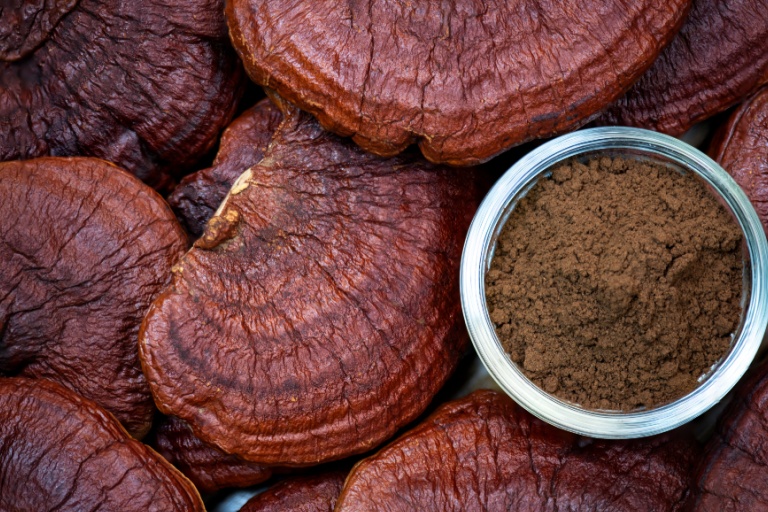
As with many anti-inflammatory herbs in Chinese medicine, the lingzhi mushroom is available today in many forms: dried slices for brewing tea, powdered supplements, tinctures, and concentrated extracts. For those curious to explore traditional wellness practices, the lingzhi mushroom offers an accessible starting point, one grounded in thousands of years of accumulated wisdom.
It is worth noting that while traditional practitioners attribute profound benefits to lingzhi, modern research is still catching up. The best approach is an open and informed one: respect the tradition, stay curious about the science, and listen to your own body.
The spiritual meaning of lingzhi: More than a mushroom
Perhaps the most enduring lesson of the lingzhi mushroom lies not in its biochemistry, but in what it represents.
In the old stories, finding wild lingzhi was never easy. It grew in remote mountains, on ancient trees, in places that required long journeys through difficult terrain. The mushroom’s rarity mirrored the rarity of true wisdom; both demanded patience, dedication, and a willingness to leave the familiar behind. The journey to find lingzhi, as many scholars have observed, was itself a metaphor for the spiritual path: the seeker must venture beyond the comfort of the mundane world to discover something extraordinary.
From imperial courts to mountain hermitages, from physicians’ apothecaries to artists’ studios, the lingzhi mushroom has woven itself into the fabric of Chinese civilization. It stands as a quiet reminder that nature holds gifts for both the body and the spirit if we are willing to seek them with humility and an open heart.
As the timeless wisdom of Laozi teaches, the greatest truths often reside in the simplest things. A lingzhi mushroom growing silently on a mountainside. A story passed from generation to generation. A tradition that continues to nourish, after two thousand years and counting.
The lingzhi mushroom of immortality endures not because it grants eternal life, but because it reminds us that the search for meaning, health, and spiritual depth is itself a kind of immortality.
Follow us on X, Facebook, or Pinterest
