
For more than a century, some Western researchers have tried to investigate reports of unusual human abilities, from extrasensory perception to telekinesis and reincarnation. Organizations such as Britain’s Society for Psychical Research, founded in 1882, brought these subjects into formal study, and a number of universities in Europe and America later explored related ideas as well. Even so, such phenomena have never been accepted by mainstream science.
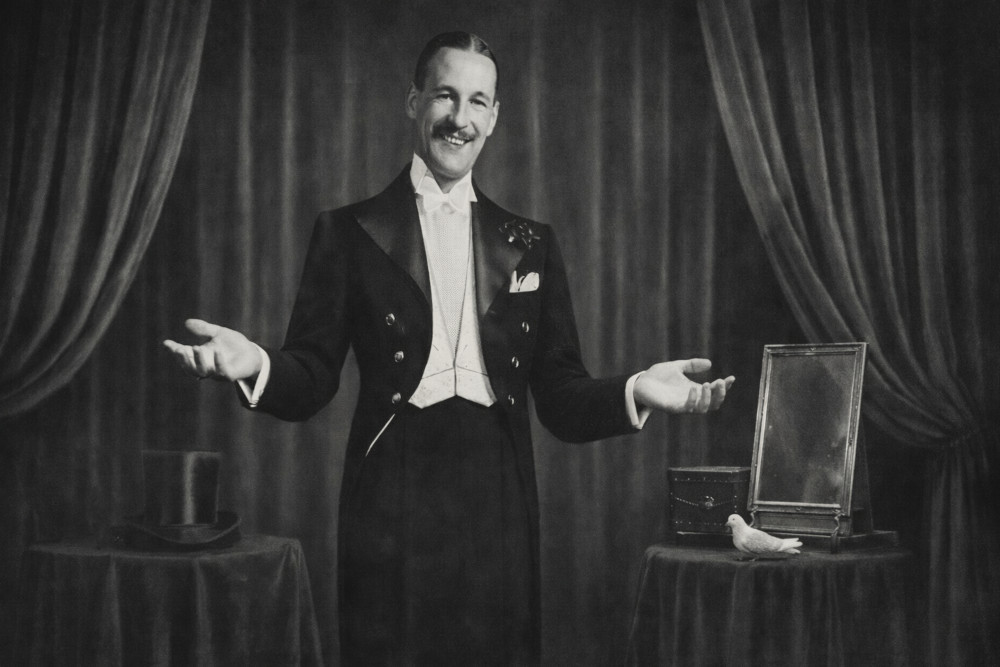
Against that backdrop, stories about Jasper Maskelyne have continued to fascinate readers. To some, he was simply a gifted illusionist from a famous British family of magicians. To others, he was something more — a man whose abilities seemed to go beyond ordinary stagecraft. According to the account that has long circulated around his life, Maskelyne used those extraordinary talents during World War II to help Britain deceive German forces in North Africa.
From stage magician to wartime operator
Jasper Maskelyne was born in 1902 into one of Britain’s best-known magic families. His grandfather, John Maskelyne, was widely regarded as a pioneer of modern magic, and Jasper began assisting his father, Neville, while still a child. By the 1930s, he had become a successful magician in his own right and was admired by London audiences for his showmanship and technical skill.
When World War II broke out in 1939, Maskelyne joined the British military. He was not merely an entertainer in uniform, but a man whose gifts could be turned toward the battlefield. He used his remarkable abilities and ingenuity to perform three astonishing wartime feats, each designed to confuse, mislead, and weaken Hitler’s forces.
How Alexandria was ‘moved’
In 1941, Maskelyne was sent to Egypt, where British forces were struggling against the German army led by Field Marshal Erwin Rommel, the commander later known as the “Desert Fox.” The British position in North Africa was precarious. Supply lines were under pressure, and repeated enemy attacks threatened to cripple Britain’s ability to hold the region.
That May, British intelligence reportedly learned that Germany was preparing a large-scale air raid on the port of Alexandria. Maskelyne, then 39 years old, stepped forward with an audacious proposal: he claimed he could make Alexandria effectively “disappear” and spare it from destruction.
According to the story, he identified a barren site several kilometers away called Mayotte Bay, a place whose terrain and appearance resembled Alexandria closely enough to fool enemy pilots at night. There, his team set up lights that mimicked those of the port and city. Meanwhile, Alexandria itself was blacked out after dark. For eight consecutive nights, German bombers attacked what they believed was Alexandria, only to strike the false target instead.
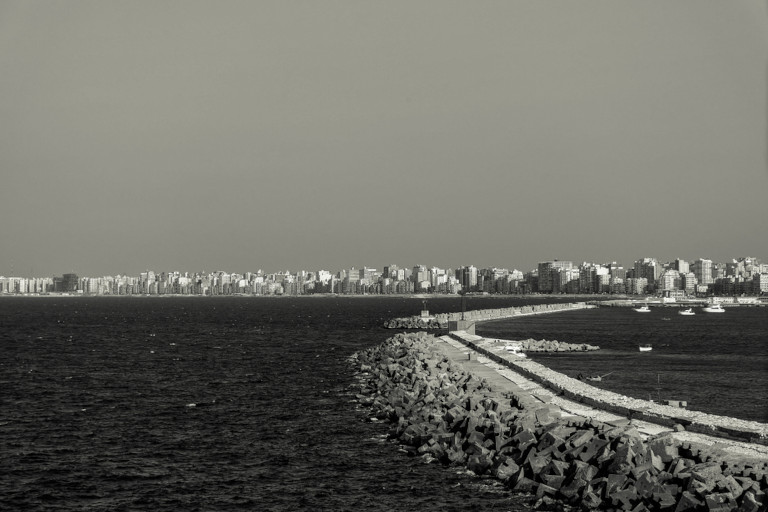
Whether seen as military deception, theatrical brilliance, or something more mysterious, the operation became one of the most dramatic episodes linked to Maskelyne’s name.
How bright light shielded the Suez Canal
The Suez Canal was one of Britain’s most important wartime lifelines, vital to military transport and supply. In September 1941, German forces reportedly planned to bomb the canal and disrupt British defenses, including anti-torpedo protections already installed in parts of the waterway. British planners, faced with the enormous challenge of defending a 175-kilometer canal, settled on an unusual idea: they would try to “hide” it.
Maskelyne is said to have designed 24 enormous fans and mounted them onto searchlights positioned along the canal. The fan blades were made from mirrored glass. As they spun, each light was broken into multiple beams, creating a blinding, shifting curtain of intense white light that shot high into the sky.
When German aircraft arrived over the canal on the night of October 5, Maskelyne ordered the special lights switched on all at once. Pilots were suddenly engulfed in fierce rotating glare that made it nearly impossible to see the ground. Unable to identify their targets, they released their bombs blindly. The account says that after returning to base, frustrated German airmen reported that the British had somehow “hidden” the canal.
The ‘ghost army’ in North Africa
The story grows even more dramatic with the Battle of El Alamein, one of the most decisive battles of the North African campaign. There, Maskelyne is said to have created the illusion of a vast “ghost army,” complete with fake divisions and even a fabricated submarine fleet assembled from wooden boards and discarded materials.
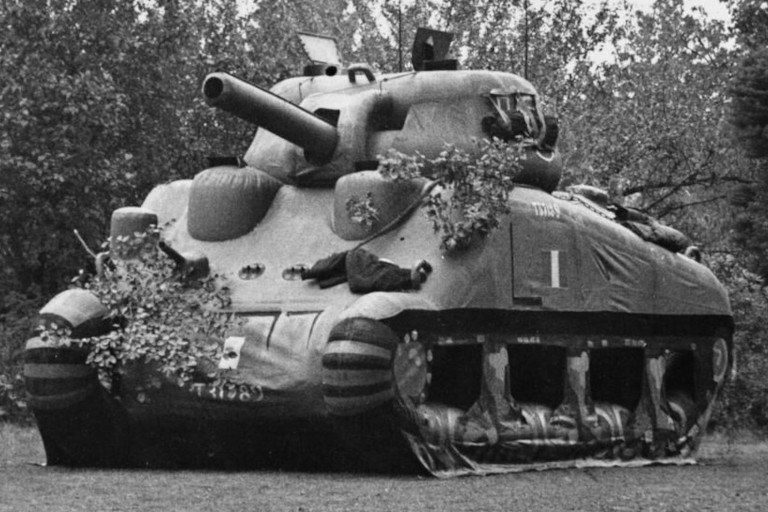
The purpose was simple: convince German forces that the British were stronger, larger, and better positioned than they really were. In wartime, fear and uncertainty can be as powerful as weapons, and these illusions likely helped shake German confidence and alter the course of the fighting in North Africa.
Such exploits, if true, would explain why Maskelyne became a figure of fascination. One account even says the Gestapo hated him enough to place his name on a blacklist for elimination. In this telling, he was no ordinary performer. He was a secret weapon operating in the shadows of war.
A secret revealed only years later
Maskelyne kept quiet about the full extent of what he had done, while British authorities treated these deception efforts as top-secret wartime operations. Because of that secrecy, his achievements were never publicly celebrated during his lifetime, and he received little formal recognition.
Maskelyne died in 1973 at the age of 71. Only later, after American author David Fisher published the biography The War Magician, did these stories reach a wider audience. The book presented Maskelyne as the man behind one of the grandest wartime “magic shows” in history, blending illusion, intelligence, and daring on a battlefield where survival often depended on deception.
Whether one sees Jasper Maskelyne as a master magician, a wartime strategist, or a man with abilities that seemed to defy ordinary explanation, his story remains unforgettable. In an age of tanks, bombs, and brutal military force, he is remembered as someone who fought back with light, illusion, and a talent that many believed was far beyond the ordinary.
Translated by Joseph Wu
Follow us on X, Facebook, or Pinterest
