
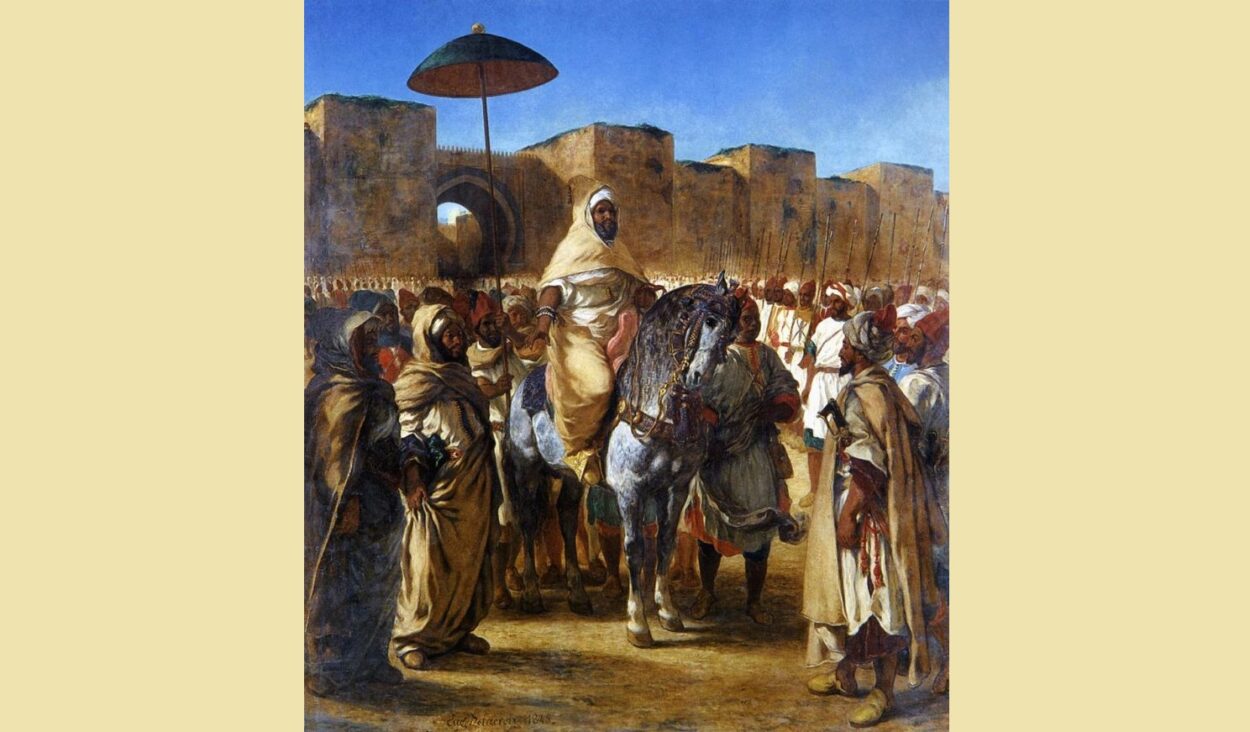
How the Moors — dark-skinned Africans who crossed into Europe in A.D. 711 — built the intellectual, architectural, and moral foundations upon which Western civilization was raised, and how that debt was buried beneath centuries of deliberate forgetting.
Moorish influence on Western civilization is one of the most overlooked forces in history. From science and architecture to philosophy and education, the contributions of African Moors have shaped Europe in ways that remain largely unacknowledged today.
There is a story the modern West tells itself about its own origins. It begins in ancient Greece, moves through Rome, darkens briefly into the Middle Ages, and then miraculously re-illuminates in the Renaissance — as though the light simply returned, as though knowledge wintered in the European soul and bloomed again when the season changed.
The gap in the middle of the story
The story is told in universities, enshrined in curricula, embedded in the architecture of museums. It is told so confidently, so consistently, that most people educated in the Western tradition have never noticed what the story omits.
Seven centuries. An entire civilization. Dark-skinned Africans who paved the streets of Europe’s greatest city with lamplight while London and Paris sat in unlit mud. Scholars — men and women both — who preserved the works of Aristotle, extended the mathematics of the Greeks, developed surgery, astronomy, and philosophy at a time when Christian Europe officially forbade the pursuit of any knowledge that did not confirm ecclesiastical doctrine. A kingdom called al-Andalus, stretching across what is now Spain and Portugal, whose libraries held more books than the rest of Europe combined.
The Moors. The name alone has been stripped of its meaning. What once described a people — primarily black Africans, Moroccan Berbers, a minority of Arabs — has been reduced to a costume, an exotic footnote, a convenient ambiguity. Shakespeare gave us Othello and then let us pretend the Moor was merely a dramatic device. The history books gave us a sentence or two about Islamic Spain and moved on quickly to the Crusades. The gap we experience in the present is almost always one we created in the past. What we do not know, we cannot reckon with. What we cannot reckon with, we repeat.
This article is an attempt at reckoning. Not a revision of history, but a restoration of it — because what was erased was not minor. The foundations of Western science, philosophy, navigation, agriculture, architecture, and the very institution of the university were laid in al-Andalus. And the people who laid them were African.
Who the Moors were and why it has been convenient to forget
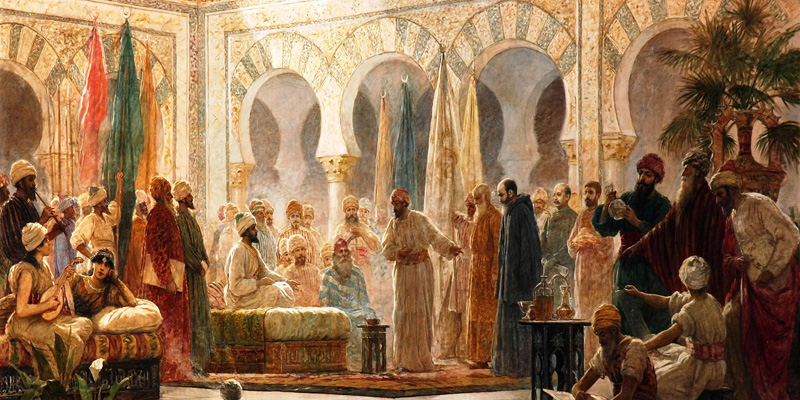
On April 30th, 711 AD, a general named Tariq ibn Ziyad led an army of 7,000 men across the Strait of Gibraltar. Of those 7,000 soldiers, 6,700 were native Africans — Moors, as they came to be called. They landed on a steep coastal cliff, built a fortress on it, and named the site after their general: Gebel Tariq. The Hill of Tariq. Today, we call it Gibraltar.
Within three years, the conquest of Iberia was complete. The Visigoths, who had ruled the peninsula — described by historians of the era as a vigorous but barbaric people who believed in religious compensation for their vices — were defeated. And the Moors proceeded to build something the European continent had not yet seen: a civilization.
The question of who, exactly, the Moors were has been a contested one, and the contest itself is revealing. Historian Dr. Chancellor Williams states it plainly: the original Moors, like the original Egyptians, were black Africans. As intermarriage became more widespread over centuries of conquest and coexistence, the term Moor became more diffuse — applied to Berbers, Arabs, and people of mixed heritage.
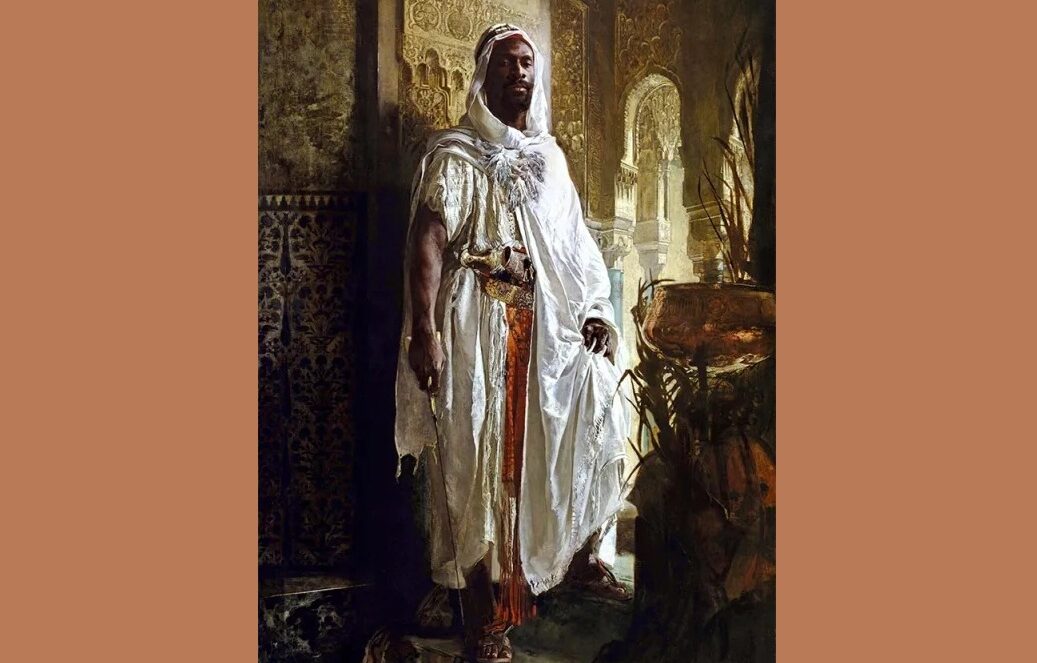
But the armies that crossed with Tariq, the builders who raised the mosques, palaces, and libraries of al-Andalus, were predominantly dark-skinned Africans from territories spanning present-day Morocco, Mali, Senegal, Ethiopia, and Kenya. A European chronicler of the time described them with barely concealed awe: their faces black as pitch, their eyes shone like burning candles, their horses swift as leopards.
This is not a peripheral detail. The civilization that those dark-skinned Africans built over the next eight centuries is the same civilization whose legacy forms the unacknowledged substrate of the Western world. The erasure of that racial identity from the historical record is not an innocent omission. It is the same mechanism — operating centuries before the transatlantic slave trade, before colonialism as we name it — by which the intellectual supremacy of an African people was systematically disconnected from the African identity of the people who created it.
To allow that the foundations of Western science and philosophy were African in origin would require a complete restructuring of the mythology upon which European civilization has built its self-understanding. That restructuring has not yet fully occurred.
Moorish influence on Western civilization: How Africa shaped Europe’s intellectual rise
Before examining what the Moors taught, it is worth spending a moment in the place where they lived — because the physical reality of al-Andalus was itself a form of argument. An argument about what civilization means, and what it looks like when it is actually functioning.
In the tenth century, Córdoba was a city of over 1 million people. Its streets were paved — hundreds of years before Paris had a single paved road, centuries before London had street lighting of any kind. Walking through Córdoba at night, a traveler could cover ten miles under uninterrupted lamplight. The city contained 200,000 homes, 800 public schools, and over 900 public baths. The Great Mosque — the Mezquita — rose from a roof of scarlet and gold, its interior supported by a thousand columns of porphyry and marble, its atmosphere lit by more than two hundred silver chandeliers.
Consider that number: 900 public baths. At a time when the Christian Church of Europe had officially declared bathing sinful — a dangerous exposure of one’s spiritual humors to malevolent forces — the Moors had built nearly a thousand public baths in a single city. They had done so because the Islamic concept of purification held that water was sacred: a clean body, a clean environment, a clean soul. This was not luxury. This was theology made architecture.
Granada, Toledo, Seville, Lisbon — each city a variation on the same theme. Advanced drainage and irrigation systems kept the countryside fertile. Gardens called paradises — a word borrowed directly from the Persian for enclosed garden — graced both public squares and private courtyards. New crops arrived with the Moors from Africa and the East: cotton, rice, sugar cane, dates, ginger, lemons, and strawberries. The waterwheel transformed irrigation and drove machines. The Alhambra in Granada — still standing, still breathtaking — stands as testimony to a level of architectural and hydraulic sophistication that would not be matched in northern Europe for five hundred years.
Historian Basil Davidson writes that there were no lands at that time more admired by their neighbors or more comfortable to live in than the rich African kingdom that took shape in Spain. The inhabitants of Moorish cities in the 12th and 13th centuries enjoyed a style of life that Paris and London would not achieve until centuries later. This is not romantic exaggeration. This is the archaeological and historical record.
What they knew: The Great Transmission
The physical beauty of al-Andalus was not accidental. It was the expression of a system of knowledge, and that system of knowledge was the most important gift the Moors gave to the Western world.
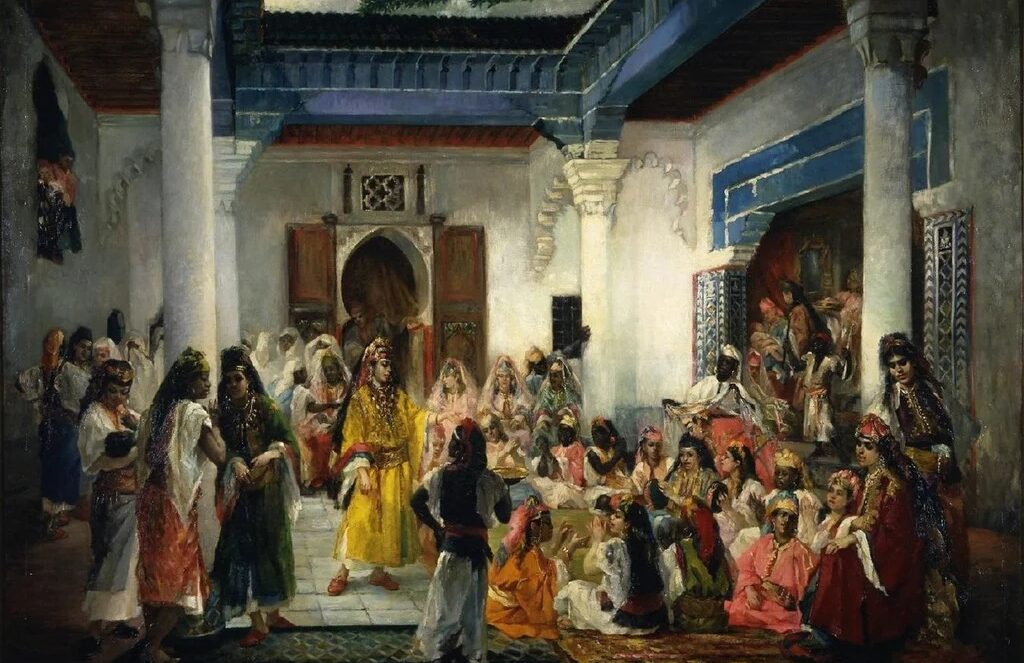
When the Moors arrived in Iberia, they brought with them access to the accumulated wisdom of the ancient world. The works of Aristotle, which Christian Europe had suppressed or lost. The medical texts of the Greeks were preserved and extended by Arab and African scholars. The mathematical knowledge of the Egyptians and Persians. The astronomical observations of centuries. All of it translated into Arabic, codified, elaborated, and diffused through the culturally unified world of classical Islam until it reached the westernmost edge of the known world — al-Andalus — where it was discovered by the scholars of the Christian West and translated into Latin between approximately A.D. 1150 and 1250.
Historian Richard Fletcher describes this transmission directly: The scientific and philosophical learning of Greek and Persian antiquity was inherited by the Arabs in the Middle East, translated and elaborated by Arabic scholars, diffused through classical Islam, and there in Spain discovered by scholars of the Christian West. The rediscovery of Aristotle’s works by this route, Fletcher states, decisively changed the European mind. Newton’s work would have been inconceivable without the mathematical knowledge transmitted through Spain. The medical advances of the seventeenth century were grounded upon Arabic observation and practice.
Education in al-Andalus was universal. John G. Jackson writes that knowledge was accessible even to the most humble, while in Christian Europe, 99% of the population was illiterate — including kings who could neither read nor write. The Moors understood something that the Church, in its monopoly on approved knowledge, actively suppressed: that the free movement of ideas is the engine of civilization. Islam, unlike the ecclesiastical authorities of Christian Europe — who imprisoned Galileo for considering ideas outside prescribed canonical doctrine — accommodated new knowledge with what scholars have described as civilized tolerance. That single difference in intellectual posture is what allowed al-Andalus to become the intellectual capital of the world.
The Moors tarnished the knowledge, and the Jews collected it. The Jews were intermediaries. The Moors and the Christians were fighting each other, and the Jews formed a bridge between them. — John G. Jackson
Women occupied a full and active place in this intellectual life. This fact deserves particular emphasis, given how thoroughly it contradicts the prevailing historical narrative about Islamic societies. In al-Andalus, women were not confined to domestic roles. They appeared in public freely, contributed to literary and scientific movements, and practiced as surgeons, doctors, historians, and philosophers.
This was not an aberration. It was a structural consequence of a society that had genuinely internalized the principle that people of all races and backgrounds were equal in the sight of God — and that principle was not merely preached but practiced in the daily architecture of social life.
The Jewish bridge: How knowledge crossed into Europe
Between the world the Moors built and the world that eventually became modern Europe, there was a crucial intermediary: the Jewish scholars who studied under the Moors and then carried that knowledge northward.
Toledo, Córdoba, and Granada were cities of remarkable interfaith coexistence. For centuries, Muslims, Christians, and Jews had lived side by side in al-Andalus — trading, intermarrying, and in many families blending all three lineages. The Moors had granted the Jews, who had been persecuted under the Visigoths, full consideration and protection. The Jews, in turn, were among the Moors’ most committed allies. When Tariq conquered Toledo in 711, the Jewish population handed over the city and supplied his army with arms and horses.
It was within this context of deep intellectual exchange that Jewish scholars studied under Moorish teachers and absorbed the full breadth of the knowledge the Moors had preserved and developed. They were not, as Jackson carefully notes, the creators of this knowledge. They were its collectors and transmitters. And when they carried that knowledge north — through France, through the Germanic territories, into England — they seeded the institutions that would eventually define Western intellectual life.
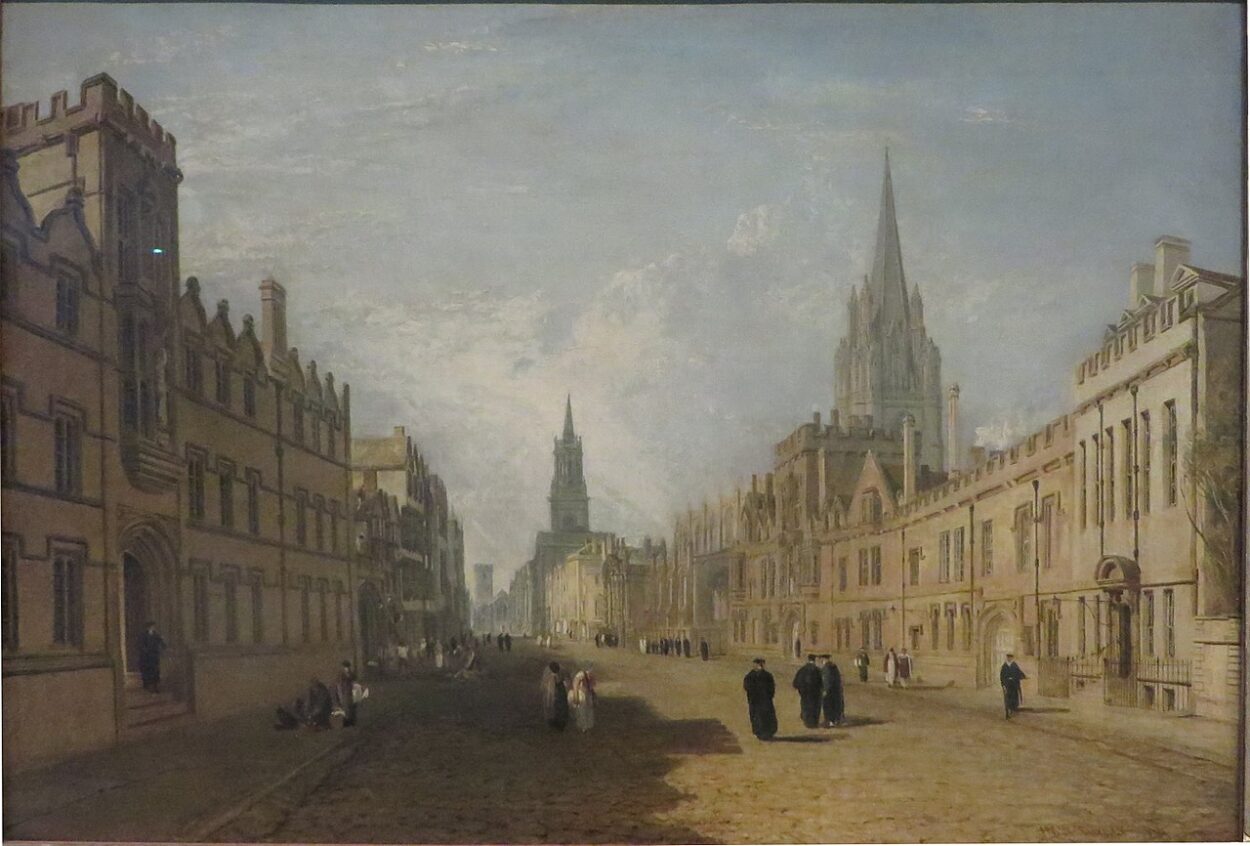
The founding of what became Oxford University has direct roots in this transmission. Jewish scholars trained in the Moorish tradition established a school of scientific learning in England — the institution that would eventually become one of the most prestigious universities in the world — not as an original act of European intellectual creation, but as an act of transplantation. The knowledge was Moorish. The university was its container.
Cambridge followed a similar logic. The great medieval European universities — Paris, Bologna, Oxford, Cambridge — were not born from nothing. They were born of contact with al-Andalus, of the Latin translations of Arabic texts, of the hunger of European scholars who had glimpsed a world of knowledge that their own tradition had forbidden them to seek.
The betrayal at Granada: Where racism was born
Every empire ends. The question is not whether it falls, but how — and what the falling creates. The Moorish Empire in al-Andalus was not destroyed in a single decisive moment. It was worn away over centuries through the Reconquista — the long Christian military and religious effort to reclaim the Iberian Peninsula from Islamic rule. By 1236, Córdoba had fallen. By the late 13th century, only the Kingdom of Granada remained. And on January 2nd, 1492, the last Moorish caliph, Abu Abdallah — known to history as Boabdil — handed the keys of the Alhambra to King Ferdinand and Queen Isabella of Spain.
What happened next was not merely the end of an empire. It was the beginning of a moral catastrophe whose consequences have not yet been fully resolved. Ferdinand and Isabella had given the Moors guarantees. At the moment of surrender, they had promised that the Moorish population could continue their lives, maintain their customs and religion, govern themselves under Moorish courts, and that converts to Islam would not be forcibly reconverted to Christianity. These were the terms of peace. The Moors accepted them.
Within ten years, Queen Isabella abrogated the agreement entirely. Historian John Carew describes her decision plainly: her religious zealotry and appetite for confiscated Moorish and Jewish property overrode any commitment she had made. She appointed Tomás de Torquemada as Inquisitor General. She signed the edict expelling the Jews on March 31, 1492 — the same year Columbus sailed west under a Moorish navigator using a Moorish astrolabe. The moment the ink dried on the expulsion order, the fate of the Moors was also sealed.
Stanley Lane-Poole, writing in the nineteenth century, saw the arc with clarity: with Granada’s fall, all Spain’s greatness fell. For a brief while, the reflected light of Moorish splendor cast its glow on the land. Then came the rule of the Inquisition, and the blackness of darkness into which Spain was plunged ever since. Beggars, friars, and bandits took the place of scholars, merchants, and knights. So fell Spain when she had driven away the Moors.
This precedent established a tradition of treachery and racism that was adopted by all of the European colonizers who came in the wake of the Spanish — and it would endure through the entire colonial era.
The logic of the Inquisition — that a people defined by their faith and their skin could be expelled, enslaved, or destroyed with moral impunity — did not stay in Spain. It traveled. It traveled across the Atlantic with Columbus. It traveled down the coast of Africa with the Portuguese navigators whose knowledge of navigation came from Moorish science. It became the intellectual and moral framework for five centuries of colonialism. The racism that was formally institutionalized at Granada in 1492 was not a European innovation. It was a European choice. A choice to betray, and then to build an ideology that justified the betrayal.
The present gap: What ignorance costs
The Africa of the 21st century is routinely described as a developing continent — the Third World, the aid recipient, the place where civilization has not yet fully arrived. The contrast with the dynamic, technological, intellectually ambitious West is assumed to be natural, as though it reflects something innate in the peoples involved rather than something inflicted upon them.
This framing is not innocent. It is the downstream consequence of a deliberate historical erasure that began at Granada in 1492 and was systematized through the centuries of colonialism that followed. The continent that is today characterized by poverty and underdevelopment is the same continent whose people built the intellectual foundations of Western civilization, kept the flame of ancient knowledge alive through Europe’s Dark Ages, and taught the scholars of England, France, and Germany what it meant to think freely.
The gap between how we see Africa today and what Africa actually contributed to human history is not a gap in Africa’s achievements. It is a gap in our knowledge. And that gap has been maintained, as John Carew writes, not because the Moorish contribution was insignificant, but because acknowledging it would require restructuring the entire mythology of European intellectual and cultural supremacy.
Western scholarship, Carew observes, has characteristically dragged its feet on this question. Very little has been offered within the classroom. Most high school and college students are thoroughly familiar with the classical Renaissance — Michelangelo, Leonardo, the Greeks and Romans — but have never encountered the scientific renaissance that preceded it, the one that happened in al-Andalus in the 12th and 13th centuries, the one carried out by African Muslims who had preserved the wisdom of Egypt and Greece and extended it into new territories of human knowledge.
The consequences of this ignorance are not merely historical. They are present and active. The story we tell about where civilization came from shapes what we believe about who deserves to lead it, who deserves to define it, who belongs at its center, and who belongs at its margins. When that story omits seven centuries of African intellectual supremacy, it does not merely distort the past. It actively licenses the injustices of the present.
What the present requires of us
Understanding is not sentiment. It is not guilt. It is not the performance of historical remorse. Understanding is a structural act — the act of accurately mapping where you are by correctly tracing how you arrived.
The Western world is currently standing in a room whose foundations it did not lay. The scientific method, the university, navigation, advanced agriculture, architectural principles of harmony and proportion, the preserved texts of Aristotle, without which there would have been no Enlightenment — none of these arrived from nowhere. They arrived from al-Andalus. They arrived from Africa. They arrived from the hands and minds of dark-skinned people who built a civilization of such sophistication and beauty that even their conquerors could not destroy it entirely — who built it, and then were expelled from it, and then were systematically written out of the story of what they built.
The Alhambra still stands in Granada. The Mezquita still stands in Córdoba. The streets of Lisbon still hold the shape that Moorish city planning gave them. The music of flamenco and fado carries in its rhythms the unmistakable trace of African melody. The racial diversity of the Iberian Peninsula — the full spectrum from dark to fair that one can still see today in southern Spain and Portugal — is the genetic signature of centuries of coexistence, intermarriage, and shared civilization. The evidence has never disappeared. Only the willingness to look at it honestly has been in short supply.
To understand where we are, we must understand where we came from. And where we came from — all of us who have been shaped by Western civilization — runs through Africa. Through Morocco and Mauritania, through the armies of Tariq, through the libraries of Córdoba, through the scholars who taught the scholars who built the universities that taught the scientists who built the modern world. That is not a peripheral thread in the story. That is the thread without which there is no story.
The gap in the present is always, at its root, a gap in memory. Close the gap in memory, and the present begins to make a different kind of sense.
Follow us on X, Facebook, or Pinterest
