
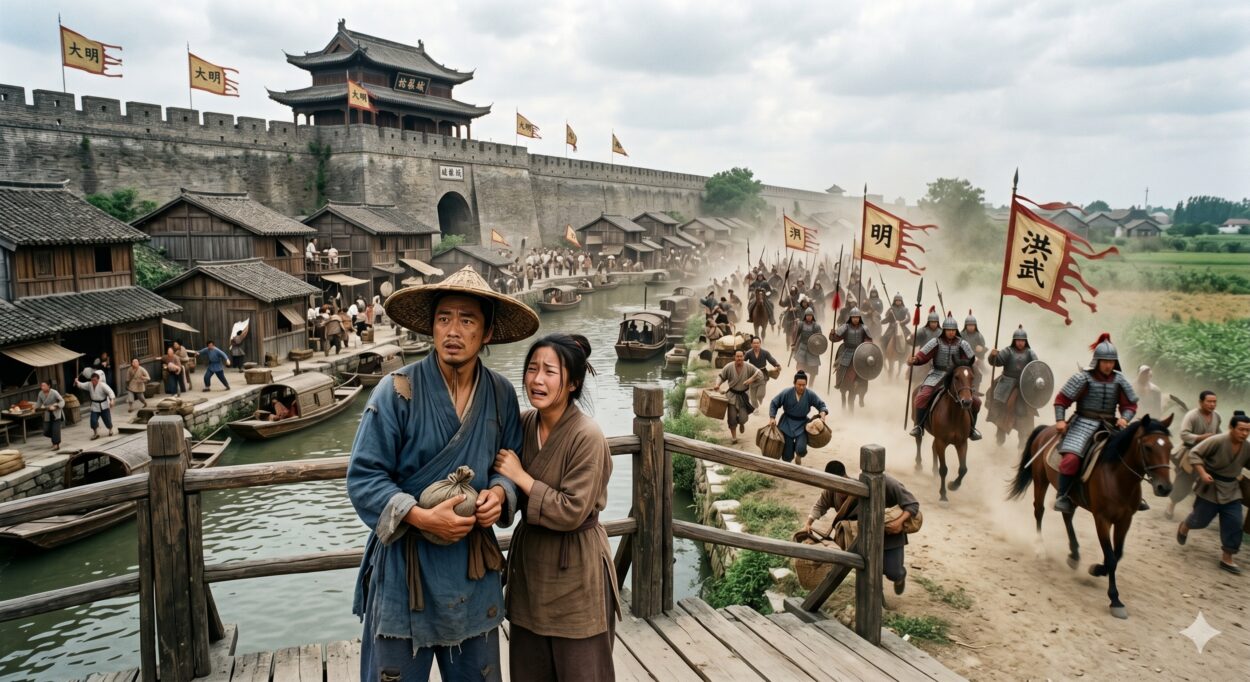
In the early years of the Hongwu era under the Ming Taizu, the mist and rain of Jiangnan could not wash away the smoke of war from the late Yuan and early Ming periods. Jiang Ziqi, a native of Wu (the area around present-day Suzhou), had been happily married for less than three years. He and his wife had been living a peaceful and contented life outside the walls of Gusu City (the ancient city center of Suzhou). However, news of the advancing army hung over the water towns of Jiangnan like dark clouds, and the clatter of weapons and the thunder of hooves soon reached them, shattering their tranquil life in an instant.
Jiang Ziqi fled with his wife to seek refuge, but in the panic of their escape, he accidentally lost track of her. As his wife wandered alone and terrified through the war-torn wilderness, she was spotted by an officer from a detachment of soldiers, who took her back to his official residence in the north. With this separation, all contact between the couple was severed.
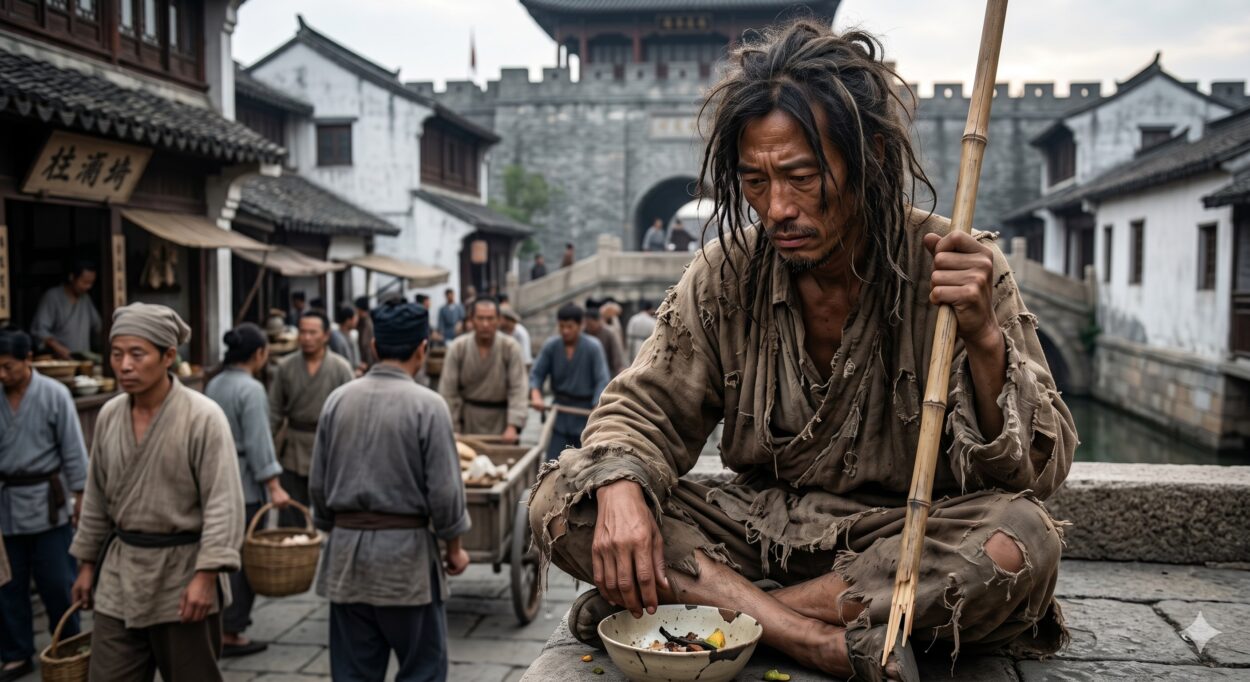
Jiang Ziqi refused to give up. He spent his entire fortune searching every corner of the Wu region, but never found his wife. Eventually, his money ran out, and he became a beggar. With disheveled hair and ragged clothes, he begged while holding a bamboo staff with a broken tip; the scraps of food in his bowl were his only source of strength to keep going. As the seasons changed, Jiang Ziqi journeyed northward, begging his way to the capital. He had no idea that his wife lived in one of the grand mansions in the city.
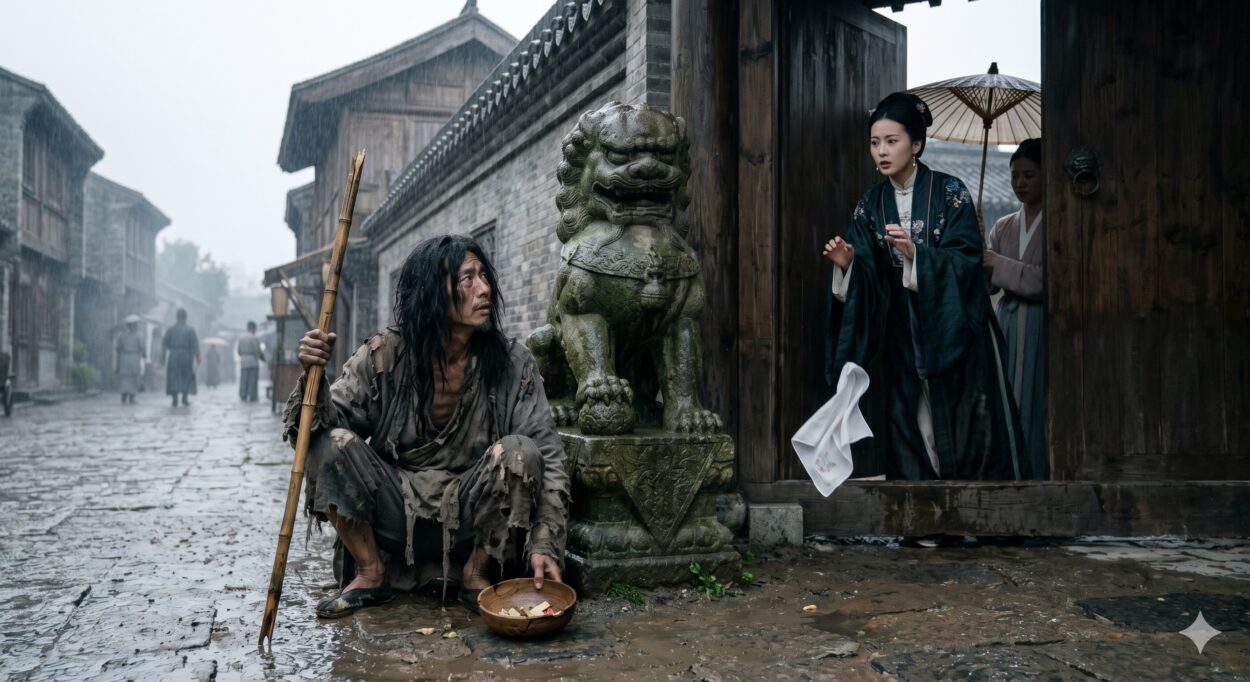
That day, a fine misty rain fell over the capital. He took shelter beside a stone lion at the entrance of a grand mansion. With a sudden creak, the gate swung open, and a woman stepped out. Their eyes met, and the woman was struck as if by lightning; the handkerchief she held slipped from her grasp and fell into the mud.
Jiang Ziqi dared not look upon this noblewoman for long, merely bowing his head in humility. The woman fought back her sobs, turned, and ordered her servants to bring the finest wine, dishes, and cooked rice. She personally packed them into a cloth bag and pressed it into Jiang Ziqi’s arms. Jiang Ziqi felt the bag was heavy with contents; he mumbled his thanks and shuffled away.
The separated couple is finally reunited
The next day, Jiang Ziqi found himself unconsciously back at the door of this household. A woman, who seemed to disregard their social standing, hurried forward to lead him behind the screen wall. “Ziqi… is it really you?” Jiang Ziqi looked up abruptly. As their eyes met, a flood of overwhelming emotions rendered both husband and wife speechless. The immense anguish dissolved into tears of relief. It turned out that this woman was none other than his wife, a mistress of a military officer who brought her back to the capital! He heard her innermost thoughts: Though she had been taken as a concubine, her heart remained true to her husband and homeland.
However, the joy of their reunion was instantly overshadowed by the officer’s lawful wife. This mistress, suspicious by nature, saw the concubine whispering with a filthy beggar and immediately ordered her servants to drive Jiang Ziqi away. Jiang Ziqi fled in panic, but after crossing two streets, he was pinned to the ground by the household servants. They roughly snatched his beggar’s bag; with a clatter, a pair of golden hairpins and a letter fell out along with the food. The servants then took him back to the official residence.
That evening, the military officer returned home. His wife, her face flushed with anger, presented the letter and the golden hairpins, saying: “This woman you brought back has no sense of propriety — she’s been exchanging gifts and consorting with a beggar!” The military officer furrowed his brow as he took the letter, which was stained with mud and water. He had expected to find obscene words, but upon opening it, he discovered a poem written in blood-stained characters:
“My husband remains in Wu and Yue, while I am left in Jiangdong; three years of affection have vanished in an instant. The sunflower, though heartless, still turns toward the sun; the willow catkins, though feeble, drift with the wind. Two streams of tears fall beneath the lonely lamp; my hometown, a thousand miles away, exists only in my dreams. I have always regretted the hardships of those days; now that we meet, I cannot even tell you my name.”
When he read the line “The willow catkins, powerless, drift with the wind,” the military officer’s heart gave a slight tremor. A veteran of countless battles, he knew well the bitterness of separation and turmoil. This woman had lived in the mansion for years without ever vying for favor; she spent her days alone by a solitary lamp, her heart all along yearning for the husband who had once searched for her in the wind and snow.
He looked down at Jiang Ziqi, whose body was shivering uncontrollably, then turned his gaze to the concubine weeping with her face buried in her hands in the inner chamber. In that instant, a wave of compassion welled up in the military officer’s heart. With a sigh, he ordered Jiang Ziqi’s bonds to be cut and summoned the sobbing concubine from the inner chamber, saying: “You were once a loving couple; it was I who brought this upon you.” Far from punishing them, the military officer ordered 50 taels of silver and several shi of rice to be brought forth as travel expenses for the couple, saying: “Go now, return to your hometown in Wu and Yue, and renew your vows.”
Jiang Ziqi and his wife exchanged a glance, as if they were in a dream. They immediately knelt down together and kowtowed, tears streaming down their faces. Beneath the city gates of the capital, the two figures, supporting one another, grew smaller and smaller as they walked away. They were still dressed in simple clothes, but the pair of golden hairpins was tucked tightly against their bodies — a rare source of warmth during their three years of hardship, and a testament to the goodness of human nature.
Translated by Eva and edited by Maria
Follow us on X, Facebook, or Pinterest
