

For 2,000 years, households across China greeted the arrival of summer the same way. They tied bundles of mugwort and calamus above the doorway, let the leaves dry in the heat, and burned a handful at dusk so the smoke could drift through the rooms. They were not decorating. They were defending the house against the fifth lunar month, a stretch of the calendar that tradition named the Poison Month. So it is fair to ask what any modern reader would ask: Is there a genuine natural mosquito repellent buried in this tradition, or only ritual and hope?
The answer is more interesting than yes or no. One remedy that circulates widely today under the banner of old Chinese wisdom does not survive laboratory testing at all. Another, far older and far less famous outside China, holds up so well that researchers have measured it against DEET. This article separates the two. Along the way, it tells the strange story of how a kitchen oil that cannot repel a single mosquito helped shape one of the most widely used insecticide ingredients on earth.
The month China called poisonous
The Dragon Boat Festival (端午, Duanwu) falls on the fifth day of the fifth lunar month, and in traditional reckoning it opened the most dangerous stretch of the year. The heat arrived. So did the humidity, the standing water, the insects, and the fevers that followed them. Chinese folklore gathered these threats into a single image: the Five Poisons (五毒, wudu), usually named as the snake, the centipede, the scorpion, the lizard, and the toad. The month they emerged from hibernation became the Five Poisons Month (五毒月, wuduyue), or simply the Poison Month.
This was not superstition floating free of observation. Before sanitation, before antibiotics, before anyone had connected a mosquito to a fever, early summer really was when households fell ill. People answered with what they had: herbs, scent, smoke, cleaning, and timing. Mugwort (艾草, aicao) and calamus (菖蒲, changpu) went up over the door. Children wore embroidered sachets (香囊, xiangnang) stuffed with dried aromatic herbs. Families bathed in herbal infusions and scrubbed their homes from corner to corner. You can read more about the Dragon Boat Festival and its five protective plants, each chosen for a reason.
Not every custom aged well. Realgar wine (雄黄酒, xionghuangjiu), painted on children’s foreheads to ward off the poisons, is made with arsenic sulfide. It is genuinely toxic. It belongs in the history books, not in your home. But the plants above the doorway were doing something. In 2009, UNESCO inscribed the Dragon Boat Festival on its list of Intangible Cultural Heritage, the first Chinese traditional festival to receive that recognition. What it preserved was not only a boat race. It was a public health ritual, refined across centuries by people paying very close attention to which summers they survived. That instinct, to read meaning and use into the plants at hand, runs through how plants carry meaning in Chinese culture more broadly.

Does sesame oil repel mosquitoes?
No, controlled testing has found that sesame oil provides no meaningful protection against mosquito bites. It lacks the volatile terpenes that give repellent oils their effect. Where sesame oil does appear in commercial repellents, it serves as a carrier base, and the essential oils blended into it do the actual work. The claim has real momentum online. It usually arrives as a story rather than a study: someone’s grandmother, someone’s hiking trip, a post shared on Weibo. Rub a little sesame oil on your arms, the story goes, and the mosquitoes will leave you alone.
Researchers have checked. A 2020 assessment found that sesame oil does not provide significant protection against bites from Aedes aegypti, the mosquito that carries dengue, Zika, and yellow fever. In 2023, a team publishing in Scientific Reports tested 20 essential oils against both mosquitoes and ticks and arrived at the same conclusion by a different route. Oils containing few terpenes, they noted, including soybean, castor, linseed, cottonseed, and sesame oil, do not repel mosquitoes or ticks.
The comparison is unkind. In that test, sesame oil’s duration of protection was statistically indistinguishable from plain, unscented lotion, which kept mosquitoes off for roughly 2 minutes. Clove and cinnamon oil, applied the same way, protected for over an hour. The study’s 10% DEET control was still working after six hours, when the researchers stopped the experiment. Terpenes are the volatile aromatic compounds that lift off a surface and reach an insect’s sensory organs. Sesame oil is nutritionally rich and pleasantly nutty, but chemically it is quiet. It sits on the skin. It does not broadcast. Why does the belief persist? Probably because it feels plausible. The oil leaves a film. It carries a faint scent. And one mosquito-free evening is a persuasive thing to remember, while the many bitten evenings quietly slip from memory.
A note on this article. Nspirement published a version of this sesame oil claim in 2017, drawn from a story circulating on Weibo. Better evidence has since arrived, and it points the other way. We have rewritten the piece rather than quietly remove it, because our readers deserve to know what changed and why.
The grain of truth in the sesame story
Here is the twist. Sesame oil really does have a relationship with insects. It is simply not the one the folk remedy imagined. Sesame seeds contain two compounds, sesamin and sesamolin, that belong to a chemical family called the methylenedioxyphenyls. They do not kill insects. They do not repel them either. What they do is stranger. They act as synergists. An insect exposed to a natural insecticide fights back with enzymes, chiefly a family called cytochrome P450, that break the poison down before it can do lasting harm. A synergist jams that machinery. The insect cannot detoxify. The insecticide remains potent longer, and a much smaller dose becomes lethal.
Sesame oil was among the first synergists anyone identified. Chemists documented sesamin’s synergistic action with pyrethrum insecticides, and by the 1950s a United States patent covered the industrial process for extracting pyrethrin synergists from sesame oil. That same methylenedioxyphenyl chemistry underpins piperonyl butoxide, today the most widely used pyrethrin synergist in the world. It sits inside household insect sprays on shelves in nearly every country. So sesame did leave a permanent mark on how we fight insects. But read the mechanism closely and the folk claim collapses. A synergist makes a poison hit harder. It does nothing whatsoever to stop a mosquito from landing on your arm.
There is something quietly moving about this. The tradition was not foolish. It brushed against real chemistry, in a real plant, with real effects on insects. It simply could not have known which effect, because the tools to find out would not exist for another 2,000 years.
Mugwort: The natural mosquito repellent science supports
Now, the other half of the story, the half almost nobody outside China tells.
What the research found
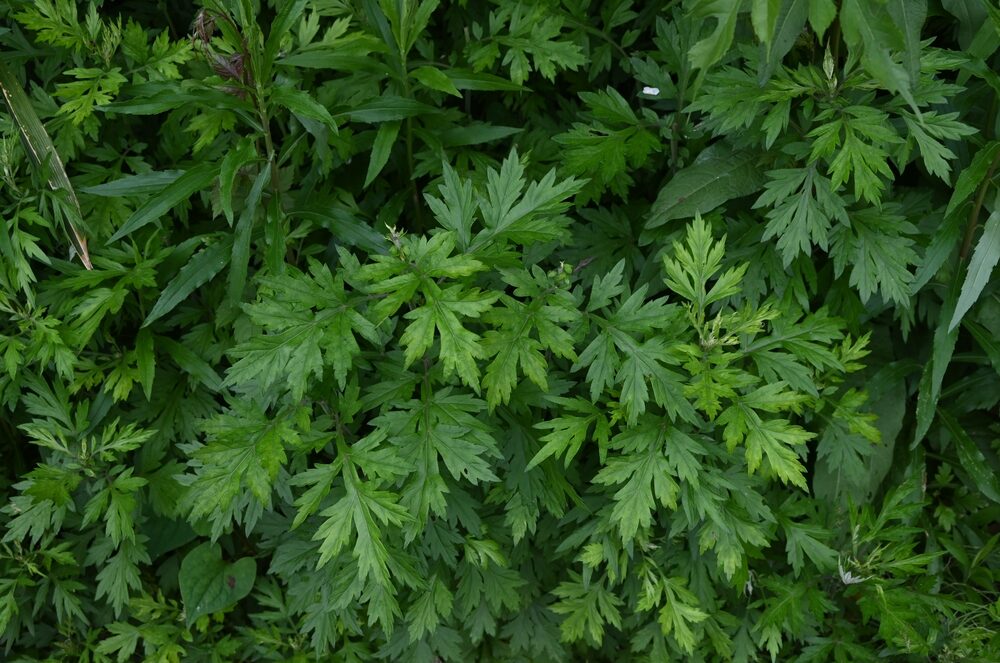
In 2022, researchers publishing in Scientific Reports gathered mugwort (Artemisia argyi) from seven Chinese provinces, distilled the essential oil from each, and tested all seven against Anopheles sinensis, a mosquito that carries malaria. The oil from Gansu province performed best. Its repellency was comparable to 10% DEET, holding roughly 66% protection 65 minutes after application. The same oil knocked mosquitoes down fastest when vaporized, with a median knockdown time of 4.7 minutes. Oil from Hubei province proved to be the most effective larvicide, with a median lethal concentration of approximately 40 µg/mL.
Four compounds turned up in every one of the seven oils: eucalyptol, β-caryophyllene, caryophyllene oxide, and phytol. Eucalyptol, the same compound that gives eucalyptus oil its distinctive character, drove the fumigant effect. Phytol was the most lethal to larvae. And in 2024, a team at Wuhan University, publishing in the Journal of the American Chemical Society, identified intermedeol, a sesquiterpene present in mugwort only in traces, which showed significant repellent activity against mosquitoes and ticks alike.
Hold this result carefully. It is one laboratory study, on one mosquito species, at one moment in time. It is not permission to throw away your repellent in a malaria zone. But it is a striking finding, and it deserves to be far better known than it is.
Why burning it made sense
The researchers did not stumble onto mugwort by accident. They went looking because people were already using it. As they wrote, burning dried Artemisia leaves “has been widely used to repel mosquitoes by minority people living in remote areas in southern provinces of China.” The science followed the folk practice, not the other way around. And burning, it turns out, is a shrewd delivery system. Mugwort’s active compounds are volatile. Heat lifts them into the air and fills a room with precisely the aromatic molecules mosquitoes avoid. A bundle of leaves smoldering by the doorway is, functionally, a fumigant. Readers may already recognize this plant from elsewhere in traditional Chinese medicine. It is the same dried mugwort used in moxibustion, where practitioners apply its slow, penetrating heat to acupuncture points. One plant, two traditions, both built on the same patient observation: this leaf, when it burns, does something.
What actually works today: Repellents backed by evidence
If you are protecting yourself somewhere mosquitoes carry disease, tradition alone is not enough. Mosquitoes kill more people than any other animal on earth, more than 1 million a year. Malaria alone caused roughly 263 million cases and 597,000 deaths in 2023. Dengue reached 6.5 million cases in the same year.
Important. Mosquito-borne illness can be fatal. If you live in or travel to an area where dengue, malaria, Zika, West Nile, or chikungunya circulate, use a repellent registered with the US Environmental Protection Agency (EPA) and speak with a doctor or travel clinic first. Nothing in this article is a substitute for that.
The EPA registers only the ingredients it has evaluated for safety and effectiveness, and the Centers for Disease Control and Prevention (CDC) recommends using one. Here is how the options compare.
| Repellent | Evidence | Protection Time | Notes |
|---|---|---|---|
| DEET, 20 to 30% | EPA registered | Hours; longer at higher strengths | The long-standing benchmark |
| Picaridin, 20% | EPA registered | Hours | Less odor, gentler on plastics and fabrics |
| IR3535, 20% | EPA registered | Hours | Widely used across Europe |
| Oil of lemon eucalyptus or PMD, 30 to 40% | EPA registered | Hours | The only plant-derived repellent the CDC recommends. Not for children under 3. |
| Clove or cinnamon oil, 10% in a lotion base | Promising lab data | Over one hour | Best performers among 20 oils tested in 2023 |
| Mugwort oil | Promising lab data | About 66% at 65 minutes, one species | Comparable to 10% DEET in a single study |
| Sesame oil | Tested; no effect | Same as plain lotion | A carrier, not a repellent |
Two cautions matter more than any figure in that table. First, oil of lemon eucalyptus (OLE) is not the same product as lemon eucalyptus essential oil. The registered repellent, standardized for the compound para-menthane-3,8-diol (PMD), has been tested. The raw essential oil sold on shop shelves has not, and the CDC specifically does not recommend it. The names are nearly identical. The products are not interchangeable. Second, a homemade blend of essential oils is not a formulated natural mosquito repellent. Without a base designed to slow evaporation, the volatile compounds that do the repelling are gone within 15 to 30 minutes, long before you notice you are no longer protected. EPA-registered repellents are considered safe to use during pregnancy and while breastfeeding. Products containing OLE or PMD should not be used on children under 3 years old.
Living with the season, not just spraying it
There is a final lesson in the Poison Month, and it is the one most easily missed. Those old households did not stake their survival on a single magic ingredient. They changed how they lived for a season, leaning on no-cost wellness habits drawn from Chinese tradition that require attention rather than money. They scrubbed the house and threw open the windows. They scented the threshold and the bedding. They bathed in herbal infusions, watched what they ate, and stayed indoors when the air went still and heavy at dusk. That is not folklore. That is integrated pest management, arrived at by observation and handed down as custom.
The modern version is unglamorous and effective:
- Empty anything holding standing water: A bottle cap is enough for a mosquito to breed in.
- Repair the screens: It is the cheapest barrier a house has.
- Run a fan where you sit outside: Mosquitoes are weak fliers and avoid moving air.
- Cover your arms and legs at dawn and at dusk: That is when the biting species are most active.
None of these actions is dramatic on its own. Together, they protect a household better than any natural mosquito repellent used on its own, exactly as they did 2,000 years ago. Traditional Chinese thinking has long approached illness this way, as a matter of balance and season rather than a single enemy to be destroyed. It is one of the places where Eastern and Western medicine picture the body differently. On mosquitoes, at least, the two traditions arrive at much the same advice.

What the tradition got right
Strip the story back and three things remain. Sesame oil does not repel mosquitoes. However warmly the claim is told, and by whoever, the testing is clear, and it is kinder to say so plainly. What sesame does possess is a real and surprising history in insect chemistry, as the synergist that helped pave the way for piperonyl butoxide. The tradition was reaching toward something true and caught the wrong end of it.
Mugwort is the natural mosquito repellent the old Chinese summer was actually built around, and modern research has begun to explain why. Its oil carries eucalyptol, phytol, caryophyllene, and traces of intermedeol. Hung over a door or burned as smoke, it is doing something measurable. In one laboratory, it stood beside DEET. And the deepest protection was never a remedy at all. It was the seasonal habit: cleared water, moving air, covered skin, careful timing.
Ancient wisdom does not ask us to believe everything it says. It asks for a fair hearing. Given one, it turns out to have been paying remarkably close attention all along. That is what makes it worth returning to. Not blind faith, but a long record of people watching carefully and passing on what they learned.
Explore more traditional Chinese wellness practices on Nspirement, and follow us on Facebook, Pinterest, or X for more stories that bridge ancient wisdom and modern life.
Follow us on X, Facebook, or Pinterest
