
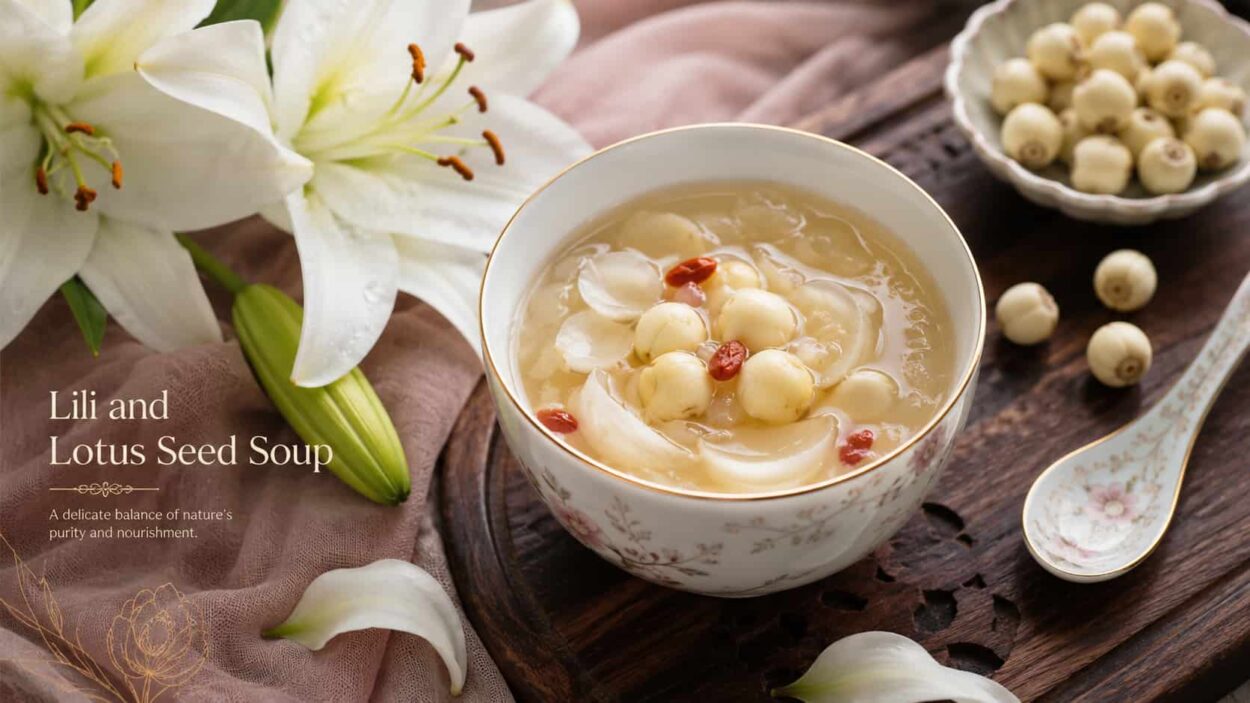
Lily and lotus seed soup is the rare wellness food that asks almost nothing of you — no fasting, no protocol, no faith in anything you cannot taste. You drink it warm, it is faintly sweet, and somewhere in the next hour, your shoulders come down from around your ears. In traditional Chinese medicine, this pairing has been treated for centuries as a quiet, dependable partnership: one ingredient to loosen the tension you have been holding, the other to put back the strength that tension has worn away.
That framing — relax one thing, rebuild another — is older than any clinical trial, and it would be easy to wave away as poetry. But when you set the traditional claims beside what the ingredients are actually made of, the folk wisdom turns out to be unusually well-aimed. Worth understanding before you reach for the rock sugar.
Lily and Lotus Seed Soup was never really a dessert
Most people meet this soup as something sweet at the end of a meal, or as a chilled tong sui on a hot afternoon. The sweetness is real, but it is incidental. In Chinese dietary thinking, lily bulbs and lotus seeds have been paired for generations not because they flatter each other on the tongue but because they were understood to balance one another inside the body — a logic of pairing, not of flavor.
The principle underneath is the one that governs almost all of Chinese food therapy: health is not won by piling on the strongest possible tonic. It is approached by nudging a system that has tipped too far in one direction back toward the middle. Not too much, not too little. The soup is interesting precisely because neither ingredient is dramatic on its own. Their value is in the relationship.
Eating them separately points in one direction. Eating them together creates balance.
Lily bulbs: the part that slows you down
If you have been running hot — irritable, sleeping badly, with a dry throat and a chest that will not quite unclench — lily bulbs are the half of the soup aimed at you. They are not a forceful tonic. They work more like a gentle pressure that eases a system down rather than forcing it up.
In traditional Chinese medicine, lily bulbs are said to moisten the lungs, which is why they turn up in remedies for dry coughs and a parched throat; to calm the mind, which is the language TCM uses for better sleep and a steadier mood; and to clear what practitioners call heart fire — the restless, overheated agitation that keeps you awake when nothing is technically wrong. In plainer terms, lily bulbs are meant to cool the fire and let you take a breath.
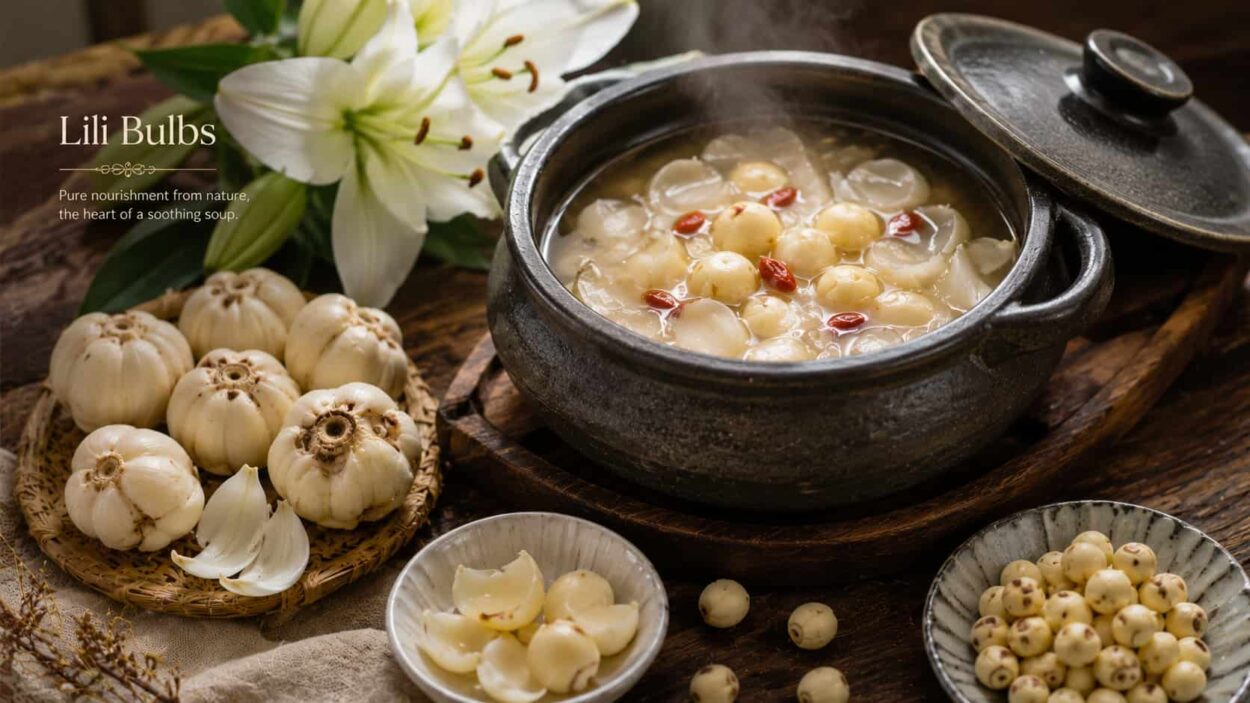
The nutrition does not contradict any of that. Lily bulbs are rich in mucilage — the soft, slippery polysaccharides that account for much of their soothing, moistening quality — along with B vitamins, which support the nervous system, some vitamin C for antioxidant cover, and potassium, which plays a role in regulating blood pressure. None of this is exotic. It is simply consistent with a food that has been used, for a very long time, by people who needed to settle down.
Best suited to: anyone under sustained stress, anyone who overworks their mind, and anyone whose sleep has gone thin.
Lotus seeds: the part that holds you up
If lily bulbs are about relaxing you, lotus seeds are about supporting you. The distinction matters. A great many people are not short on effort — they are short on the physical reserves to keep spending it. Their bodies have been depleted faster than they have been refilled. Lotus seeds are the practical half of this soup: the part meant to rebuild what fatigue has drained.
Traditionally, lotus seeds are used to strengthen the spleen and stomach — the TCM shorthand for shoring up weak digestion — to calm the mind and reduce the kind of fitful, over-dreaming sleep that leaves you tired in the morning, and to replenish energy so that exhaustion is less likely to set in. The idea is stabilization: getting the body to hold steady.
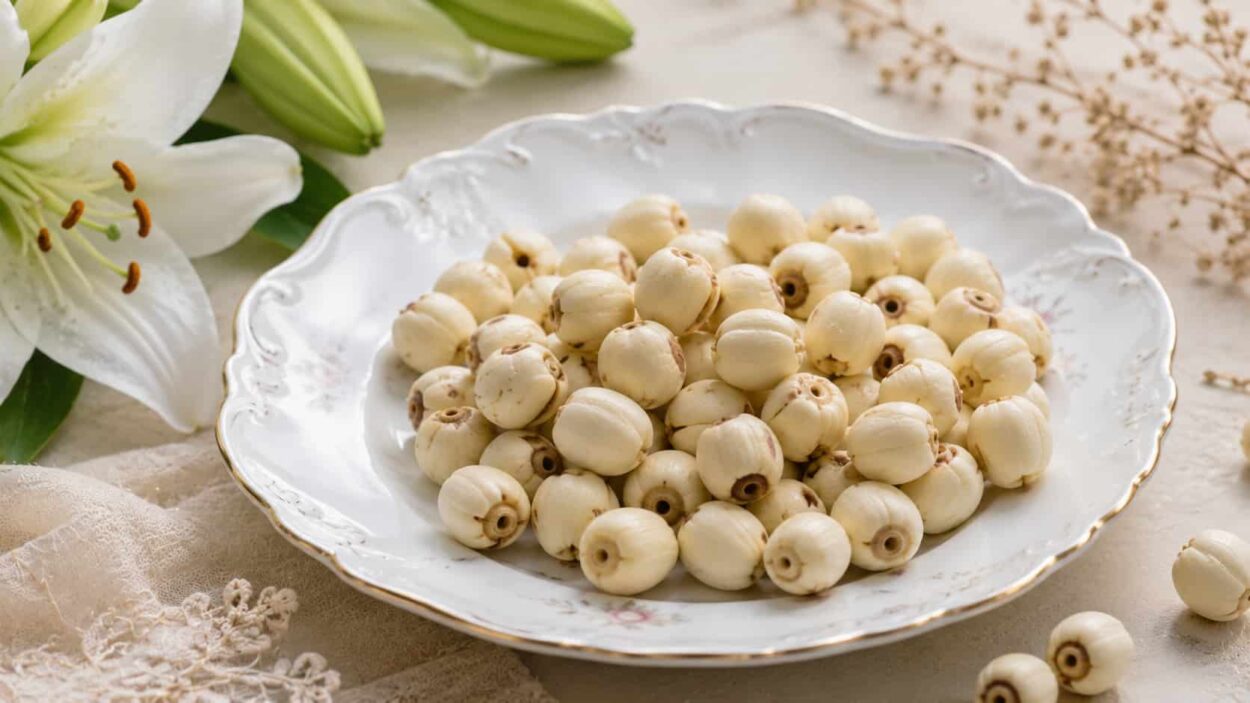
Here, the numbers are striking. Lotus seeds carry roughly fifteen grams of protein per hundred grams — genuinely high for a seed — which gives the body material to repair itself. Their glycemic index sits around forty-five, low enough that the energy they release arrives slowly and evenly rather than in a spike-and-crash. They are rich in phosphorus, magnesium, and potassium, minerals that support nerve function, bone health, and a steady heartbeat. They even contain alkaloids long associated with relaxation and sleep. A food that releases energy slowly and quietly supports the nervous system, is, almost by definition, a food that helps you keep going.
One presses the brakes. The other refuels the tank. The body returns to its track somewhere between the two.
Best suited to: people who tire easily, people with delicate digestion, and people with shallow sleep.
Why they belong in the same bowl
People often ask whether they can simply eat one or the other. They can — but they will get something different, and arguably less. Lily bulbs alone are moistening, cooling, and relaxing; they pull a system in a single direction. Lotus seeds alone are strengthening, stabilizing, supportive; they pull in another. Each is a one-way correction. The point of the pairing is that the two directions meet.
This is the whole philosophy of Chinese food therapy compressed into a single bowl. You are not trying to overwhelm the body with the most powerful ingredient available. You are trying to give it both a brake and a refuel at once, so it can find its own way back to the middle. The soup works not because either half is strong, but because together they are balanced.
Even the gentlest food has to suit your constitution
Mild does not mean universal, and the traditional framework is careful about this in a way modern wellness marketing usually is not. The same cooling quality that makes lily bulbs soothing for an overheated system makes them a poor fit for someone whose digestion already runs cold — anyone with a weak, easily upset stomach, or a tendency toward loose stools, should go easy on them. Lotus seeds, meanwhile, are slightly astringent, the very quality that steadies digestion, which means anyone who struggles with constipation should keep their portion modest.
The tradition also offers a couple of small adjustments that double as a lesson in how the system thinks. Lotus seeds contain a bitter green core, the plumule. If you dislike the bitterness, or your spleen and stomach tend to run cold, you can remove it. But if you have been feeling especially irritable or overheated, leave the core in — it is precisely the part credited with clearing heart fire. The same ingredient, prepared two ways, for two different states of the same body.
A common refinement is to add a few red dates and a scattering of goji berries. They warm the soup’s cooling nature, round out the sweetness, and make the whole thing gentler and easier to absorb — a small hedge against the lily bulb’s coolness.
- Cold-prone digestion: lily bulbs are slightly cooling, so use a lighter hand.
- Prone to constipation: lotus seeds are mildly astringent, so keep the portion small.
- Feeling irritable or overheated: keep the bitter lotus core in to help clear heart fire.
- Want a warmer, more rounded soup: add red dates and goji berries.
None of this is a cure, and the tradition is honest enough never to have claimed it was. It is dietary support — the kind you reach for when a stressful stretch is coming, and you can feel your sleep about to fray, not the kind you use to treat anything a doctor has diagnosed. The soup’s real intelligence is its restraint. It does not promise to fix you. It offers a brake and a refuel, in roughly equal measure, and trusts your body to do the rest.
Which may be why it has outlasted every wellness trend that ever shouted louder. Health, in this older view, was never about the most aggressive intervention. It was about being just right — and a bowl of faintly sweet soup, asking almost nothing of you, has been quietly making that argument for centuries.
Based on translation by: Cecilia
Follow us on X, Facebook, or Pinterest
