

Few consumer brands are as closely connected to an everyday routine as Colgate. Its familiar red-and-white toothpaste packaging can be found in bathrooms, supermarkets, and convenience stores around the world.
More than two centuries after its founding, Colgate remains the global leader in toothpaste. During the first quarter of 2026, it held 41.1 percent of the worldwide market.
Yet toothpaste played no part in the company’s beginnings. Colgate started as a small New York business producing starch, soap, and candles.
The story begins with an English immigrant named William Colgate.
From England to America
William Colgate was born in Kent, England, in 1783. His father, Robert Colgate, was a farmer who sympathized with the republican ideals associated with the American and French revolutions. His outspoken political views reportedly placed him at risk of prosecution, prompting the family to leave England in 1798 and settle in Maryland, near Baltimore.
Robert entered a partnership that produced soap and candles, giving the teenage William some of his earliest experience in the trade. The venture lasted only a few years, however, and Robert eventually returned to farming.
William later left Maryland for New York City, where he found work with a soapmaker and learned more about the business. In 1806, at the age of 23, he opened his own workshop on Dutch Street in Lower Manhattan.
Operating under the name William Colgate & Company, the business produced starch, soap, and candles. It was a modest operation without the international distribution network or household-name products that would define the company generations later.
Its most valuable asset was its founder’s reputation.
A family name becomes a brand
By conducting business under his own name, William tied his personal reputation to the quality of the goods he sold. Customers who purchased soap, starch, or candles from William Colgate & Company knew who stood behind the products.
That connection became increasingly important as the business expanded. Colgate’s first known newspaper advertisement appeared in New York in 1817. By 1820, William had established a starch factory across the Hudson River in Jersey City, New Jersey.
The company gradually developed a reputation for reliable household products. Although its future would eventually lie in personal care, Colgate remained primarily a manufacturer of soap, starch, and candles throughout William’s lifetime.
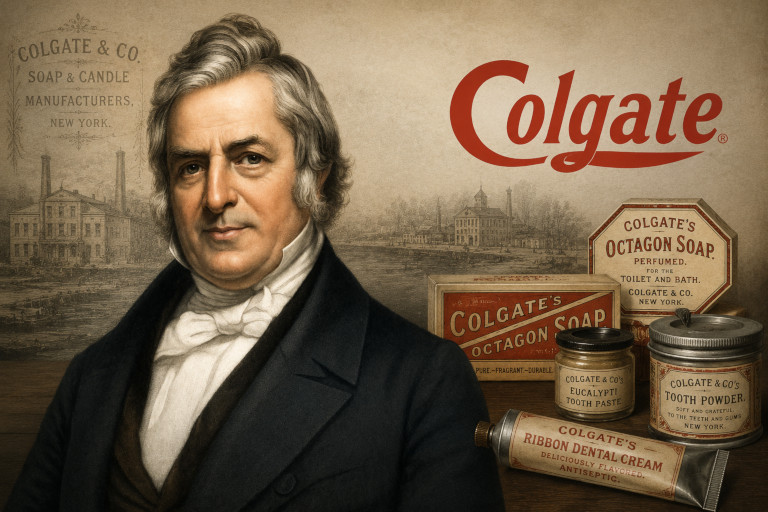
His business principles were closely connected to his religious convictions.
Faith and philanthropy
William came from a Baptist family and was baptized in New York in 1808. He became an active Baptist layman and supported churches, missionary work, Bible societies, and religious education.
A story later repeated in Baptist biographies describes an encounter that shaped his approach to both business and money. According to the account, a canal-boat captain advised the young William to make honest soap, give customers full measure, and devote one-tenth of his earnings to God.
William reportedly began setting aside a tenth of his income while he was still earning a modest wage. As his business prospered, he increased his charitable giving and became a major supporter of Baptist institutions and humanitarian causes.
His family developed especially close ties to the Baptist school that eventually became Colgate University. William supported the institution for decades, and his sons James and Samuel continued that support after his death. In 1890, the school adopted the Colgate name in recognition of the family’s contributions.

For William, commercial success appears to have carried responsibilities beyond personal enrichment. Honest dealings, dependable products, and generosity became closely associated with both his life and the company bearing his name.
The business passes to a new generation
William Colgate died in 1857, more than 50 years after opening his Dutch Street workshop. His son Samuel assumed leadership, and the business was reorganized as Colgate & Company.
By then, Colgate had grown well beyond its modest beginnings, but it was still primarily known for soap and other household products. The company expanded into perfumes and perfumed soaps during the 1860s, and Cashmere Bouquet became one of its best-known brands.
Toothpaste did not enter the product line until 1873, nearly seven decades after the company was founded.
Even then, Colgate toothpaste looked very different from the product sold today. Rather than coming in a squeezable tube, the dental cream was packaged in a glass jar. Customers had to dip their toothbrushes into the container, which made it less convenient and less sanitary than modern toothpaste.
Tooth powder also remained widely used, and Colgate’s new dental cream had not yet become the company’s defining product.
That would change with an idea inspired not by dentistry, but by how artists stored their paint.
See Part 2 here
See Part 3 here
Translated by Eva
Follow us on X, Facebook, or Pinterest
