

When William Colgate died in 1857, the company’s leadership passed to his son, Samuel. The business was reorganized as Colgate & Company and continued expanding beyond the starch, soap, and candles with which it had begun.
During the 1860s, Colgate introduced perfumes and perfumed soaps. In 1872, it registered the Cashmere Bouquet trademark, establishing a brand that would remain on the market for generations.
The following year, the longtime soapmaker entered the business that would eventually define its name.
Colgate enters the toothpaste market
In 1873, Colgate introduced an aromatic dental cream packaged in glass jars. Tooth powder remained common at the time, and the new product offered no clear advantage in convenience.
Using toothpaste from a jar could also be messy and unsanitary. Members of a household might dip their toothbrushes into the same container, and the heavy glass packaging was awkward to store and transport.
A better solution emerged through the work of Connecticut dentist Washington Sheffield and his son, Lucius Tracy Sheffield.
While visiting Paris, Lucius noticed that artists stored paint in collapsible metal tubes. He realized that the same type of container could be used to dispense toothpaste directly onto a toothbrush.
Washington Sheffield began selling toothpaste in collapsible tubes in the early 1890s. Colgate adopted the idea soon afterward, introducing Colgate Ribbon Dental Cream in a tube in 1896.
The new packaging was cleaner, lighter, and easier to use than a glass jar. It also made toothpaste easier to manufacture, distribute, and advertise. Over time, tubes helped dental cream replace much of the tooth-powder market.
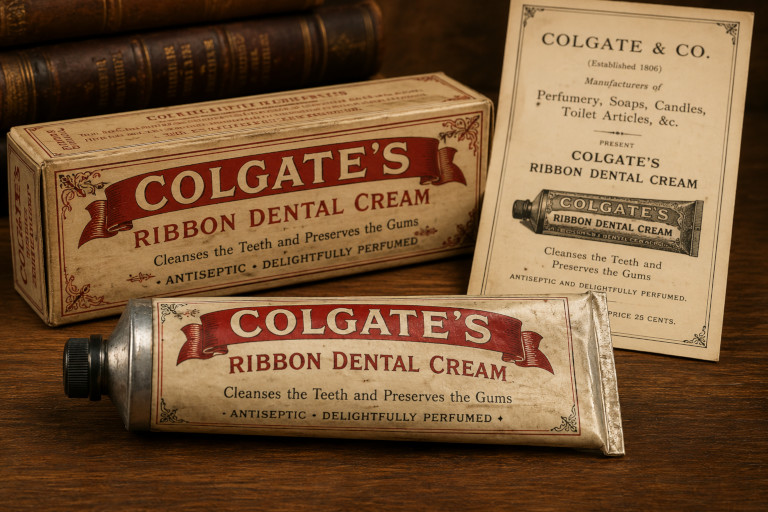
The year 1896 also marked another important development for Colgate. The company hired chemist Martin Ittner, who established an applied research laboratory and brought a more systematic scientific approach to product development.
The creation of Colgate-Palmolive
While Colgate was expanding its personal-care business, another major soap company was growing in the Midwest.
The B.J. Johnson Soap Company introduced Palmolive soap in 1898. Its name came from the palm and olive oils used in the formula, and it became one of the best-selling soaps of its era.
Palmolive merged with the Peet Brothers soap company in 1926, creating Palmolive-Peet. Two years later, Colgate merged with Palmolive-Peet to form the Colgate-Palmolive-Peet Company.
The business shortened its name to Colgate-Palmolive Company in 1953.
The merger gave the company a broader range of household and personal-care products. It also placed Colgate in increasingly direct competition with Procter & Gamble, another major manufacturer whose early success had been built on soap.
Radio became one of the most visible battlegrounds.
How soap operas got their name
During the 1920s and 1930s, radio became a central form of entertainment in American homes. Serialized daytime dramas attracted devoted audiences by carrying emotional storylines from one episode to the next.
Manufacturers recognized that the programs were especially effective at reaching women who made many of the household purchasing decisions. Soap and cleaning-product companies began sponsoring or producing the dramas, filling the broadcasts with advertisements for their brands.
Procter & Gamble, Colgate-Palmolive, Lever Brothers, and other manufacturers all became associated with daytime radio serials.
The link between the programs and their sponsors became so strong that they acquired the nickname “soap operas.” The “soap” referred to the products being advertised, while “opera” humorously described the exaggerated emotions, romantic complications, and continuing drama.
The rivalry between Colgate and Procter & Gamble extended across many products, but its most consequential chapter would be fought over toothpaste.
Crest changes the market
In the 1950s, Procter & Gamble introduced Crest, a toothpaste containing stannous fluoride. The formula grew out of years of research by scientists at Indiana University who were studying how fluoride could reduce tooth decay.
In 1960, the American Dental Association recognized Crest as effective in helping prevent cavities. The endorsement gave the product a major scientific and marketing advantage.

Crest’s sales nearly tripled within two years, and by 1962, it had become the best-selling toothpaste in the United States.
Colgate had long benefited from familiarity and strong distribution, but Crest offered consumers a specific medical benefit supported by scientific research. Cavity prevention became central to toothpaste advertising, and Colgate could no longer depend on its established name alone.
The company responded by investing more heavily in research and expanding the benefits associated with its products.
In 1968, Colgate added MFP fluoride to its toothpaste to strengthen its cavity protection. Later formulas targeted tartar, plaque, gingivitis, and bad breath.
Rather than competing solely over cavity prevention, Colgate broadened the meaning of oral care.
A more comprehensive approach
One of the company’s most important products was Colgate Total, introduced internationally in 1992 and in the United States in 1997.
Colgate Total was marketed as providing protection against several oral-health concerns, including cavities, plaque, gingivitis, tartar, and bad breath. It quickly became one of the company’s leading products.
Colgate also benefited from an international presence built over many decades. The company established its first foreign subsidiary in Canada in 1914 and expanded into Europe, Asia, Latin America, and Africa during the following years.
Crest had overtaken Colgate in the United States during the early 1960s, but Colgate developed a much larger position worldwide. By the first quarter of 2026, it held 41.1% of the global toothpaste market.
The struggle with Crest demonstrated how quickly scientific innovation could disrupt even a long-established brand. Colgate responded not by abandoning toothpaste, but by redefining what toothpaste could offer and extending its reach worldwide.
By then, however, Colgate-Palmolive had also entered a very different field — one whose origins could be traced to a veterinarian, a kitchen stove, and a guide dog suffering from kidney disease.
See Part 1 here
See Part 3 here
Translated by Eva
Follow us on X, Facebook, or Pinterest
