
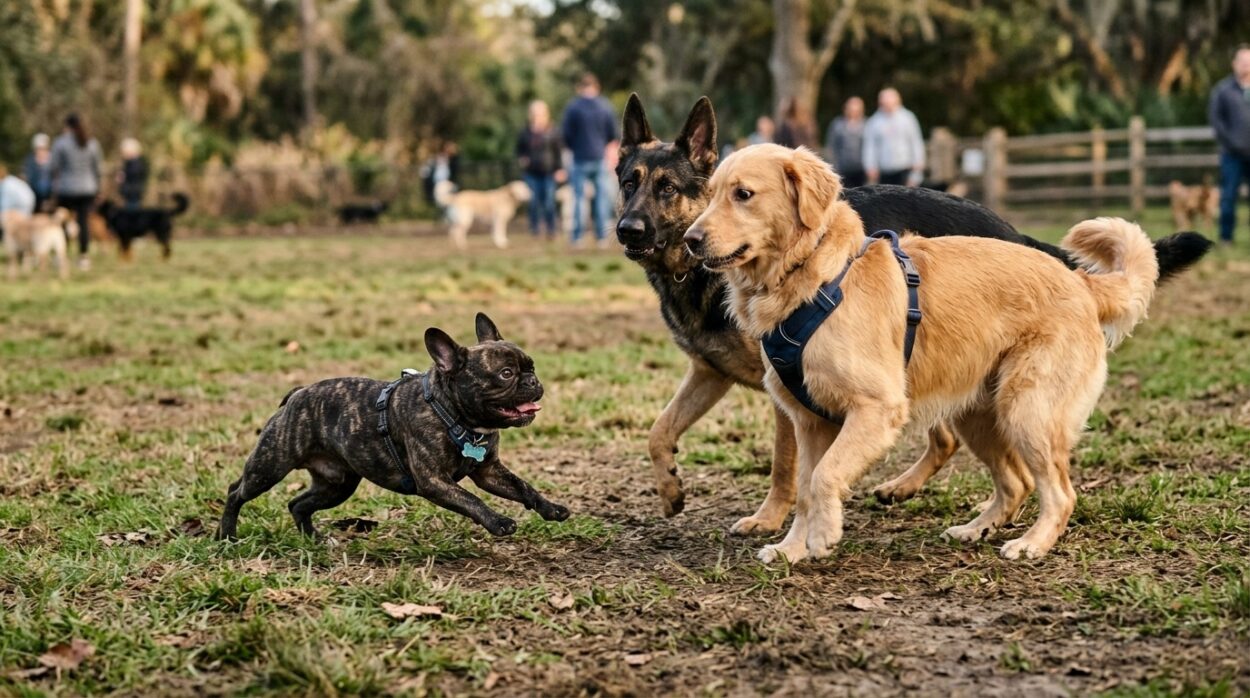
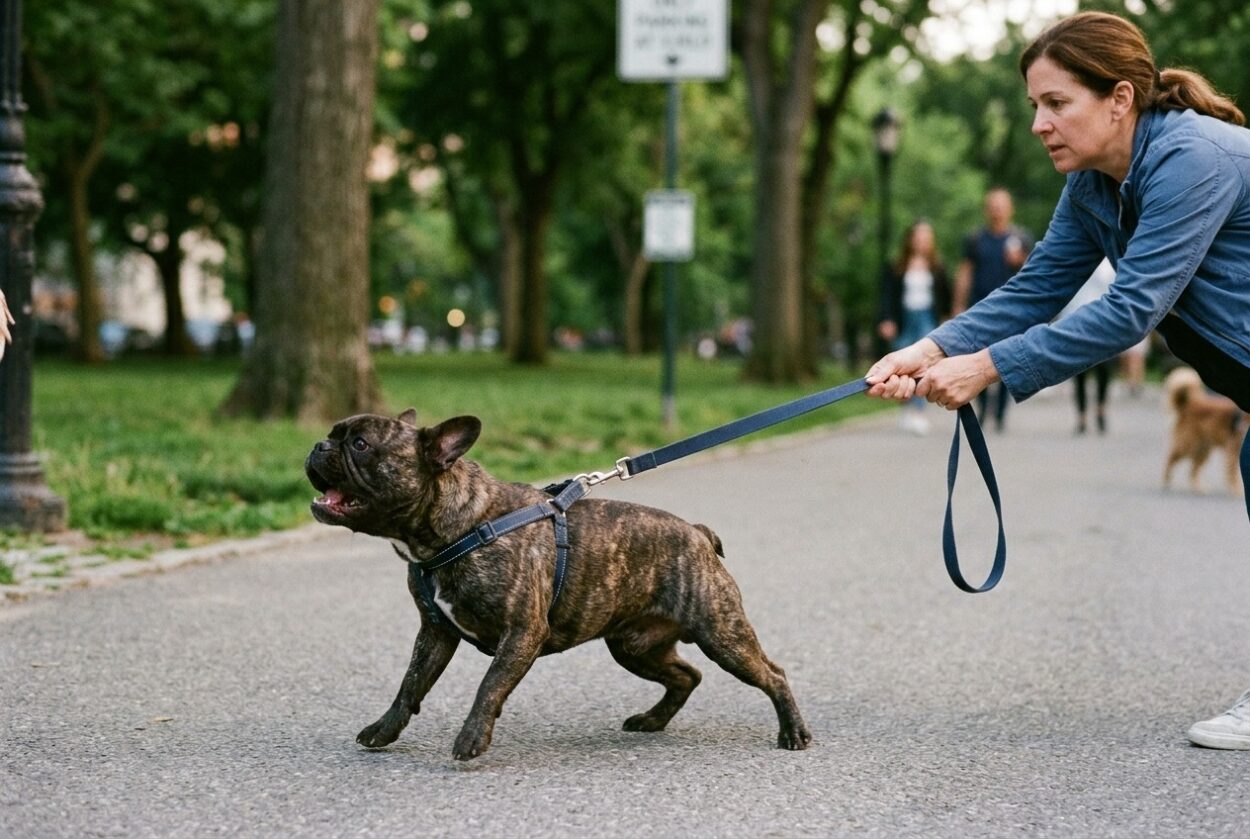
My French Bulldog charges at dogs twice his size. So I asked artificial intelligence for help — and it sent me somewhere more useful than I expected.
In my case, AI dog training starts with a compact, bat-eared dog who didn’t get the memo about his own breed. French Bulldogs are supposed to be easygoing, calm companions — that’s the common wisdom, anyway. Our Frenchie never got the briefing. From puppyhood, he’s treated every stranger on the street and every approaching dog as a personal threat, launching forward with an energy that suggests he has no idea he fits inside a handbag.
It was funny at first. Then it became exhausting. Then I started thinking: if AI can help plan a diet, structure a business strategy, or debug code — surely AI dog training is possible too. It is. But getting genuinely useful help from an AI requires understanding a few things first: what’s driving your dog’s behavior, which training philosophy you should follow, what a solid training plan looks like, and how to structure your prompts so the output is tailored to your dog. This is what I found out.
Why your dog charges at everything — and what it isn’t
Reactivity — the lunging, barking, and defensive behavior directed at strangers or other dogs — is commonly mislabeled as aggression or dominance. In most cases, it is neither. Canine behavior specialists describe reactivity as an exaggerated response to a stimulus, usually rooted in fear or overstimulation rather than a desire to harm. For French Bulldogs specifically, the most common forms are fear-based reactivity triggered by unfamiliar people or animals, and resource guarding. Neither is a personality flaw, and both respond well to the right approach.
One thing worth doing before starting any training program: rule out physical causes first. French Bulldogs are prone to ear infections, and untreated ear pain is a documented hidden driver of defensive behavior in the breed (Only French Bulldog). A dog in discomfort will react defensively to its surroundings. A vet check — ears, joints, general health — should come before any behavioral work begins.
The training philosophy that actually holds up to scrutiny
Two broad schools of dog training exist, and they are not equally effective.
The older approach, dominance-based training, rests on the idea that dogs operate within pack hierarchies and that owners must establish themselves as the “alpha.” This model is built on research into captive wolf groups that has since been thoroughly discredited. The wolves studied were strangers forced together — not natural family units — and the hierarchies observed were artifacts of that stress, not normal wolf society. Scientific consensus has moved on, and the researchers whose original work suggested the dominance model have publicly stated it should not apply to domestic dogs (Where Sit Happens, 2025).
The more serious problem with dominance-based methods is what they can do to a reactive dog. Punishing or using aversive correction on a dog that growls doesn’t address the fear behind the reaction — it suppresses the warning signal. Canine behavior specialists note that dogs trained with aversive techniques often stop growling and go straight to biting because they’ve learned that expressing discomfort isn’t safe (JustAnswer). You remove the symptom and make the root problem harder to see.
An evidence-based alternative is positive reinforcement: reward the behavior you want rather than punish the behavior you don’t. A peer-reviewed study published in Frontiers in Veterinary Science (2021) found that reward-based training carries the lowest risk of harm among training approaches, encourages positive emotional states in dogs, and builds stronger trust between the dog and its owner (NCBI). The RSPCA endorses this as its official position on dog training. This matters when you use AI. AI tools will sometimes offer techniques from multiple traditions unless you tell them not to. Knowing your framework before you open a chat window means you can evaluate — and filter — the output.
What a solid dog training plan actually contains
Before you ask any AI to build you a training schedule, it helps to know what a good plan should include. You need something to measure the output against.
- A specific end behavior: Calmer around strangers” is too vague to train toward. “Remains in a sit position when a stranger passes within three meters without lunging or vocalizing” is something you can observe, test, and mark as achieved or not.
- A realistic timeline: Reactivity is one of the more involved behaviors to address. Progress happens over weeks and months, not days. Question any plan that promises transformation in a week.
- Progress benchmarks: You need markers between start and finish. For a reactive dog, a benchmark might be “can hold attention on owner when another dog is visible at fifteen meters” by the end of week two. These give you honest information about whether the approach is working, and they tell you when to move forward versus when to stay at the current level.
- A desensitization and counter-conditioning protocol: For reactive dogs, this is the core mechanism. It involves exposing your dog to the trigger at a low enough intensity that they notice it but don’t react — and pairing that exposure with something genuinely positive: treats, play, or calm praise. Over time, the dog’s emotional association with the trigger shifts. This is gradual work, and the temptation to move too fast is the most common reason the process stalls (Dog Bizness).
- Consistency guidelines: Training outcomes depend on predictable signals: the same verbal cues each time, the same hand signals, the same reward. A good plan makes this explicit rather than leaving it to assumption.
- A way to track and adjust: Log progress — what worked on a given day, what didn’t, and how your dog responded to a new environment or a particularly challenging trigger. Training is iterative. The log is where you make sense of the pattern.
How AI dog training tools actually work — and where they fall short
AI tools — ChatGPT, Claude, and others — can generate highly personalized training plans with the right inputs. They can produce week-by-week schedules, explain the reasoning behind each step, suggest exercises for specific behaviors, and revise their advice when you report back on what happened (Playbooks; DocsBot).
What they cannot do is observe your dog. The plans an AI produces are only as accurate as the information you give it. AI can’t read body language, track energy patterns throughout the day, or identify the specific sequence of events that precedes a reaction. For moderate reactivity in an otherwise healthy dog, AI-assisted planning can be genuinely useful. For severe cases — where behavior poses a real safety risk — a certified applied animal behaviorist who can assess the dog in person is the right call.
Think of AI as a well-read planning assistant, not a trainer. It can structure your approach, help you understand the science, and adapt a schedule to your daily life. It cannot replace the feedback loop of live observation.
How to use AI dog training to build a plan that fits your dog
The difference between a generic response and a truly tailored plan comes down almost entirely to how specific your prompt is. Here is a structure that produces useful output.
- Start with a full dog profile: Breed, age, size, and a precise description of the behavior: “My two-year-old male French Bulldog, roughly 12 kg, lunges and barks at strangers and unfamiliar dogs on the lead. He is especially reactive when approached head-on or when the other dog is larger than him. He has no history of biting and lives with one other adult.”
- Add your own constraints: How much time per day you can realistically dedicate to training. Your experience level with dog training. What equipment you have — lead, long line, treat pouch. Whether other household members will be involved and how consistent they can be.
- Set a philosophy filter explicitly: Don’t leave it to chance. Write: “Use only positive reinforcement and desensitization-based methods. Do not recommend corrections, prong collars, punishment, or any aversive techniques.”
- Specify the output format: Produce a four-week training schedule with daily 15-minute sessions. For each week, list the specific behavior to work on, the cues and rewards to use, and the observable benchmark I should reach before moving forward.
- Close with a feedback instruction: After each week, I will paste my notes on what worked and what didn’t. Please revise the following week’s plan based on my report.”
That last line is what turns a one-time AI response into an adaptive system. The AI can adjust the difficulty, change the sequence, or suggest an alternative approach based on your actual results — rather than handing you a fixed plan and leaving you to figure out what to do when things don’t go as written.

Why a custom GPT is worth setting up
A standard ChatGPT or Claude conversation starts fresh every time. You have to re-explain your dog, your situation, and your history at the start of each new session. For a two-week project, that’s manageable. For a training program running over several months, the repetition adds friction and creates inconsistency. A custom GPT — available in ChatGPT’s paid tier — lets you pre-load all of this information. Your dog’s profile, the training philosophy you’re using, your progress, and the methods you’ve already tried are all embedded from the start. The model doesn’t need briefing every session.
You can also include a knowledge layer: paste in the key principles of desensitization and counter-conditioning so the tool draws on that framework rather than generic training content that may include outdated approaches. The result is a persistent, personalized assistant that builds context over time. If a custom GPT isn’t available to you, a practical workaround is to keep a running “dog file” — a short document with your dog’s profile and a brief summary of training history — that you paste at the top of each new conversation. Less elegant, but it achieves the same continuity.
When AI isn’t the right tool
Some situations call for professional help. If your dog’s reactivity has escalated to the point where it poses a genuine safety risk to people or other animals, if consistent training produces no improvement after four to six weeks, or if the behavior worsens despite a sound approach — consult a certified professional. A certified applied animal behaviorist or a veterinary behaviorist can assess what’s happening in ways an AI simply cannot. AI-assisted training works best in the moderate range: reactive but manageable, with no escalation toward contact. For that group, a structured AI-assisted plan can be a useful bridge — and in many cases, all that’s needed.
Our Frenchie still has opinions about the world. But he sits when a stranger passes at a decent distance now, which felt genuinely out of reach three months ago. A clear plan, consistent sessions, and an AI that helped us stay on track week to week made the difference. Not magic. Just method.
Follow us on X, Facebook, or Pinterest
