
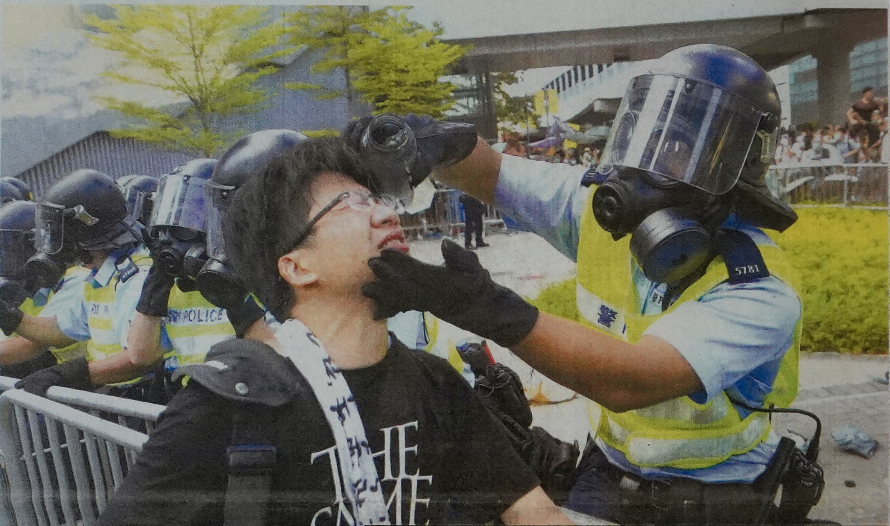
In late September 2014, outside the government headquarters in Admiralty, Hong Kong photojournalist Adrian Yu raised his camera for a moment no one had planned. A young protester had just taken pepper spray to the eyes and was crying out that he had been standing nowhere near the police line, when a riot officer in a gas mask patted his shoulder, took out his own water bottle, and began rinsing the young man’s eyes clean.
Adrian pressed the shutter and kept working. He did not think at the time that he had done anything special. Then the picture was published, and it traveled farther than anything he had shot before: through the Facebook page of The Epoch Times‘ Hong Kong edition and media company, into more than a million news feeds, and on to readers far beyond the city.
I spoke with Adrian on a video call held together by a live-translation app that insisted on mixing my English and its own Chinese rendering into a single stream, so for the first few minutes he heard two languages at once and politely asked me to repeat myself. A colleague stepped in and taught us both to speak in short passages and leave room for the machine to catch up. It was a fitting handicap. We were about to talk about what machines can and cannot do.
I had come with a theory: that a great photograph exists first inside the photographer, and that the camera only freezes what the heart has already seen. Adrian agreed, and then gently took the theory apart. What remained was something simpler and harder. He had not been looking for the water bottle. He had not been looking for anything at all. And I slowly came to understand that’s exactly why he could see it.
A camera nobody trained him to carry
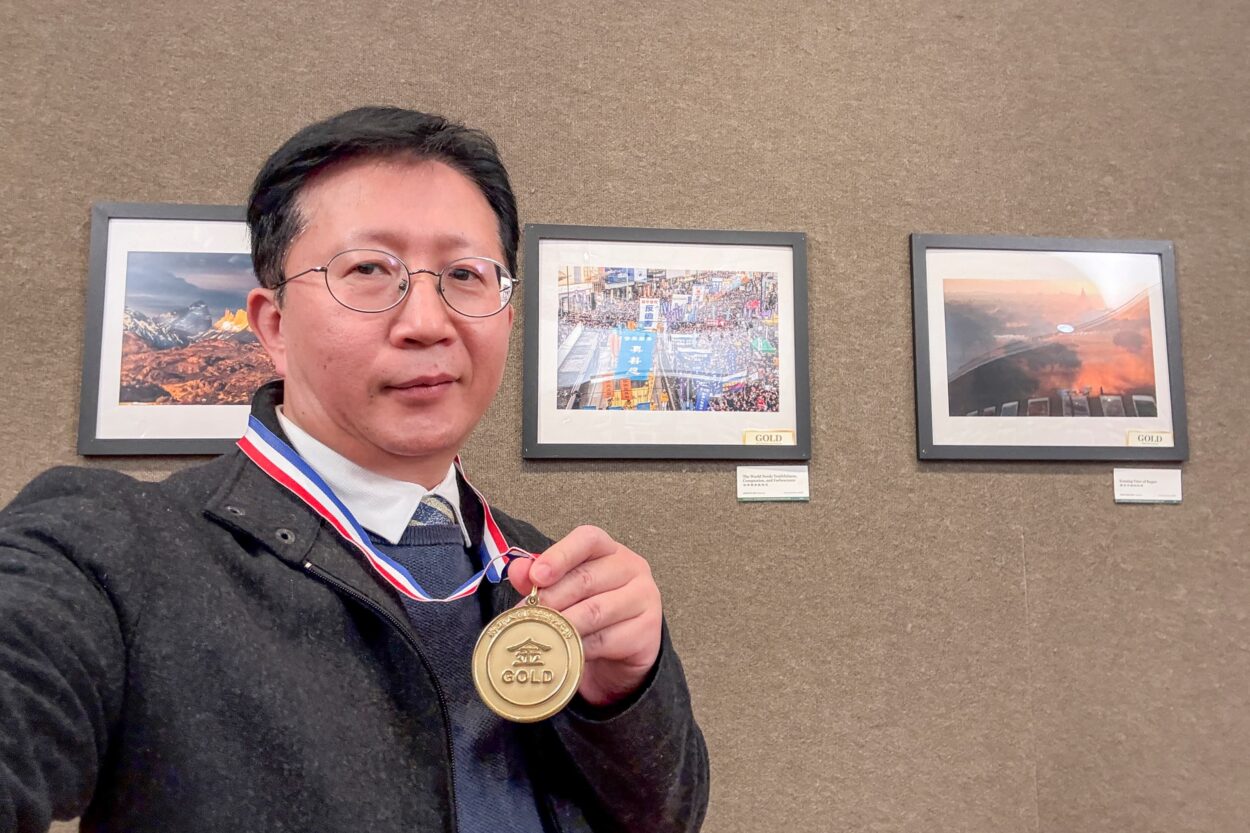
Adrian Yu did not study photography. When he talks about how he started, there is no art school, no early fascination with light, no childhood camera. Only a need, and a man standing next to it.
He joined New Tang Dynasty Television in Hong Kong, a multilingual, U.S.-based broadcaster, and the project was short on camera operators. Most of the reporters in Hong Kong at the time were women, and the video cameras of those early years were heavy machines that had to be carried for hours through streets and press scrums. Adrian was a man; he was physically strong, and the work needed doing. “I didn’t really think about why,” he told me. “I just felt the project needed me, and I had what it takes to do it well, so I took part.”
He knew nothing, not even the basics, by his own account. Fellow practitioners who could already shoot taught him the fundamentals, and he went out with reporters on interview assignments, filming news. Because Hong Kong was short-staffed and ran both the television project and the newspaper, the team settled on a practical rule: since you are already on the scene, shoot one more format. For a time, Adrian carried video and stills simultaneously, until the still image gradually became his own.
In German we have an expression for this: “Ins kalte Wasser springen,” to jump into cold water and learn to swim on the way in. I recognized it because I had lived a version of it. Years ago, working as a video editor, I was asked at the last minute to cover a parade after the assigned reporter dropped out. I said yes before I knew how. I remember walking into the crowd with almost nothing in my head except the wish that viewers would come away with a true and good impression of the day. The craft came later. The yes came first.
For Adrian, the craft came through what he describes, without hesitation, as teaching. He practices Falun Dafa, and he describes the long passage from not knowing to knowing as something his teacher, whom practitioners call Master, guided him through at every turn: through every news event, every piece of equipment, and every environment he was placed in. “Learning the buttons on a camera is easy,” he said. “But learning the inner substance of photography, its underlying logic, each person has to understand according to their own situation.”
That distinction between the buttons and the logic runs through everything he said afterward. The buttons are information. The logic is character.
Why a machine cannot be the one who sees
I wanted to ask about the logic, because the buttons are currently being automated out of existence. Generative models now produce photorealistic images of events that never happened, and more and more people treat this as the beginning of the end for photography as a human discipline. I asked Adrian the question directly.
He answered immediately, without hesitation. Artificial intelligence, he said, is a tool. It can improve how you use your equipment, refine an image’s lighting, and correct what needs correcting. What it cannot do is stand in for a human being as the subject of photography, the one who sees.
“The images AI produces are cold. There’s no emotion in them, and no warmth.”
Adrian yu
When a photographer shoots, he brings his own thinking to the frame, something of his personality, and whatever he is feeling in that instant. The image carries it. It acquires a visual language, and viewers can feel the emotion of the person behind the lens without being told. A generated image has no one behind it. In his words, it is a formulaic, rigid expression of an image: lighting and arrangement assembled by pattern rather than perception.
I spend most of my working days building with these systems, and I think he is right in a precise sense, not a sentimental one. A model produces the statistically likely picture of a thing. It has learned what scenes of a certain kind usually look like. But the photograph that stops a million people is almost never the likely picture. It is the exception: the officer who reaches for his water bottle when everything about the situation predicted he would not. A system trained on the probable cannot witness the improbable, because witnessing requires having been there.
So I offered my theory: the image first lives inside the photographer, and the camera, the lighting, the angle, even the AI, are only instruments for recreating what was already perceived. “Your view is correct,” he said. “But there are several different levels, and it may need to be broken down.”
In commercial, artistic, or portrait photography, he explained, the photographer often conceives the image early: the poses, props, expressions, and many elements of the frame. That work is designed in advance. News is different by nature. It has suddenness and immediacy. No photographer can imagine beforehand what a news event will give him.
What a Hong Kong photojournalist can know before the moment arrives
If the picture cannot be imagined in advance, what does the photographer bring to the street? Adrian’s answer was the most technical part of our conversation, and in some ways the most spiritual.
It begins, he said, with accumulation. At first, you don’t understand the news. But as you keep taking part in assignments, you start paying closer attention to the news and to society itself, and you understand both much better. Then, when you go out, you carry an expectation. You may not know what will happen at a particular event, but you know which officials or public figures will be present and roughly what they will do. You know what crowds in the street might do and what might follow. That gives you a preliminary picture of the day. He said that what actually happens on the spot depends entirely on experience.
Beneath experience he placed something even more basic: composition. Not novel composition, not a stylistic signature, but traditional composition, the classical grammar of the frame that tells the eye where to enter, where to rest, and what matters most. Practice it until it becomes second nature, he said, and then whatever happens, and whoever is in it, you can capture the best moment, which is very likely also the moment you most wanted to capture.
He used the Chinese idea that familiarity breeds skill, 熟能生巧. It is an old principle, and Chinese culture has an even older illustration of it. In the Zhuangzi, a cook named Ding carves an ox for Lord Wenhui with such ease that his movements look like a dance. Asked how, he explains that he no longer meets the ox with his eyes but with his spirit; after years of practice, his blade simply follows the natural spaces between joint and sinew, which is why the same knife has stayed sharp for nineteen years.
That is what Adrian describes. Composition practiced to the point of disappearing is no longer a set of rules the photographer consults. It becomes the structure through which he perceives. The conscious mind is relieved of arranging the frame, so it can notice what is actually happening inside it. In this sense, craft is not the opposite of spontaneity. It is what makes spontaneity reliable.
A photographer with no goal
Late in our conversation, I asked whether, after years of feedback and knowing his work had reached people, he carried an internal goal, a standard he hoped every photograph would meet.
“Actually, I don’t have a set goal that my pictures have to achieve,” he said.
Everything, he explained, revolves around reporting. He wants to express a news event through one image, or a few simple ones. There is no target beyond that. It is simply to express and record the news.
I have interviewed many people about their work, and most have an answer ready: a mission, a signature, a kind of image they are chasing. Adrian’s answer wasn’t modesty, and it wasn’t evasion. It described his actual method, and I believe it is the key that unlocks everything else he said.
Wanting narrows perception. A photographer hunting for a striking image sees the street through the filter of what he hopes to find, and whatever doesn’t match that hope becomes background. A photographer who wants nothing from the moment except to record it truthfully meets the street without that filter. He doesn’t edit reality before it reaches the lens. So when something unexpected appears, something gentle in the middle of something harsh, no prior ambition stands between him and seeing it.
This is how he describes the water bottle photograph. He could not have anticipated it. “Some scenes are very ordinary,” he said, “some happen by pure chance, and some you have to discover with your heart.” When it happened, he captured it quickly, instinctively, naturally. He called this nothing more than a basic ability a photographer should have.
“We keep learning and improving in ordinary times. You prepare thoroughly, and when that image appears in that instant, you record it. That’s enough.”
Adrian yu
A second detail didn’t come up in our conversation but appears in his newspaper report from those days. Caught in tear gas himself during the same protests, Adrian found that few people stopped to help him. One did: a police officer; Adrian knew because he saw the word on the man’s shirt. In those weeks, compassion wasn’t the property of one side of a line. It appeared in individual people at unexpected moments, and the photographer’s task was to make it clear enough to notice.
When he described the scene to me, I was moved, and I told him so. The image works not because it is dramatic, but because it reverses what the scene was built for. A setting arranged for confrontation briefly opened, and care came through. People recognized it because it reminded them that care is always available, even there.
Standing in the water
Water appears twice in Adrian Yu’s story, and the second time it is not merciful.
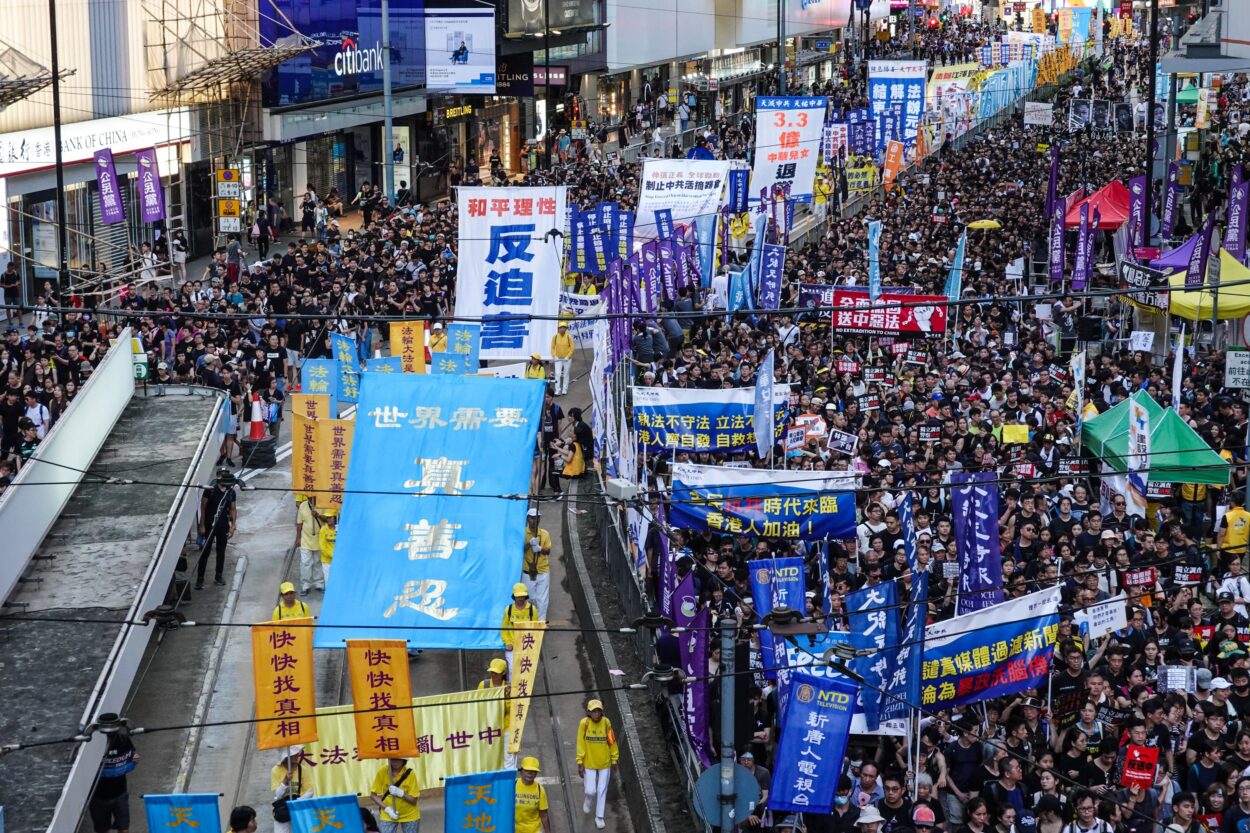
Journalism in turbulent places can take photographers into uncomfortable, frightening, and sometimes dangerous situations, and I asked how he meets them. He answered with a scene from the 2019 protests. A police water-cannon vehicle cleared students from a road, and when the street emptied, only two people remained: Adrian and a very young reporter, standing together at the corner of a wall.
Then the vehicle turned its cannon on them.
The liquid was severely irritating. It soaked his camera completely and drenched him from head to toe, and the burning in his eyes and on his body, he said, was unbearable. I waited for the next part of the story: the anger, the fear, the reflection on what they had done to him. It did not come.
“My thinking is very simple,” he said. “Do the job well.”
On the human level, he explained, that means fulfilling the role of a photojournalist. From the perspective of a cultivator, it means going out to capture and record a historic moment so more people learn about it, come to know the media he works for, and, through that, come to know the truth. “I didn’t think too much about my own emotions or my mood,” he said. “I just felt it should be done.”
In Falun Dafa, the principle at work here is Ren, usually translated as forbearance. It is easy to mistake for passivity or mere endurance. It is neither. Forbearance is the capacity to remain steady in the heart when circumstances give every reason not to: to take pain without letting it turn into resentment, and without letting it decide what you do next. Soaked and half-blind at the corner of that wall, Adrian did not stop being a photographer. His purpose was untouched by what was happening to his body, because his purpose had never been about himself in the first place.
This same quality let him see the water bottle, approached from the other side. A man with no personal goal to protect has nothing to knock him off balance with insult or injury. The same absence of ambition that opens his perception keeps his heart steady under pressure. It is one quality, observed twice.
The truth that needs a witness
Toward the end, I raised a concern I carry from my own media work. Much of what passes for news photography now is hurried: a few frames taken in passing and dropped into an article, without real thought or commitment. I asked Adrian whether his kind of work would last.
He was not worried.
“Where there is news, there will be reporting. Where there is reporting, there will definitely be truth.”
Society needs truth, he said, and so it needs reporters and photographers to go out and find it. The relationship runs both ways, and for that reason the profession will always exist and always be needed.
I think his confidence is well placed, and the arrival of generative images strengthens it rather than weakens it. When any picture can be produced from a sentence, the only pictures that carry weight are the ones someone can stand behind and say: I was there, and this happened. In an age of synthetic abundance, the witnessed image becomes scarcer and more valuable. A model can render an officer holding a water bottle. It cannot have been standing in Admiralty when one actually did.
Listening back to our conversation, I noticed that three qualities appear in exactly the order the work requires them. Truthfulness is the job itself: recording what is actually there, not what one hoped or feared would be there. Compassion is the eye: the open, unguarded attention that can recognize kindness where no one expected it. Forbearance is what keeps the photographer standing when standing hurts. Truthfulness, Compassion, Forbearance are the founding principles of the practice Adrian follows. In his photography, they are not ornaments placed on top of the craft. They are its structure.
When the interview ended, I asked whether we might use the water bottle photograph and a few others for this article. He said he would look, though he might no longer have the original file; the newspaper’s report from that time should still be findable. Then he asked me to write down exactly what I needed, so he could search properly. There was no talk of portfolio or credit. Only the same quiet instruction he gives himself: find what is needed, and do it well.
I told him there were no special requirements. Whatever was convenient. Images of compassion, of steadiness in harsh places, and perhaps one that simply showed beauty.
Looking back, I realize I was asking for the one thing you can’t request. He has never gone out looking for compassion. He goes out to record the truth, and a clear heart notices compassion when the moment comes.
Somewhere in Hong Kong, an officer once unscrewed a water bottle without planning to be remembered for it, and a photographer pressed the shutter without planning to be known for it. Neither wanted anything from that moment. That is why it could give so much.
Follow us on X, Facebook, or Pinterest
