
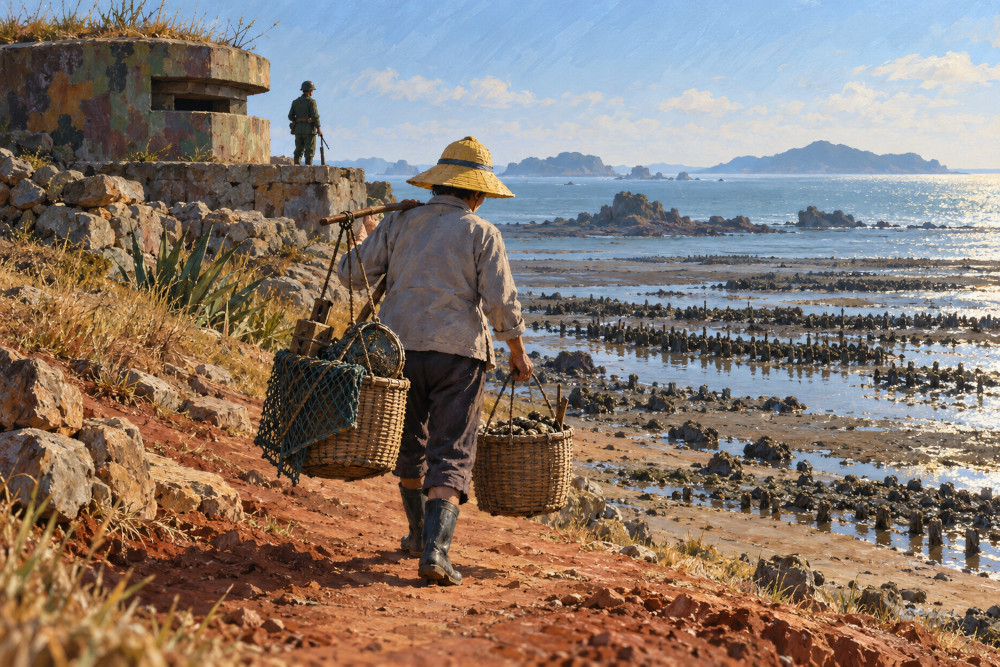
On Kinmen, even an oyster gatherer’s hat once had a military purpose. Residents heading to the shore had to change into specially colored hats at checkpoints so soldiers could identify them. Fishing-net floats sometimes carried slogans calling for resistance to communism. Objects that would have been ordinary elsewhere reflected the extraordinary conditions of life on this small island.
These reminders of Kinmen’s past are among the objects featured in a 2026 exhibition on everyday life during the military era. Today, visitors may pose for photographs in abandoned bunkers or admire the island’s network of tunnels. But for families who lived through those years, the fortifications were not attractions. They were part of a struggle to keep working, raising children, and staying alive.
Kinmen is administered by Taiwan but lies just off the coast of mainland China. Chinese Communist forces tried to capture the island in 1949 and launched a devastating artillery assault on August 23, 1958. After 44 days of intense bombardment, shelling continued on odd-numbered days for roughly two more decades, although later rounds often carried propaganda leaflets rather than destructive payloads. The attacks ended in 1979; the island’s special military administration remained in place until 1992. For residents, the long confrontation shaped far more than military strategy.
When ordinary errands required military passwords
Ting Chien-kang, a former director of the Kinmen County Government’s Tourism Department, explores that history with humor and affection in his book Keep the Broth Clear, Keep Life Simmering. He describes an island where military installations existed alongside vegetable plots, livestock pens, and family homes. At the height of the military buildup, Kinmen hosted an enormous number of troops, and civilians had to adapt to a landscape organized around defense.
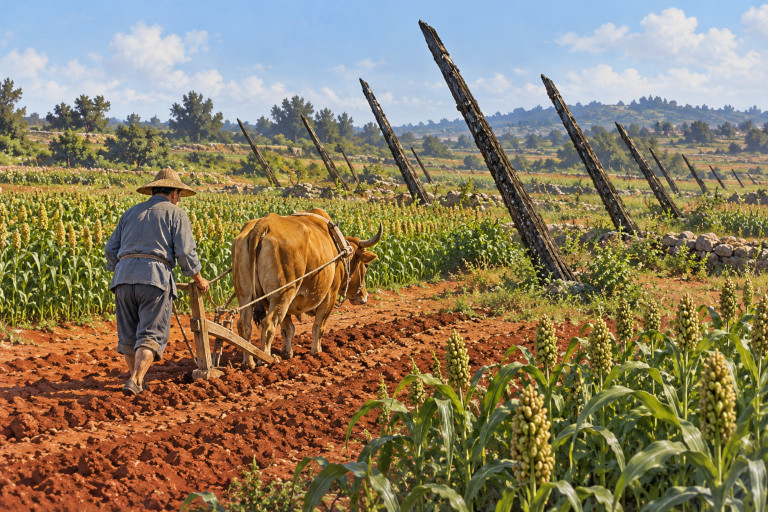
In the fields, farmers might encounter camouflaged military vehicles or rows of concrete anti-airborne stakes designed to obstruct the landing of Communist paratroopers. Sorghum still had to be grown. Oxen still needed grazing. The precautions intended to protect Kinmen from attack were woven into work that could not simply stop because the island was on the front line.
Night brought a different kind of difficulty. During periods of strict curfew, sentries guarded roads and military positions, sometimes challenging people with passwords. Ting paints a darkly comic scene of an elderly resident venturing out to use an outdoor toilet or retrieve an escaped pig, only to be startled by an armed soldier demanding the night’s password. In his telling, a frightened grandmother might answer with a hurried reference to Sanmin Zhuyi, Sun Yat-sen’s Three Principles of the People.
It is an amusing image until one considers the fear behind it. A civilian and a young sentry could both be frightened by an unexpected encounter in the dark. What looks like a quaint military relic to a tourist today represented years of restrictions and uncertainty to the people who lived there.
The family shelters beneath the red earth
The danger was far more immediate when artillery shells began falling. During the intense bombardments, people learned to recognize the sound of incoming fire and hurry toward whatever shelter was available. For many families, protection meant a cramped dugout near the house or a small space excavated beneath a courtyard or floor.
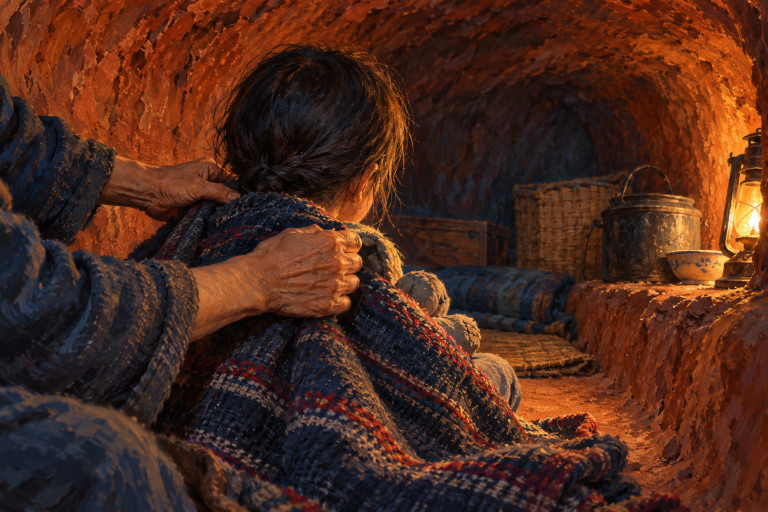
These civilian shelters were nothing like the larger military tunnels carved into Kinmen’s granite. Some were little more than holes in the red earth. Their entrances could be narrow, the air damp and stale. Families crowded together with blankets and a few essentials while explosions sounded above them and loose soil fell from the ceiling.
Ting describes the urgency of a grandmother wrapping a baby in a blanket and rushing underground with the rest of the household. The scene is simple, but its meaning is unmistakable. In those moments, the urgent concern was not military strategy or political slogans. It was whether parents could keep their children safe until the shelling stopped.
Neighbors shared cramped spaces and reassured one another as best they could. These shelters offered no comfort, yet they allowed ordinary family life to continue in circumstances that repeatedly threatened to destroy it.
How artillery steel became kitchen knives
The bombardments also left an unusual legacy in Kinmen’s soil: enormous quantities of artillery fragments and spent shells. Later propaganda rounds often left recoverable steel casings. Rather than allowing all that metal to remain a reminder of destruction, local blacksmiths found a practical use for suitable salvaged steel.
Ting recalls watching a craftsman lift a glowing piece of artillery steel with long tongs and place it on an anvil. The hammer struck again and again. Under the blacksmith’s practiced blows, metal that had arrived on Kinmen as part of a weapon gradually became a kitchen blade.
Over time, artillery-shell knives became one of Kinmen’s best-known traditional crafts. What began as a practical way to make use of discarded steel developed into a thriving local trade, with knives valued by cooks and visitors alike for their quality and unusual history.
For Ting, the transformation is personal. He uses a Kinmen steel knife to cut meat in his hot-pot restaurant. When customers ask about the blade, he can tell them that its steel once belonged to an artillery shell. What was manufactured for war now helps prepare food for families.
Metal sent across the strait to destroy lives has been reshaped by the very people who endured the attacks. As Ting puts it: “The world gave us war. We gave the world a kitchen knife.”
From defensive tunnels to liquor cellars
Kinmen’s people have also found new purposes for some of the island’s underground military infrastructure. Former installations that once supported defense operations now serve as storage facilities for kaoliang, the strong sorghum liquor for which Kinmen is famous.
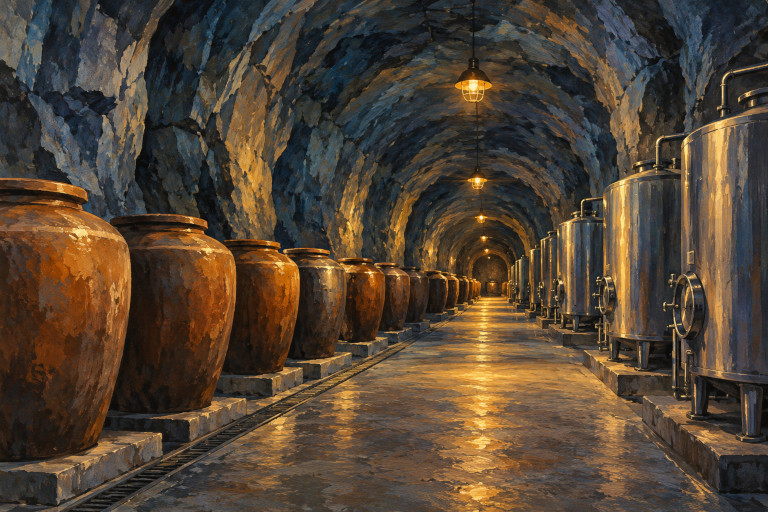
Kinmen Kaoliang Liquor Inc. has converted several former military tunnels into cellars. Their cool, relatively stable temperature and humidity make them useful for storing and aging liquor in pottery jars and steel tanks. The Changjiang Tunnel, once used for a power station, began storing liquor in 2007; the former military tunnels at Xiaxing were put to similar use in 2017.
In a smaller domestic version of this change, Ting describes household air-raid shelters that no longer hold chamber pots and emergency supplies. Some now provide space for bottles of liquor saved for a special occasion. The contrast is almost difficult to believe: a family once went underground to protect its life; now it may go underground to retrieve something intended for a celebration.
Not every tunnel has been transformed, and repurposing old defenses cannot erase what Kinmen’s families endured. But the changes reveal a practical form of resilience. The island’s residents did not choose the shells, the curfews, or the years of military tension. They did, however, find ways to use what the conflict left behind.
An oyster gatherer’s hat, a shelter cut into red earth, a knife forged from artillery steel, and a bottle of liquor aging beneath granite all tell parts of the same story. While military history records battles and dates, these objects recall the people who had to get through the next day — and the next — until ordinary life could begin to feel ordinary again.
Adapted from an excerpt of 湯底要清,日子要滾:一本從金門話慢火熬成的地方書 by Ting Chien-kang. The English rendering of the book title is Keep the Broth Clear, Keep Life Simmering: A Local Story Slowly Steeped in the Kinmen Dialect.
Translated by Katy Liu
Follow us on X, Facebook, or Pinterest
