

In the early hours of October 25, 1949, Communist forces launched an amphibious assault on Kinmen, a small island off the coast of mainland China. What followed became known as the Battle of Kinmen, or the Guningtou Victory, as Nationalist forces loyal to Chiang Kai-shek’s Kuomintang government (KMT) called it. Nearly 10,000 Communist troops took part in the landing. After three days and nights of intense fighting, lasting about 56 hours, the assault ended in a crushing defeat for the attackers. More than 3,000 were killed, while thousands of others were wounded, disabled, or captured, leaving the surviving Communist troops unable to return to the mainland. How did a force of such considerable size suffer such a devastating defeat, and what circumstances led to this unexpected outcome? The following account examines the battle from three perspectives: the Communist forces, the Nationalist defenders, and a third perspective that looks beyond the battlefield to consider what may have been unfolding in the heavens above.
How the battle of Kinmen began
In early July 1949, after advancing into Fujian Province, Mao Zedong ordered the Third Field Army to begin preparations for an invasion of Taiwan, committing eight armies to the effort. By August, Communist forces launched the Fuzhou Campaign, and by October, they had captured Zhangzhou and Xiamen, along with several smaller coastal islands, leaving Kinmen increasingly isolated. Kinmen was far more than a small island off the coast of mainland China; it occupied a strategically important position in the Taiwan Strait and had played a historical role in earlier military campaigns involving Taiwan, as both Zheng Chenggong (Koxinga) and Shi Lang had used the Kinmen-Xiamen area as a staging ground for their respective campaigns. As long as Kinmen remained under Nationalist control, it provided an important defensive position off the Fujian coast that helped protect Taiwan from a Communist advance while allowing Nationalist forces to maintain a military presence close to the mainland. If the Communists had captured Kinmen, however, they would have gained a strategic foothold from which to threaten shipping routes across the Taiwan Strait and strengthen their position for a future assault on Taiwan.
The Communist forces
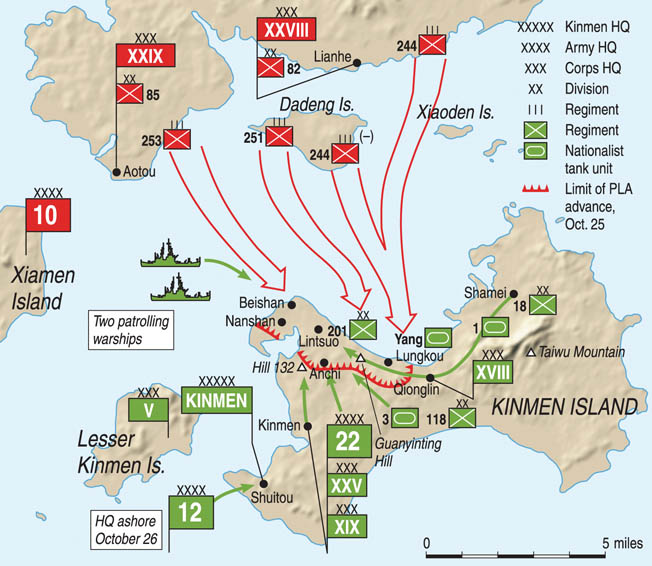
Ye Fei commanded the Communist forces during the Battle of Kinmen, with Xiao Feng serving as the frontline commander. Late on the night of October 24, approximately 9,000 Communist troops set out for Kinmen from waters about 5.5 nautical miles off Xiamen, traveling aboard more than 300 motorized sailing vessels and other boats as the first wave of the assault. The plan called for three regiments to land first, establish a beachhead, and send the boats back to the mainland to transport the second and third waves, bringing another three regiments across. Although the first wave initially succeeded in landing and capturing several positions and villages, the troops soon encountered fierce resistance from the Nationalist defenders and urgently needed reinforcements.
Unexpectedly, strong winds and sudden tidal changes left the landing craft stranded on the beaches, unable to return to the mainland to transport the remaining troops. This effectively cut off the carefully planned reinforcement operation. Without the second and third waves, the Communist troops became increasingly isolated and outnumbered. By October 26, their ammunition and supplies were running dangerously low, and after midnight, communications between the 28th Army’s frontline command and the troops on Kinmen gradually broke down. A total of 9,086 people — including soldiers, boatmen, and civilian laborers — had landed on the island, but with reinforcements unable to reach them, the invading force faced an increasingly desperate situation as some were killed, others surrendered, and many were taken prisoner.
What was happening in the Heavens?
According to a spiritual account, three enlightened beings lived in different places: one at Sun Moon Lake in Taiwan, another on Mount Jiuhua in Anhui Province, and the third in the United States. Gathering together from time to time, one of them passed over Xiamen, heard the thunder of artillery fire, and noticed a vast cloud of murky energy rising into the sky, prompting him to descend from the clouds to take a closer look at the fierce fighting between Communist and Nationalist troops on Kinmen. According to this account, the Chinese Communist Party was not simply a political organization, but the earthly manifestation of an evil entity that evolved from destructive forces in the universe, appearing in a lower dimension as a red dragon — the ancient serpent described in the Bible. This entity was said to have entered the world carrying hatred toward God, humanity, and all of creation, with the ultimate purpose of destroying humankind like a swarm of locusts sweeping across the land, leaving mountains of corpses behind.
After using its violent and sinister power to drive the legitimate Republic of China government to Taiwan, the evil Red Dragon was not satisfied and continued to seek control of Kinmen to advance toward Taiwan. However, according to this spiritual interpretation, the Republic of China government was not destined to perish because it carried a mission to preserve China’s traditional culture. Seeing the fierce Communist assault, the enlightened being decided to intervene; with a movement of his arm and a small display of supernatural power, strange winds began sweeping across the waters surrounding Kinmen, and the tide receded. After the first wave landed, their stranded boats were attacked and destroyed by Nationalist air, naval, and ground forces, leaving enormous fires blazing along the shoreline. With their boats destroyed, Communist reinforcements could no longer reach Kinmen, leaving the troops on the island isolated, surrounded, and eventually wiped out. From this spiritual perspective, this extraordinary turn of events was no coincidence, but the result of an intervention in the Heavens.

The Nationalist forces
Now let us turn to the Nationalist side. The defenders on Kinmen were not particularly alert on the night of the invasion until a Nationalist platoon leader accidentally stepped on a land mine during a routine inspection. The tremendous explosion jolted the troops awake, and assuming the Communists were attacking, they rushed to their defensive positions only to discover large numbers of Communist troops landing on the island. Nearly 10,000 Communist troops had come ashore, causing several beachhead positions and villages to fall into enemy hands and forcing Nationalist troops to retreat. Before withdrawing, the defenders needed to destroy their weapons and ammunition to prevent them from being turned against them, so armored vehicle crews pointed their cannons toward the sea and fired as rapidly as possible to use up their shells. Miraculously, those seemingly random shots struck the Communist naval vessels offshore as though the shells had eyes.
Even more astonishing was the account of one tank gunner who loaded an armor-piercing round containing incendiary material instead of a high-explosive shell and fired at a Communist vessel, striking the warship’s ammunition magazine and igniting the explosives inside. The resulting towering flames lit up the night, allowing the Nationalist defenders to launch a powerful counterattack using 12 57-mm anti-tank cannons, 4 heavy mortars, 4 mountain cannons, and naval bombardment from Admiral Li Yuxi’s warship Taiping. At daybreak, Nationalist P-51 Mustang fighters made repeated diving attacks with machine guns, rockets, and incendiary bombs, reducing the remaining vessels to ashes and forcing Communist soldiers into the sea. By 3 a.m. on October 26, only one Communist reinforcement battalion had landed, but it was equipped with light weapons and was easily repelled by Nationalist tanks toward Guningtou. At dawn, General Hu Lian arrived on Kinmen to personally direct a coordinated counterattack from Hunan, trapping the remaining Communist forces and systematically recapturing the island’s strategic positions.
Communist forces gave drugs to civilian boatmen
Liu Yazhou, a senior general in the Communist Air Force and son-in-law of Li Xiannian, disclosed in his essay A Review of the Battle of Kinmen: In Memory of My Beloved Father, Liu Jiande, a Veteran of the 21st Army of the East China Field Army, that Communist authorities resorted to paying civilian boatmen gold and supplying them with opium to secure their participation. He wrote: “Fujianese boatmen had to be recruited with enormous sums of money. Each boat was paid three taels of gold, and each boatman another three taels, plus opium. Even then, the boatmen either went into hiding or deliberately sabotaged the operation. At the height of the battle, the army command paid a large sum to recruit a steamship in Xiamen to reinforce Kinmen. But the owner deliberately drove the vessel straight onto a sandbar, stranding it. The boatmen who boarded the ships were terrified of dying. Even after they had been given drugs to smoke beforehand, they were still as timid as mice. As the boats approached Kinmen’s beaches, gunfire and artillery roared like boiling water. The boatmen were so frightened that they cowered in the lower decks, refusing to come out. Many of the vessels were operated by Communist soldiers who knew little about navigation, resulting in further losses.”

What did the local people really think?
The Communist Party has long claimed that its rise to power was the choice of the Chinese people, but Liu Yazhou’s essay offers a revealing counter-narrative regarding local sentiment: “Civilian boats could not be relied upon. The people could not be counted on to support us. Fifty years ago, when we fought at Kinmen, and today, when we consider fighting Taiwan, we were deploying troops into areas where we knew little about local public sentiment. We were facing two enemies. At the time, Fujian had only recently been brought under Communist control, and the people were still afraid of our troops. The boatmen were divided on whether to cooperate with us. At the Guningtou Battle Memorial Hall in Kinmen, I saw a captured document from the 28th Army. It listed four key principles for attacking Kinmen. One of them read: ‘If boatmen hesitate or retreat, enforce strict supervision.’”
He continued: “After our troops landed, the people of Kinmen offered us no support whatsoever. Instead, they sided with the enemy. When our troops were fighting Chiang Kai-shek’s forces in Guningtou Village, Nationalist aircraft came to bomb our positions. The villagers gathered on nearby hillsides to watch the spectacle. According to the village history, ‘Whenever an aircraft hit its target, the villagers cheered loudly.’ When Nationalist troops escorted captured Communist soldiers and wounded men away from the battlefield, the villagers shouted, ‘Beat them! Beat them! Beat them!’” Despite the Communist Party having established Soviet-style base areas in Fujian since the 1930s, the local population in Kinmen showed fierce opposition, cheering the defeat of the landing forces rather than welcoming them as liberators. This testimony challenges the Party’s claim of rising to power through popular support, showing how it imposed its rule through armed force.
The significance of the Battle of Kinmen
The Communist defeat at Kinmen brought its plans to invade Taiwan to an abrupt halt. On October 27, 1949, news of the victory reached Taipei, leading Chiang Kai-shek to declare: “We have won this battle completely… Taiwan is safe.” Attaching enormous importance to the outcome, he said the Guningtou Victory saved both Kinmen and Taiwan, marking the first time the Nationalist army turned defeat into victory by annihilating a Communist force. Following the victory, Chiang urged his followers to use Taiwan as a base to oppose communism and restore the nation while firmly establishing Sun Yat-sen’s Three Principles of the People: Nationalism (national independence), Democracy (popular governance), and People’s Livelihood (economic well-being).

What happened to the captured Communist soldiers?
Among the Communist troops captured at Kinmen, those who wished to remain were incorporated into the Nationalist Army, while three groups of prisoners of war were released and sent back to mainland China in 1952. However, the Communist Party viewed having been taken prisoner as equivalent to treason, subjecting the repatriated soldiers to political investigations and ideological indoctrination in special reeducation units in Hangzhou, Fuzhou, and Nanjing that were often more brutal than the battlefield itself. Forced to accuse and denounce one another, all were expelled from the Party and the military, with many sent to farm, some imprisoned, and several groups executed by firing squad. Their suffering persisted into the Cultural Revolution, leading survivors to reflect: “We fought hard for three days, only to suffer for thirty years.”
The will of Heaven
Before and during the Battle of Kinmen, a series of remarkable coincidences — such as sudden winds, receding tides, and highly accurate artillery fire — seemed to favor the Nationalist forces, leading some to see the unseen hand of Heaven directing events beyond human perception. Today, the Chinese Communist Party continues to issue threats against Taiwan with slogans like “Keep the island, but leave no one alive,” revealing its ongoing destructive ambitions. Another remarkable account concerns the 270-million-year-old “Doomed Communist Party Stone” discovered in Guizhou Province in 2002, which features naturally formed characters reading “The Chinese Communist Party Is Doomed,” which geologists determined to be free of human carving. Ultimately, the Battle of Kinmen reminds us that human history unfolds under a greater moral order, where righteousness, virtue, and the enduring spirit of the upright will ultimately prevail over regimes built on violence and fear.
Translated by KT and reviewed by Tatiana Denning
Follow us on X, Facebook, or Pinterest
