

It is one of the most famous photographs in the world. A lone man in a white shirt, carrying shopping bags, stands before a column of tanks on a wide Beijing avenue. The image has been reproduced millions of times, displayed in museums, and cited as one of the defining photographs of the 20th century. Yet when journalist Louisa Lim showed this photograph to 100 students at four Beijing universities, only 15 could identify its subject. The rest had never seen it before.
This striking disconnect lies at the heart of one of history’s most remarkable acts of collective forgetting. The Tiananmen Square Massacre of June 4, 1989, claimed the lives of hundreds, perhaps thousands, of unarmed civilians. It was broadcast worldwide and condemned by governments worldwide. Yet inside China, an entire generation has grown up knowing almost nothing about it.
How did an event of such magnitude become invisible to those who live where it happened? What actually occurred during those fateful days in the spring of 1989? And how does truth persist even in the face of relentless suppression? This article explores the history that China’s youth were never taught, the human stories behind the headlines, and the quiet courage of those who refuse to let the world forget.
What happened at Tiananmen Square in 1989
To understand the Tiananmen Square Massacre, we must first understand what brought over a million people to that vast public square in the heart of Beijing.
A nation seeking change
On April 15, 1989, Hu Yaobang died of a heart attack. Hu had served as General Secretary of the Communist Party and was widely admired for his efforts to introduce democratic reforms. He had been forced from power in 1987 after being blamed for student protests, and his death transformed him into a symbol of the reform movement many Chinese yearned for.
Students began gathering in Tiananmen Square to mourn Hu and to call for the changes he had championed: greater democracy, freedom of speech and the press, and an end to government corruption. What began as a memorial quickly evolved into something larger.
By mid-May, the crowds had swelled to over one million people. Students from across China poured into Beijing. Workers joined them. Ordinary citizens brought food and water. At the center of the square stood a 33-foot statue the students had built and called the “Goddess of Democracy,” facing the portrait of Mao Zedong that hangs over the entrance to the Forbidden City. The atmosphere was electric with hope. Many believed China stood on the brink of historic transformation.
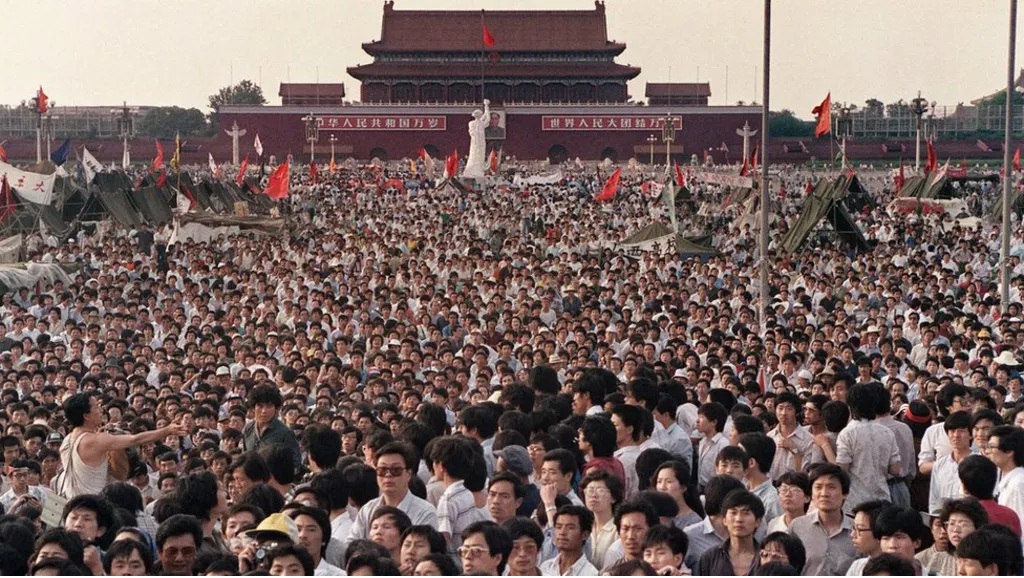
The crackdown: June 3-4, 1989
The government did not share that hope. On May 20, martial law was declared in Beijing. Troops began massing around the city. For two weeks, the world watched and waited. On the night of June 3, the waiting ended.
Tanks and heavily armed soldiers of the People’s Liberation Army advanced toward Tiananmen Square from multiple directions. Citizens who tried to block their path were met with gunfire. Much of the violence occurred not in the square itself but along Chang’an Avenue and in neighborhoods like Muxidi, where residents poured into the streets to stop the military’s advance. The troops pushed through. By dawn on June 4, the square had been cleared. The “Goddess of Democracy” lay crushed beneath tank treads.
Estimates of the death toll vary widely, reflecting both the chaos of that night and the government’s subsequent efforts to suppress information. The official Chinese government figure is 241, including soldiers. The Chinese Red Cross initially estimated approximately 2,700 deaths before retracting the figure under pressure. Western estimates range from several hundred to several thousand. Declassified British diplomatic cables initially suggested the toll could be as high as 10,000, though later analyses revised this to 2,700-3,400.
What is certain is that unarmed civilians were killed by their own military. What is also certain is that the Chinese government has never acknowledged this truth.
Beyond Beijing: A nationwide movement
The term “Tiananmen Square” can be misleading. While that iconic location served as the focal point, the 1989 democracy movement was national in scope. By mid-May, protests of varying sizes had erupted in more than 400 Chinese cities, including demonstrations in Tibet and Xinjiang.
Following the June 4 crackdown, it spread across the country. Thousands were arrested on charges of “counter-revolution.” Many received lengthy prison sentences. Some were executed. The movement was crushed not only in Beijing but everywhere it had taken root.
Tank Man: The image that defined an era
The day after the massacre, on June 5, 1989, a man whose identity remains unknown changed the visual language of resistance forever.
The unknown rebel
A column of Type 59 tanks was moving east along Chang’an Avenue, the broad boulevard that runs past Tiananmen Square. From the Beijing Hotel, several photographers had positioned themselves with telephoto lenses. At first, Associated Press photographer Jeff Widener was annoyed when a lone figure stepped into his frame. A man in a white shirt and dark trousers, carrying what appeared to be shopping bags, had walked into the path of the lead tank.
The tank attempted to steer around him. The man shifted to block it. The tank stopped. For several minutes, man and machine faced each other. At one point, the man climbed onto the tank and appeared to speak with the crew inside. Eventually, several people rushed from the sidewalk and pulled him away. He disappeared into the crowd. His identity has never been confirmed. He is known simply as Tank Man, or the Unknown Rebel.
Why Tank Man matters
The photograph became one of the most reproduced images in history. It appeared on the front pages of newspapers around the world. It was broadcast on television screens in Eastern Europe and the Soviet Union, where people were already questioning their own governments.
Tank Man became a universal symbol of individual courage in the face of overwhelming force. He demonstrated that even the most ordinary person, carrying shopping bags, could stand against tyranny. The image helped galvanize movements for freedom far beyond China’s borders. Yet this image, so famous elsewhere, is virtually unknown in China. The Great Firewall blocks it. Textbooks don’t include it. A photograph that shaped world history has been erased from the memory of those who live nearest to where it was taken.
The Great Erasure: How China censors Tiananmen
The Chinese government’s approach to the Tiananmen Square Massacre can be summarized in a single phrase that has become its official position: “Nothing happened.”
The official narrative
In Chinese schools, the events of June 4, 1989, simply do not exist. Textbooks make no mention of the protests or the crackdown. Teachers are forbidden from discussing the topic. Students who ask questions are met with silence or deflection. Human Rights Watch has documented that the government “has never accepted responsibility for the massacre or held any officials legally accountable.” The official line, when any acknowledgment is made at all, is that the military’s actions were necessary to restore stability and prevent chaos. For 35 years, this position has not changed.
The Great Firewall’s role
China’s Internet censorship apparatus, known as the Great Firewall, treats Tiananmen as a top priority. China Digital Times has documented at least 262 Tiananmen-related phrases that are censored on the social media platform Weibo. The censorship goes far beyond obvious terms. Creative workarounds like “May 35th” (since May has only 31 days, May 35 equals June 4) have been blocked. Candle emojis are suppressed around the anniversary. Even displaying playing cards showing a 6 and a 4 together has triggered censorship.
In 2022, popular livestreamer Li Jiaqi accidentally displayed a tank-shaped ice cream cake during a June 4 broadcast. His stream was immediately cut, and he disappeared from social media for months. The incident introduced millions of his young fans to the very topic the censorship was designed to hide.

Generation amnesia
The impact of this suppression has been staggering. Louisa Lim, author of “The People’s Republic of Amnesia: Tiananmen Revisited,” describes the result as “generation amnesia.”
Twenty-five years after June 4, 1989, even China’s educated youth have only a foggy understanding of the incident. They are skittish about discussing it. Many have never heard of student leaders such as Wang Dan or Wu’er Kaixi. They are unaware of the Goddess of Democracy. They have never seen the footage that was broadcast worldwide. As one young Chinese person told Radio Free Asia: “It’s like something from a legend. I may understand it, but I can hardly feel it.”
Wei Jingsheng: A voice that refused to be silenced
The Tiananmen protests did not emerge from nowhere. They built upon an earlier democracy movement that produced one of China’s most courageous dissidents.
The Fifth Modernization
In late 1978, a section of wall on Xidan Street in Beijing became known as “Democracy Wall.” Citizens posted handwritten essays calling for political reform. The government initially tolerated this expression. On December 5, 1978, a young electrician named Wei Jingsheng posted what would become the movement’s most famous document. Titled “The Fifth Modernization,” it argued that China’s official Four Modernizations, industry, agriculture, science and technology, and national defense, would fail without a fifth: democracy.
Wei wrote: “Without democracy, society cannot progress. Without democracy, modernization cannot succeed.” For this essay, Wei was arrested in March 1979 and sentenced to 15 years in prison for “counter-revolutionary” activities.
Eighteen years of imprisonment
Wei refused to recant. Despite harsh prison conditions that caused him to lose teeth and develop heart problems, he continued to write and to criticize the government. Briefly released in 1993, he immediately resumed his activism and was imprisoned again in 1994. In total, Wei Jingsheng spent 18 years in Chinese prisons. He was finally released and deported to the United States in 1997. He has since won numerous human rights awards, including the Sakharov Prize for Freedom of Thought.
His testimony on youth awareness
Wei’s observations about young Chinese people’s knowledge of history are sobering. “Many young people today don’t even know what June 4, 1989, refers to,” he has said. Even middle-aged and older generations, who may have heard something about the events, often lack accurate details about what actually happened. This is the success, and the tragedy, of censorship. An entire nation’s memory has been altered. But Wei and others like him continue to bear witness, ensuring that the truth survives even when it cannot be spoken openly.
How young Chinese learn the truth
Despite the censorship, some young Chinese do eventually learn about Tiananmen. Their stories reveal both the power and the limits of information suppression.
VPNs and the digital underground
China’s youth are technologically sophisticated. Many use VPNs, virtual private networks, to circumvent the Great Firewall. Though illegal, these tools are widely used. In 2023, Radio Free Asia posted a Twitter (X) query asking Chinese citizens born after 2000 to share how they first learned about the Tiananmen massacre. Nearly 1,400 people responded.
Their stories varied. Some discovered the truth while studying abroad. Others obtained information via foreign gaming platforms or messaging apps that circumvented censorship. A few learned from family members who trusted them with dangerous knowledge.
Brave teachers and whispered history
Several respondents described teachers who took risks to share the truth. “In a university elective course many years ago, the teacher secretly played a video for us with the door closed, without saying a word,” one person recalled. Another recalled a high school Chinese literature teacher who concluded a class with a sentence the student would never forget: “A country should never use its tanks against its own people, no matter what.”
These teachers risked their careers and, potentially, their freedom to ensure that at least some of their students would know. Such acts of quiet courage occur across China, invisible to the world but profoundly meaningful to those who receive the gift of truth.
The emotional distance
Even for those who learn the facts, there is often an emotional gap. The events feel remote, almost mythological. “I may understand it, but I can hardly feel it,” as one young person put it. Research suggests that awareness of the Tiananmen events correlates with education level, exposure to the world beyond China, and general intellectual curiosity. But knowing facts is different from feeling the weight of history. For those who never experienced the fear and hope of 1989, the massacre can seem like ancient history rather than a wound that remains unhealed for millions.
Keeping memory alive: Commemoration today
For decades, there was one place on Chinese soil where the Tiananmen massacre could be openly commemorated: Hong Kong.
Hong Kong’s lost vigils
Every June 4 from 1990 to 2019, tens of thousands of people gathered in Hong Kong’s Victoria Park for a candlelight vigil. They lit candles, sang songs, and listened to speeches by survivors. It was a powerful annual reminder that memory persisted.
That changed in 2020. Citing pandemic restrictions, authorities banned the vigil. When some attempted to gather anyway, they were arrested. The organizers of the Hong Kong Alliance in Support of Patriotic Democratic Movements of China were themselves imprisoned under the new National Security Law.
Between 2020 and 2024, 82 people in Hong Kong were arrested for commemorating the Tiananmen massacre around its anniversary. Forty-three were convicted and sentenced to a combined total of over 20 years in prison. In 2025, Victoria Park, where those vigils had been held, hosted a carnival showcasing Chinese cuisine and products.
Taiwan as a memory keeper
With Hong Kong silenced, Taiwan has emerged as one of the last places in the Chinese-speaking world where Tiananmen can be openly remembered. Each year, hundreds gather in Taipei’s Freedom Square for a candlelight vigil. A scaled-down replica of the “Pillar of Shame,” a sculpture commemorating the massacre that once stood at the University of Hong Kong before being removed, now stands in Taiwan. “When Hong Kong can no longer hold the June 4 vigils, and can no longer even mention it, Taiwan’s existence becomes very important,” said one activist who fled Hong Kong.
Global remembrance
Diaspora communities worldwide ensure that June 4 is not forgotten. In 2023, the Hong Kong Democracy Council compiled a list of 77 commemoration events in 40 cities across 10 countries. These vigils are held in parks and university campuses, in front of Chinese embassies, and in community centers. They are attended by aging survivors and young students who did not experience 1989 but understand why remembering matters.

The ongoing human cost
The tragedy of Tiananmen did not end on June 4, 1989. Families of victims continue to suffer. Those who remember continue to be persecuted.
The Tiananmen mothers
Ding Zilin was a professor at People’s University in Beijing. Her 17-year-old son, Jiang Jielian, was killed on the night of June 3-4, 1989. Unable to accept silence, Ding began documenting the names and stories of those who died. With Zhang Xianling, whose son was also killed, she co-founded the Tiananmen Mothers, a group dedicated to preserving the memory of victims and seeking accountability.
As of the most recent count, the Tiananmen Mothers have documented 202 victims by name, including their ages, where they died, and the circumstances of their deaths. This work is not merely historical; it is an act of resistance against the erasure of human beings. For their efforts, members of the Tiananmen Mothers have faced constant surveillance, harassment, and detention. They are routinely placed under house arrest around the anniversary.
Prisoners of conscience
People continue to be imprisoned for the simple act of remembering. Chow Hang-tung, a barrister who helped organize Hong Kong’s vigils, has been detained since September 2021. From prison, she has undertaken hunger strikes on June 4 each year to mark the anniversary. Others are imprisoned for posting commemorations online, for holding signs in public, or for lighting candles in their windows. The cost of memory remains high.
Why this history matters
Some may ask why events from 1989 matter today. The answer lies in what Tiananmen reveals about the relationship between truth, memory, and hope. The students who gathered in Tiananmen Square were not seeking revolution. They wanted their government to listen. They wanted dialogue. They wanted the freedoms that citizens of many nations take for granted: to speak openly, to organize peacefully, to hold their leaders accountable.
Their courage, and the courage of those who remember them, reminds us that the desire for dignity and justice is universal. It transcends borders and generations. It cannot be crushed by tanks or erased by censorship. The Chinese government has spent 35 years trying to make the world forget June 4, 1989. Yet every year, candles are lit around the globe. Every year, people who never met the victims speak their names. Every year, the truth persists.
As democracy activist Wei Jingsheng has observed, many young Chinese do not know what happened. But some do. And those who know carry a responsibility: to remember, to bear witness, and to ensure that the courage of 1989 is not forgotten. History has repeatedly shown that truth survives. Walls fall. Archives open. Witnesses speak. What is suppressed in one generation resurfaces in the next.
The story of Tiananmen is not finished. It continues in the hearts of those who remember, in the persistence of those who bear witness, and in the hope that one day, the people of China will be free to learn their own history. May the courage of those who stood in Tiananmen Square inspire us all to seek truth, to honor memory, and to never lose hope.
Follow us on Twitter, Facebook, or Pinterest
