
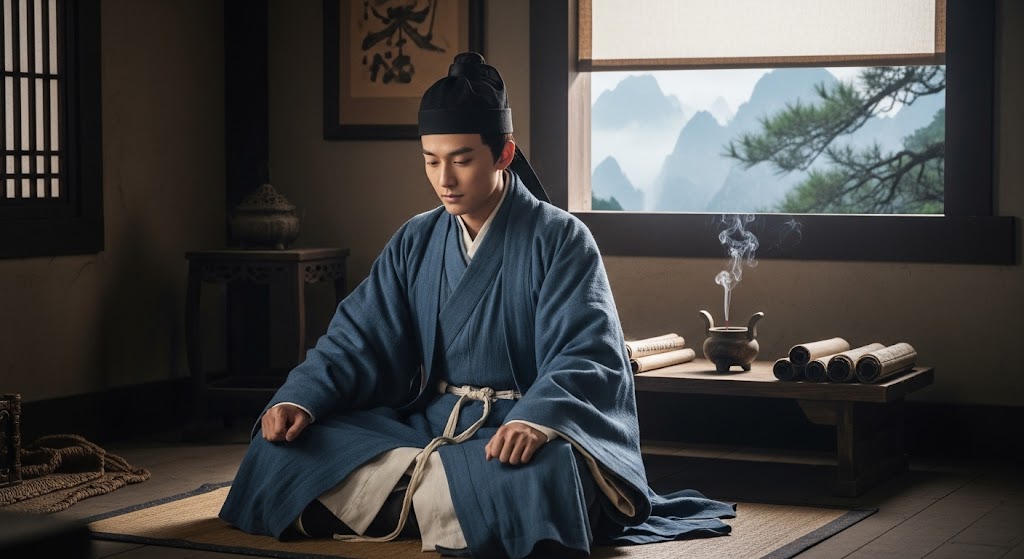
Qi Benshou, courtesy name Yangzhen, also known as Jinhui and Xiaoyaozi, was a Taoist priest from Laoshan during the late Ming Dynasty who became an Immortal. Originally from Qiantang County (an ancient place name now part of Hangzhou), he had a quiet nature, disliked worldly noise, and longed for spiritual cultivation. During the Wanli era, he met the Taoist Bai Buye and recognized him as a true cultivator. He became his disciple and followed him in practice.
The two were initially cultivated in the area around Shouchun in Jiangnan (present-day Shou County, Huainan City, Anhui Province) and later traveled together to Laoshan, located by the East China Sea. They explored the mountain’s scenic wonders and eventually arrived at Tianmen Peak. Seeing the place as divinely gifted for cultivation — remote, tranquil, and cut off from the mundane world — they settled there and built the Xiantian Hermitage to live and practice.
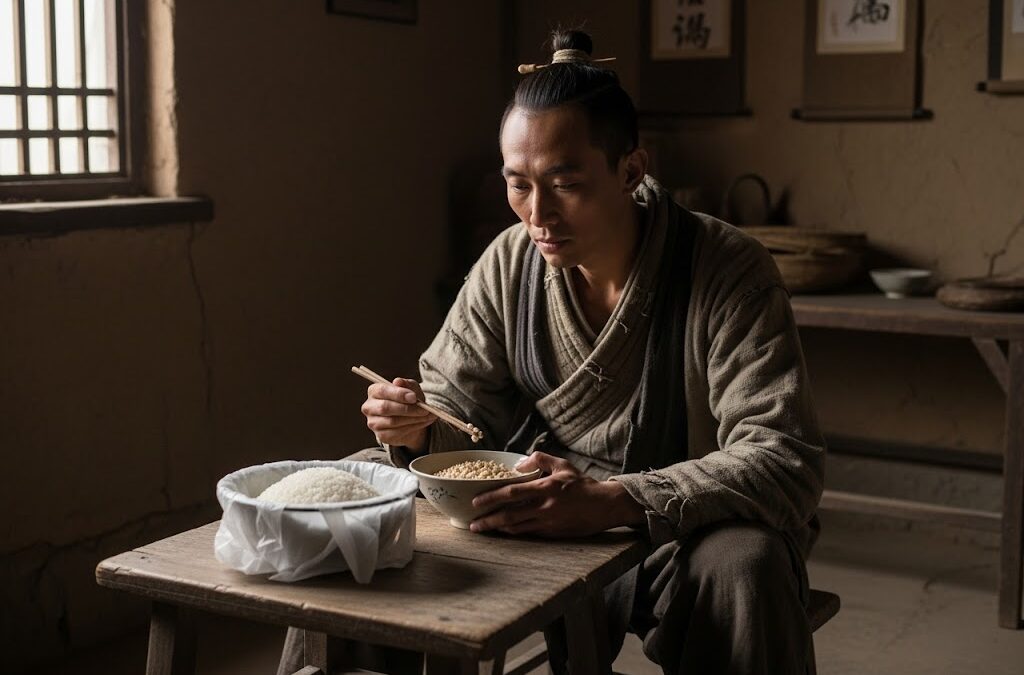
During his cultivation, Qi Benshou endured great hardship. He constantly overcame his desire to help others, willingly eating coarse grains himself so he could offer rice to others. He practiced self-restraint and benefited those around him, earning deep respect from fellow practitioners. Over the course of 21 years, he expanded the hermitage, adding three halls and two side rooms, gradually transforming the modest retreat into a thriving sanctuary. His perseverance and dedication were truly admirable.
One year, in the tenth lunar month of winter, the weather was bitterly cold. An elderly nun, appearing to be in her nineties, arrived at the Xiantian Hermitage. No one knew where she came from — she was shivering from the cold, her clothes filthy, and she begged to rest inside the hermitage. The other Taoists considered her too unclean and refused to accept her, citing reasons such as gender propriety and the need to avoid suspicion. They waved her away, urging her to leave.
Qi Benshou quickly stopped them, saying, “She seeks to survive — how can we bear to watch her die? Although men and women should avoid impropriety, in times of urgency, we must adapt. She is old and near death — what impropriety is there?” He then led her to his bed, covered her with blankets to warm her, and offered food to comfort her. The elderly nun said nothing in thanks, but Qi Benshou showed no resentment and continued to care for her attentively.
After settling her in, he sat on a meditation mat to rest. The other Taoists returned to their rooms. In the middle of the night, a brilliant white light suddenly burst from Qi Benshou’s room, illuminating the entire space and casting a glow on the whole hermitage. The Taoists were astonished and rushed to his door to ask what had happened. Qi Benshou opened the door and calmly said there was nothing unusual. Yet when they looked inside, the elderly nun had vanished. Only then did they realize she was a true Immortal in disguise, sent to test their hearts. Regrettably, they lamented having missed their chance to show compassion.
Qi Benshou becomes an Immortal
In the first month of spring in the second year of the Tianqi era (1622 CE), Qi Benshou quietly said to his teacher Bai Buye: “The Three Pure Ones are arriving — we must respectfully welcome them.” The two bowed together in reverence to the divine. After the ceremony, Qi Benshou suddenly turned to the others and said: “My merits are complete, my worldly ties are finished — I am leaving.” As soon as he spoke, he swiftly departed and vanished in an instant.
Everyone rushed to search for him and arrived at Baxian Dun, where they found one of his straw sandals. Beneath the mound lay the vast ocean. While they were still puzzled, a mountain patrol worker approached and said: “I was resting atop a rock and saw a Taoist float gracefully to this spot. He tossed something onto the sea — it looked like a meditation mat. He leapt onto it and sped off toward the southeast like lightning. I came to investigate and found this letter. Please read it.”
The letter was in verses and read: “I am a Taoist and my name is Qi Benshou. My cultivation has long been true — twenty years of meditation and bitter practice beneath Laoshan. When the Tianqi era arrives, it is time for me to journey like white clouds to Yingzhou (a sacred mountain). If you ask where I’ve gone, I roam the terraces where Immortals live.”
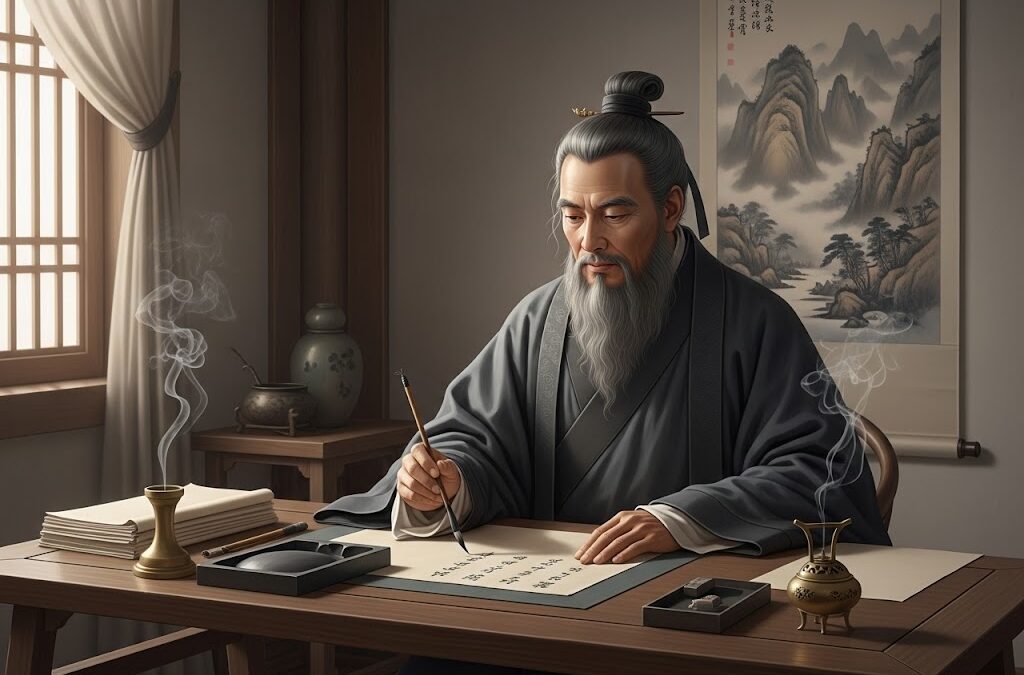
It was said that Qi Benshou had never studied or learned to write, yet upon attaining the Tao many years later, he could compose such refined verses — considered a divine miracle. The Taoists all declared he had become an Immortal. They reported the miraculous event to the imperial court, and the emperor, moved by the story, issued a special decree conferring upon Qi Benshou the title “Shangyuan True Lord of Universal Salvation and Taoist Transformation.”
Though Bai Buye and Qi Benshou were teacher and disciple in name, both were cultivators, and who achieved enlightenment first depended on who completed their merits. In the end, Qi Benshou surpassed Bai Buye through his hardship, altruism, and by passing the test of the disguised Immortal. Of course, Bai Buye’s guidance was essential to Qi’s path. The key to Qi Benshou’s transcendence was his selfless rescue of the elderly nun, proving that compassion in moments of crisis was a vital measure of spiritual attainment.
Cultivation, it seems, is not merely about sitting in meditation or practicing movements. To become a benevolent Immortal, one must show mercy and save others in times of peril — that is the proper standard.
Translated by Cecilia and edited by Amanda
Follow us on X, Facebook, or Pinterest
