
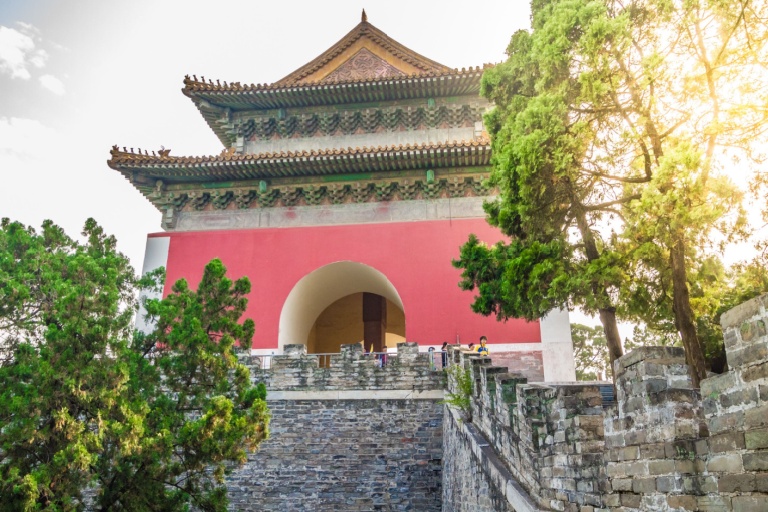
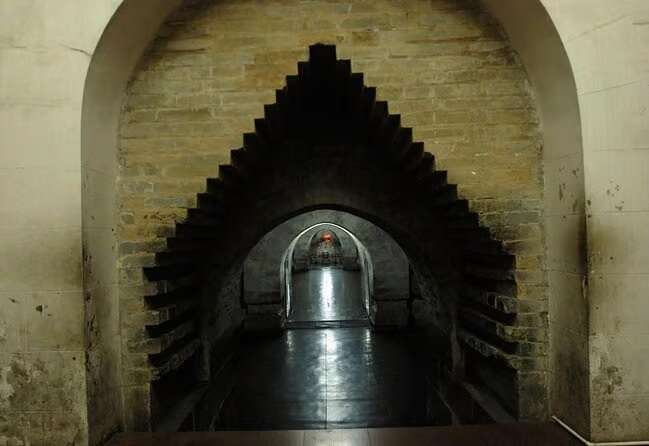
On October 5, 1957, the main gate to the underground palace of the Dingling Mausoleum was finally broken open by the archaeological team. For the first time in three centuries, the coffins of Emperor Wanli and his two empresses, along with their splendid burial treasures, were revealed to the world.
Inside lay layers upon layers of dazzling relics — each one a masterpiece of exquisite craftsmanship. Among them, the most astonishing were 69 volumes of embroidered brocades discovered in the emperor’s coffin, whose radiant colors, luxurious textures of unparalleled quality, and sheer abundance were unlike anything ever seen before.
Yet, just as the archaeologists rejoiced over their great discovery, the wheel of historical retribution began to turn. As mentioned earlier, China’s preservation technology at that time was extremely crude and primitive, and the mishandling of these priceless artifacts soon led to devastating losses.
For example, the wooden figurines unearthed from the tomb by European standards should have been preserved at ultra-low temperatures (around -200°C) through freeze-drying and sealing. But the team merely melted beeswax in a pot and coated the figurines with it to “prevent oxidation.” As a result, many of these delicate figures warped and discolored; their once-serene expressions twisted into grotesque grimaces.
The splendid silks and brocades that had shone brilliantly when first unearthed quickly disintegrated after exposure to air. Once the vacuum environment of the tomb was broken, oxidation reduced them to dust and ash. Countless precious paintings and calligraphies have oxidized, faded, and some have even turned to smoke.
Even the emperor’s magnificent kesi dragon robe — woven with an ancient and intricate silk tapestry technique that had already been lost to history — began carbonizing right there at the excavation site. A single skilled artisan in ancient times could produce only an inch of kesi per day; a single robe took 10 years of continuous weaving. Yet such a treasure of immeasurable historical and artistic value was destroyed in a moment of carelessness.
The damage continued: Some archaeologists applied plasticizers to the ancient textiles, hoping to preserve them, only to find the fabrics turning black, brittle, and crumbling to dust. Many metal artifacts have also corroded and deformed due to poor storage. Out of the more than 3,000 items unearthed from Dingling, few survived intact. Most of what is displayed in the Dingling Museum today is mere replicas — shadows of the glory that once was.
If the destruction of the burial relics due to ignorance and mishandling was tragic, then what happened next — the deliberate destruction of the imperial coffins themselves — was nothing short of unforgivable.
The desecration of the Dingling coffins
On September 30, 1959, the Dingling Museum was officially established and prepared to open to the public. That morning, Wang Qifa — the worker who had first broken ground at the tomb when it was excavated — received an order from the museum’s office director.
“The museum is opening soon,” the director said. “Since we’ve already made replicas of the emperor’s and empresses’ coffins, the originals are no longer needed. Take a few men to clean the underground palace and dispose of the coffins. We need everything tidy before the leaders come to inspect.” Three imperial coffins, the sacred resting places of an emperor and two empresses, were to be treated as garbage.
Though uneducated, Wang Qifa was deeply troubled. He thought to himself, We’ve toiled all these years to find these imperial coffins — the very heart of the tomb! The scholars told us every single artifact was priceless. How can we discard them? Hesitant, he tried to reason with the director: “This doesn’t seem right.” The director glared and barked, “What’s not right? Do as you’re told. Take off the bronze rings, chop the coffins into wood strips, and throw them away!”
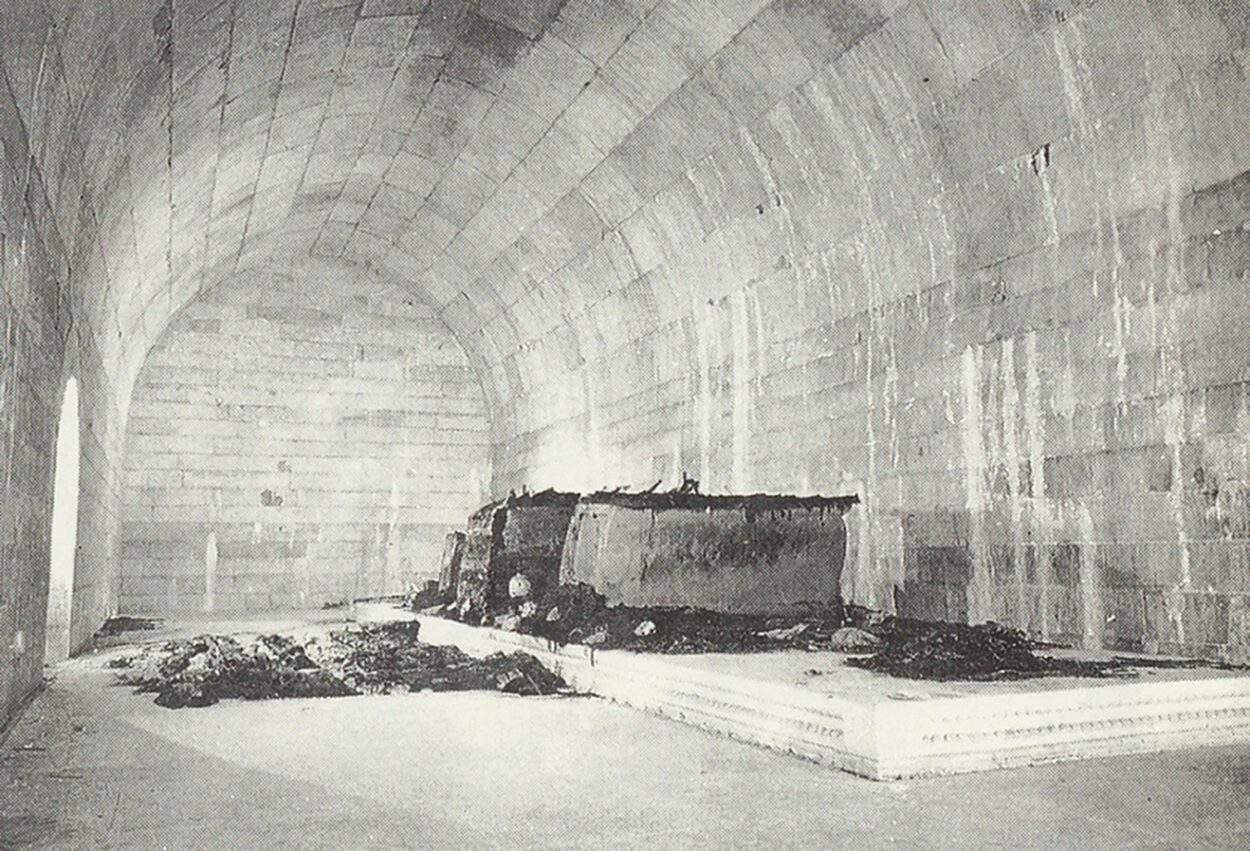
The workers surrounded the coffins — made of precious, fragrant golden nanmu wood — and began prying off the bronze fittings. Despite lying underground for more than three centuries, the wood remained as solid as stone, with only slight traces of corrosion. Just removing the copper rings exhausted them. Wang watched with grief and anger. Summoning his courage, he pleaded: “Please, let’s not destroy them. If there’s no space in the warehouse, at least store them in a corner.” The director’s eyes flashed with suspicion. “What, you want to keep the coffins for yourself?” he sneered.
Wang’s face flushed with humiliation and anger, but it was the height of the Anti-Rightist Movement, and disobedience could bring disaster. He bit back his words and went outside to smoke in silence. The director, angry at Wang’s quiet protest, called in several armed guards. Together, they dragged the imperial coffins out of the tomb and dumped them into a mountain ravine.
A week later, when Xia Nai — the deputy director of the Archaeological Research Institute — learned what had happened, he was thunderstruck. His whole body trembled, his face went pale, and he immediately phoned the museum, demanding that the coffins be recovered at once and be preserved carefully. But by then, it was too late. The ravine was empty — the imperial coffins had vanished without a trace.
So where did they go?
See Part 1 here
See Part 2 here
Translated by Katy Liu
Follow us on X, Facebook, or Pinterest
