
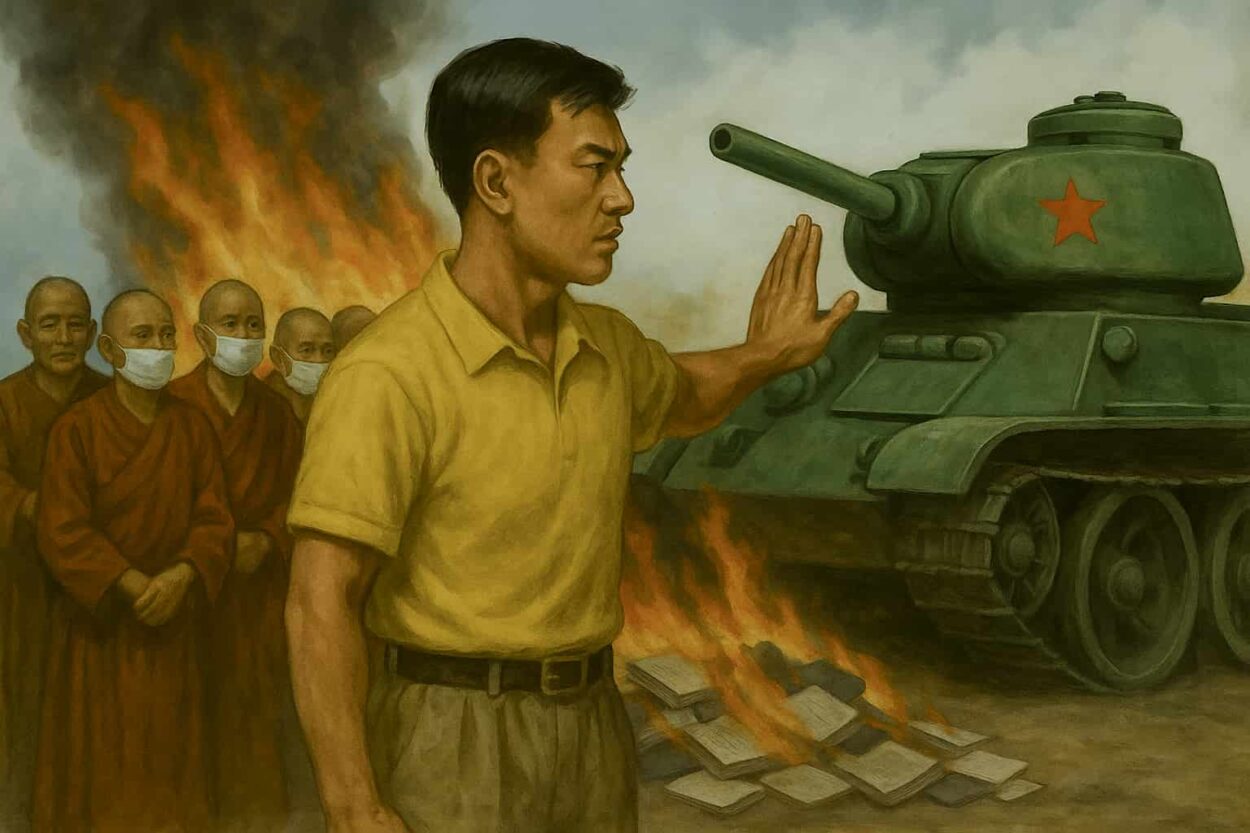
The debate over Mao Zedong’s moral legacy is often reduced to statistics and political slogans; however, Lu Di’s forbidden two-volume study argues that the deeper story lies not in numbers, but in how Mao reshaped China’s moral, psychological, and cultural foundations. His book, circulating mostly outside the mainland, dissects not only the historical record, but the transformation of conscience itself.
On a quiet street in Taipei, hidden between cafés and stationery shops, stands a small independent bookstore where mainland tourists sometimes wander in by accident. The shelves are crowded with the usual exports — Taiwanese fiction, travelogues, cookbooks — but in a far corner sits a thick, two-volume work with an unassuming white cover.
The title, printed in traditional Chinese characters, reads: 《毛泽东全方位解剖》— Mao Zedong: A Full-Spectrum Dissection.
Few inside the People’s Republic of China will ever hold this book in their hands. It exists there mainly as a rumor — a whisper in online forums, a PDF circulated through VPNs, a reference in overseas essays smuggled back into the mainland’s digital underworld. Published in Taiwan, written by an exiled scholar, and filled with the sort of analysis that Chinese censors categorize as “historical nihilism,” the book is not simply banned. It is unmentionable.
Yet for those who do find it, Lu Di’s work is not merely a biography. It is a moral autopsy. A study not only of Mao’s political legacy but of the psychological architecture he left behind — a system of fear, obedience, and ideological performance that reshaped the inner life of a nation.
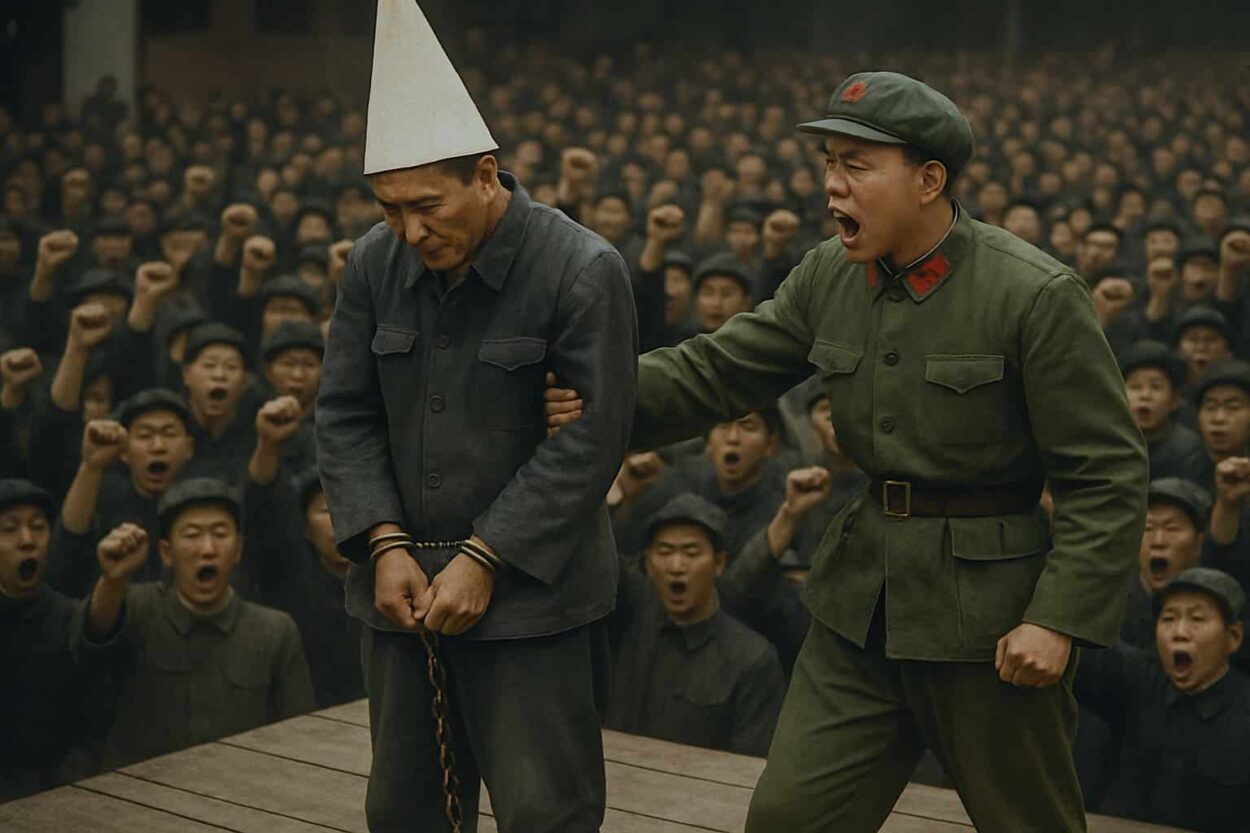
What makes this book dangerous is not its numbers, its estimates of famine deaths, or victims of political campaigns. Those numbers matter, but they are not the book’s core. What threatens the official narrative is something deeper: the insistence that Mao’s greatest impact was not physical but moral — what he did to China’s conscience, its language, and its ability to think independently.
How one man became four: The framework of a forbidden biography
Lu Di, the author, was born in the late 1940s and grew up inside the ideological storms he now dissects. Like millions of others, he lived through the Cultural Revolution, was sent to the countryside, returned to the city, and later left China for academic research abroad.
His writing carries the quiet intensity of someone who has spent decades thinking about the contradictions of his birthplace — how a society with such ancient moral roots could be remade so quickly into something unrecognizable.
His biography of Mao is structured not around chronology but around four archetypes:
- Mao the thinker
- Mao the strategist
- Mao the poet
- Mao the statesman
Each role, he argues, reveals a different layer of the same personality — a personality that, when placed at the helm of a revolutionary state, produced a unique form of political culture.
Understanding Mao the thinker
Lu Di does not treat Mao as a philosopher in the classical sense. To him, Mao is a practical manipulator of ideas, someone who uses ideology less as a framework of truth and more as a flexible toolkit for justifying action.
Mao’s theoretical writings are dissected with unusual precision: the slogan “one divides into two,” the doctrine of “continuous revolution,” and the notion of “principal contradictions” are examined not as coherent theories but as rhetorical devices — ways of shifting intellectual ground to maintain the perpetual necessity of struggle.
This is one of Lu’s most unsettling insights:
Mao did not use ideology to interpret reality; he used ideology to remake reality according to his political needs.
As a result, the nation’s intellectual culture gradually adapted to his method. What was rewarded was not logic but obedience; not accuracy but alignment; not moral clarity but strategic ambiguity.
For Lu, Mao’s “thought” becomes a system for dissolving independent reasoning, a political chemistry designed to break down stable categories of right and wrong and rebuild them under a single axis of loyalty.
Mao the strategist: the architect of uncertainty
If Mao’s philosophy reshaped people’s inner logic, his strategic genius reshaped their external behavior. Lu Di argues that Mao’s true mastery lay not in military brilliance — an image often celebrated in official narratives — but in manipulating human relationships.
He traces Mao’s patterns across decades:
- Pitting rivals against each other.
- Frequent purges followed by rehabilitation.
- Encouraging mass campaigns to weaken bureaucratic power.
- Creating cycles of chaos that only he could interpret or resolve.
This created a political environment in which instability was deliberate, not accidental. Each campaign — Yan’an Rectification, the Anti-Rightist Movement, the Cultural Revolution — functioned as an ideological reset button. Yesterday’s hero could be today’s enemy; today’s enemy might be tomorrow’s rehabilitated comrade.
In such a world, the only safe behavior was absolute conformity.
Lu’s deeper point is that Mao’s strategic style filtered down into daily life. It became part of the national temperament:
- Families hid their thoughts from one another.
- Teachers feared their students.
- Citizens learned to read subtle political winds, adjusting their speech and posture accordingly.
- Truth became less important than timing.
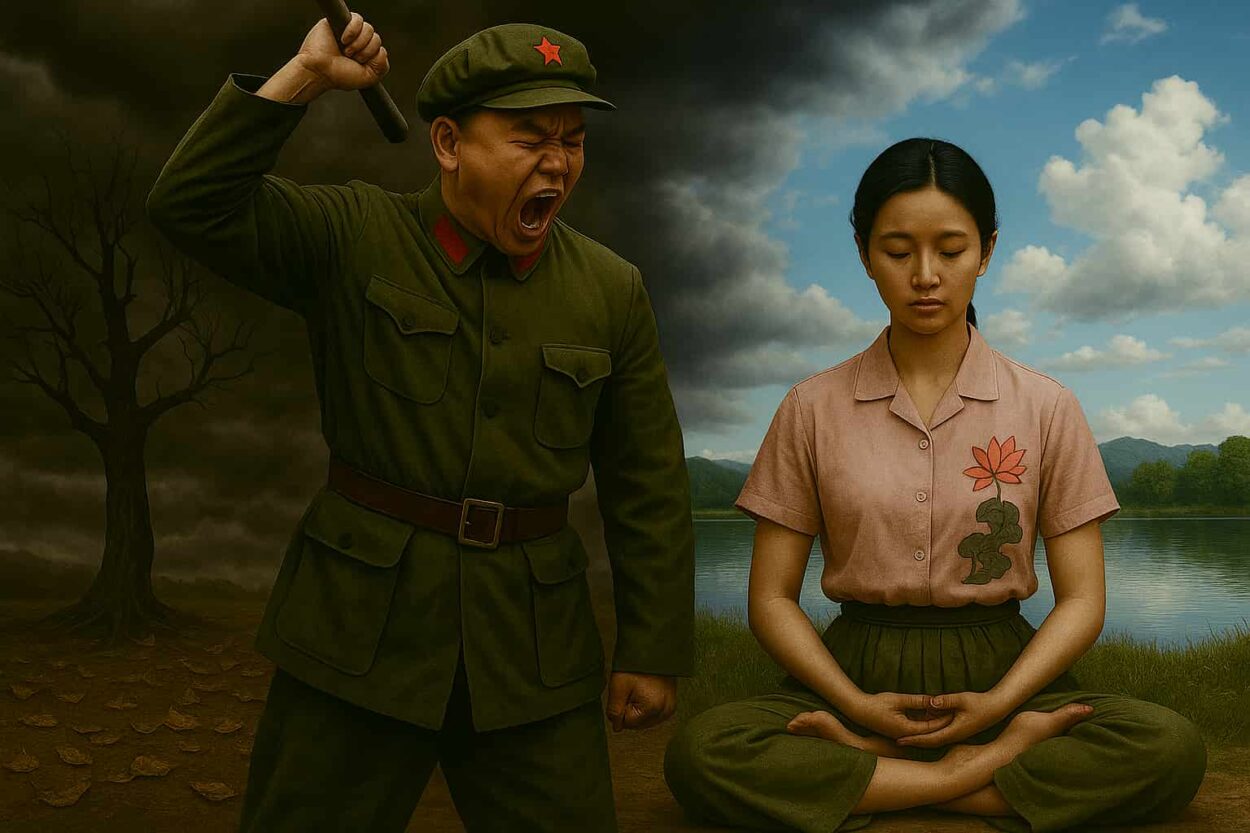
This is the moral environment Lu describes — a world where sincerity is dangerous, and survival requires constant performance.
Mao the poet: the tragedy of self-mythologizing
Lu Di approaches Mao’s poetry with surprising sensitivity. He acknowledges the genuine beauty in Mao’s early works — poems filled with youthful ambition, lyrical mountain landscapes, and the romantic energy of revolution.
But as Mao’s power grew, Lu argues, the poetry hardened. It lost nuance, replacing human sentiment with heroic abstraction. Mao’s literary voice became overshadowed by the mythic persona he cultivated.
More importantly, Mao’s poetic style became the nation’s poetic style. Writers were expected to imitate the heroic cadence of Mao’s verse, glorifying labor, sacrifice, and revolutionary fervor. Art was conscripted into political service.
Lu sees this not merely as literary loss but as a symbol of how culture itself was transformed — how artistic expression, like morality and logic, was re-scripted to reinforce ideological obedience.
Mao the statesman: power through fear and moral inversion
The book’s second volume examines Mao’s governance: land reform, collectivization, the Great Leap Forward, political purges, and the Cultural Revolution.
Here, Lu’s analysis moves from psychology into ethics. He argues that Mao built a political system that inverted traditional moral codes:
- Violence became a sign of ideological purity.
- Harshness became a sign of commitment.
- Suspicion became a sign of vigilance.
- Public humiliation became a form of justice.
- Destroying “enemies” became a moral obligation.
What shocked Lu, he writes, was discovering how many ordinary citizens — people with no history of cruelty — participated in or tolerated acts that violated their own moral instincts. To him, this was the most tragic part of Mao’s legacy: not the campaigns themselves but what they forced people to become.
How fear became a social language
One of Lu’s most powerful insights is his exploration of fear as a political technology. Under Mao, fear was not random; it was systematic. It operated through:
- Self-criticism sessions
- Public denunciations
- Constant ideological study
- Shifting definitions of “enemy”
- Unpredictable political winds
Fear taught people to overwrite their own instincts. They learned to present two faces: one for the outside world, another for private survival. This trained moral reflexes to bend not toward truth but toward safety.
This is where Lu’s analysis moves beyond history into psychology. He argues that Maoism created a dual consciousness:
- External conscience: perform obedience
- Internal conscience: bury disagreement
The result was a society where moral clarity dissolved. People did not forget what was right; they learned that rightness was irrelevant to survival. And once that happens, Lu writes, a culture enters long-term ethical limbo.
The unresolved moral wound
One of the most striking parts of Lu’s book is his argument that the past remains unresolved not because people refuse to remember but because they were never allowed to speak openly.
Many older generations still carry private stories like the following:
- A relative lost in the Great Leap Forward.
- A friend humiliated during the Cultural Revolution.
- A teacher imprisoned for a comment in class.
These stories rarely reach the public sphere. Silence, inherited across generations, becomes its own kind of memory.
Lu believes this silence is not just political; it is psychological. A person cannot heal from trauma that they are not allowed to name. A nation cannot process its past if its past is deemed too dangerous for discussion.
This is why his book is so threatening: it restores names to nameless tragedies, causes to what are officially described as “mistakes,” and moral responsibility to what textbooks describe as “complex conditions.”
Why the Party cannot allow this book to circulate
Lu’s work crosses multiple red lines of modern Chinese censorship:
1. It challenges foundational myths
Mao remains a core symbolic figure. Challenging Mao’s moral authority challenges the Party’s foundational legitimacy. Even today, criticisms of Mao are carefully bound.
2. It questions the official interpretation of history
For decades, the Party has maintained a formula: “Mao was 70% correct, 30% wrong.” Lu’s analysis does not fit this balance. He sees Mao’s errors not as deviations but as expressions of a consistent worldview.
3. It rehumanizes victims by naming moral responsibility
Official narratives emphasize collective responsibility — “the masses made mistakes.” Lu’s analysis assigns responsibility to the top. This shift from collective to individual accountability is politically explosive.
4. It exposes the psychological mechanisms of control
The Party can tolerate limited discussion of historical events. What it cannot tolerate is analysis that reveals how authority shapes thought, behavior, and moral instincts.
Lu’s book does precisely that.
The deeper message: It was never only about numbers
In public debates, arguments often revolve around numbers:
Was it 20 million deaths? 30? 45?
Lu Di does not minimize these tragedies, but he insists that moral judgment does not hinge on arithmetic. Whether the famine killed 20 million or 30 million, the fundamental reality remains: national-scale suffering was the result of political decisions, not inevitable natural disasters.
What matters more, he argues, is understanding the system of thought that made such suffering possible — a system in which:
- dissent was seen as betrayal
- mistakes were hidden to protect image
- ideology outweighed evidence
- obedience outweighed expertise
- political purity outweighed human life
These patterns, Lu warns, do not disappear simply because the campaigns have ended. Institutions change their surface; psychological legacies linger beneath.
How Mao Zedong’s moral legacy shaped a generation’s conscience
What makes Mao Zedong: A Full-Spectrum Dissection so haunting is not only its critique of Mao, but its portrait of ordinary people caught in a shifting ideological universe.
Lu Di is not condemning a nation; he is mourning it.
He suggests that the actual damage of Mao’s rule was not a series of catastrophic policies, but the creation of a social environment where morality became conditional.
Many Chinese citizens did not willingly abandon their moral values; they were forced into patterns of behavior that contradicted their inner ethics.
Over time, this creates lasting wounds: silence, confusion, generational trauma, and the difficulty of articulating dissent.
Can a society heal without telling the whole truth?
Every nation carries its scars, but not every country is permitted to name them. Some wounds are allowed to surface, to be studied, debated, grieved over. Others remain submerged, visible only through subtle distortions in the culture — taboos, anxieties, silences inherited like family heirlooms.
Lu Di argues that Mao-era China falls squarely into the latter category. The trauma is vast, but the language to describe it is restricted; the memories exist, but the framework to process them is absent. The result is a society suspended between remembrance and forgetting — caught in what psychologists call “unresolved trauma,” where the past is ever-present precisely because it cannot be spoken clearly.
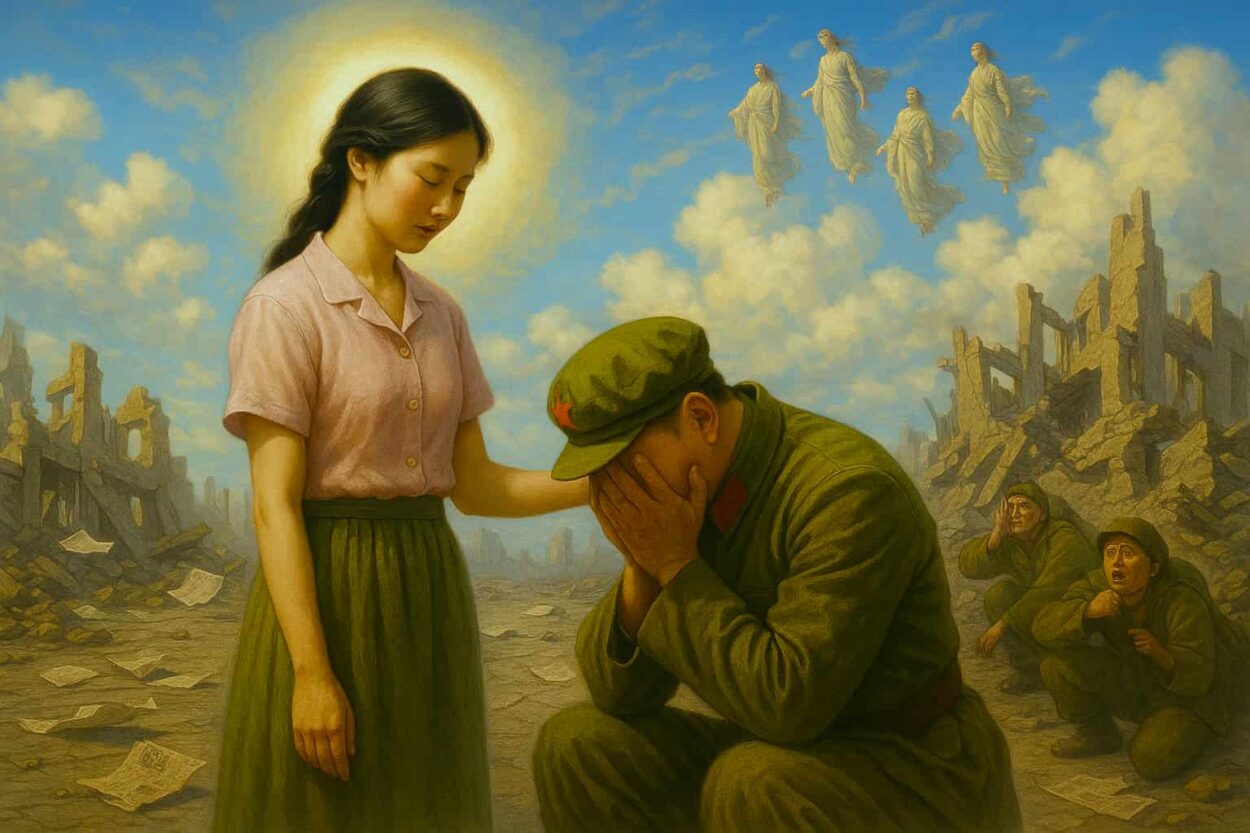
For Lu, healing is neither abstract nor symbolic. It requires specific, foundational acts, each of which has historically been difficult — or forbidden — in China.
Remembering openly
The first step is the simplest and the most perilous: to remember honestly.
In many societies, confronting historical trauma involves public inquiries, judicial processes, or national conversations. But in China, discussions of the Great Leap Forward, the famine, the Anti-Rightist Movement, or the Cultural Revolution remain tightly controlled.
What the state describes as “complex lessons” or “difficult periods” are, in Lu’s view, deep human tragedies, each with names, families, choices, and consequences.
To remember openly would mean:
- acknowledging the suffering without euphemisms,
- recognizing ordinary citizens as moral agents rather than passive participants,
- and allowing survivors to speak without fear.
This is not just about setting the record straight; it is about restoring dignity to people whose experiences were buried under statistics or political language.
Assigning moral responsibility
Healing also requires clarity about responsibility — not to punish, but to understand.
Lu argues that one of Maoism’s enduring legacies is the diffusion of blame. Because each campaign was carried out by “the masses,” responsibility becomes blurred across millions of shoulders. The logic is circular: if everyone is responsible, then no one is specifically responsible; if the nation collectively erred, then it is improper to single out individuals who initiated or directed the violence.
This produces a moral fog.
People know something terrible happened, but the cause appears abstract, almost natural — “chaos,” “mistakes,” “excesses,” “misunderstandings.”
Lu insists that naming responsibility is not an attack on any group. It is the beginning of moral clarity.
Just as families cannot heal without acknowledging who harmed whom, nations cannot restore their moral balance without identifying the forces that shaped their history.
Understanding how a system manipulates conscience
One of Lu’s most urgent contributions is his exploration of how ideology can rewire moral instincts.
Mao’s campaigns were not simply political decisions; they were psychological architectures. They trained people to doubt their natural impulses, to fear their private judgments, and to replace personal conscience with ideological survival strategies.
Understanding this manipulation is essential to healing because it enables individuals to reinterpret their past actions. Instead of seeing themselves as villains or cowards, they can begin to see the environment that pressured them into impossible choices.
In Lu’s view, this process is liberating. It breaks the inherited pattern of silence. It allows people to look back without shame or fear. And it enables new generations to understand the pressures that shaped their parents and grandparents.
Rebuilding trust between citizens
Trauma fractures trust — not only in institutions but in one another.
During mass campaigns, people were often forced to participate in criticism sessions, report on neighbors, or denounce colleagues. These actions created deep interpersonal wounds that many families never discussed openly.
The residue of this distrust is visible even today:
- People avoid political discussion in public.
- Social caution becomes a default posture.
- Individuals maintain a separation between private beliefs and public speech.
Lu argues that truthful remembrance is the only way to rebuild this trust. When a society can speak openly about why people behaved as they did — not as evidence of moral weakness but as the predictable result of an unbearable system — relationships can begin to repair.
Trust cannot grow in silence.
It requires mutual recognition of a shared past.
Reestablishing moral clarity beyond political alignment
Perhaps the deepest injury Lu identifies is the erosion of moral independence. Under Mao, ethics were subordinated to ideology; actions were judged not by universal moral standards but by their alignment with political goals.
This created a generation of citizens who learned to measure morality by proximity to power rather than principles. Even after the political storms passed, the habit remained: caution first, conscience second.
Lu believes that healing requires restoring a sense of morality that is:
- universal rather than situational,
- grounded in human dignity rather than political necessity,
- and capable of critiquing both past and present without fear.
This, he writes, is not nostalgia for traditional values or a rejection of modern political life. It is an attempt to recover the basic human intuition that some acts are wrong no matter who orders them.
Why Lu Di writes from exile
This is why Lu’s work exists outside China: not by choice, but by necessity.
Inside the mainland, a book that dissects Mao’s psychology, analyzes his manipulation of moral norms, and examines the psychological impact of mass campaigns would be impossible to publish.
Even sympathetic scholars would be required to soften, neutralize, or omit large sections.
For Lu, writing abroad is not an act of rebellion — it is an act of fidelity.
Fidelity to memory.
Fidelity to the people whose lives were shaped by forces they could not control.
Fidelity to the truth that trauma does not dissolve simply because it becomes politically inconvenient.
To him, the book is moral testimony — a document meant to withstand time, politics, and the shifting boundaries of permissible speech. It is a way of ensuring that, even if official narratives suppress certain truths, those truths do not vanish. They remain accessible to anyone willing to look, think, and remember.
Conclusion: the cost of forbidden memory
Mao Zedong: A Full-Spectrum Dissection is more than a biography. It is a guided tour through one of the most consequential moral transformations in modern history. It asks questions that remain unresolved:
- What happens when a society’s moral compass is replaced by ideology?
- How long do the psychological effects of fear and obedience last?
- Can a nation examine its past honestly while its founding myth remains sacred?
- What does healing look like when silence has become a cultural reflex?
In the end, Lu’s book offers neither condemnation nor absolution.
It offers clarity.
Clarity about what was lost.
Clarity about the systems that made it possible.
And clarity about the courage required to confront the past, not to assign blame but to recover moral ground.
The book survives because readers, both inside and outside China, sense that something essential remains unspoken. They read Lu’s words not out of political defiance but out of a human desire to understand how a society’s moral universe can shift so dramatically — and how it might be rebuilt. In this way, Lu Di becomes not merely a historian of Mao, but a historian of memory, reminding his readers that the greatest injustices are not only those that took lives but those that reshaped the meaning of right and wrong.
Follow us on X, Facebook, or Pinterest
