
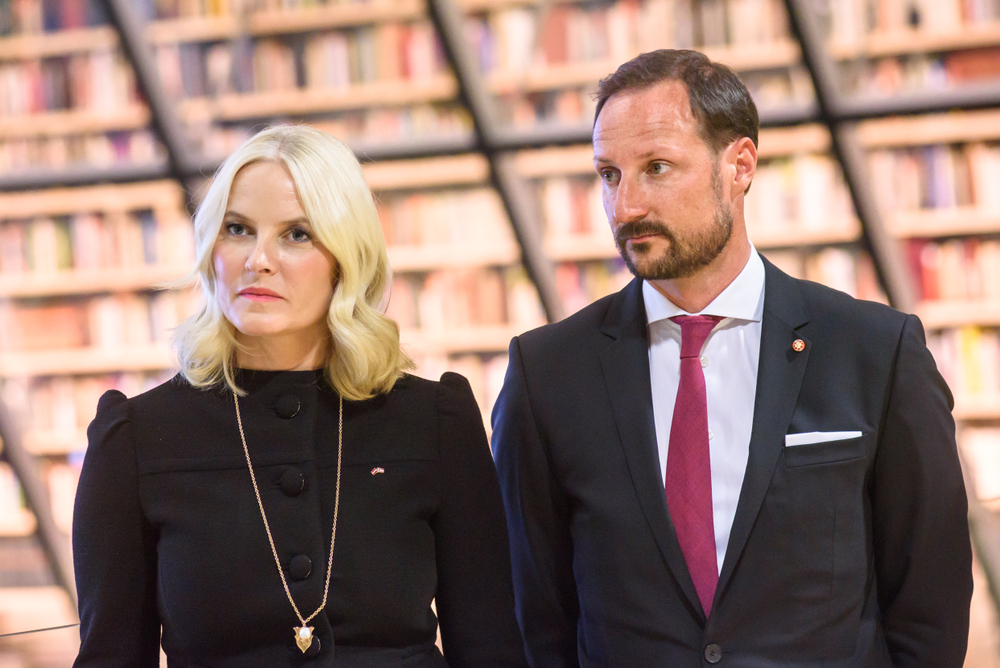
By the time Crown Prince Haakon made his choice, the consequences were unavoidable. His decision to stand by Mette-Marit had already placed the monarchy under unprecedented strain, and public opinion remained deeply divided.
What followed would no longer be decided behind palace walls. It would unfold in full view of the nation.
Truth and redemption
The turning point came three days before the wedding.
On August 22, 2001, the royal communications team made a decisive choice: silence would no longer serve them. The truth would have to be faced openly.
Inside the press conference hall at Oslo’s Royal Palace, the atmosphere was tense. Journalists from around the world crowded the room, cameras trained on the doors, prepared to witness a moment that could determine the future of Norway’s monarchy.
When the doors opened, Crown Prince Haakon entered holding Mette-Marit’s hand. She wore a simple pale blue blouse, her hair pulled back without ceremony. Her face was drained of color. Fear flickered in her expression, but the firmness of her grip on Haakon’s hand revealed resolve beneath the anxiety.
She took her seat, adjusted the microphone, and began to speak. Her voice trembled, but she did not read from prepared notes. Instead, she chose to speak plainly.
“My teenage years were marked by rebellion,” she said, pausing as tears welled in her eyes. “Compared with many others, I lived more recklessly. We crossed boundaries — not only for excitement, but to challenge authority.”
The room fell silent, broken only by the steady clicking of camera shutters.
“I lived a dissolute life,” she continued, using the phrase levd et utsvevende liv. “I regret it deeply. If I could erase those years, I would. But that is not possible.”
She looked up and addressed the nation directly, asking for the chance to prove that she had changed. She pledged to distance herself completely from drugs and to devote her future work to opposing them.
Throughout the statement, Haakon held her hand, offering quiet reassurance. The broadcast reached homes across Norway. Many who had expected defiance or evasion instead saw a woman acknowledging her past without excuses.
Public reaction shifted almost overnight. What Norwegians saw was not an opportunist seeking status, but someone accepting responsibility and asking — without entitlement — for understanding. That level of openness, and the risk it carried, gave space for something that had been absent from the debate: forgiveness.
Gradually, the question changed. Perhaps a future queen who understood hardship, who had known failure and regret, might be better equipped to understand the people she would serve than someone untouched by adversity.
A soul that glows
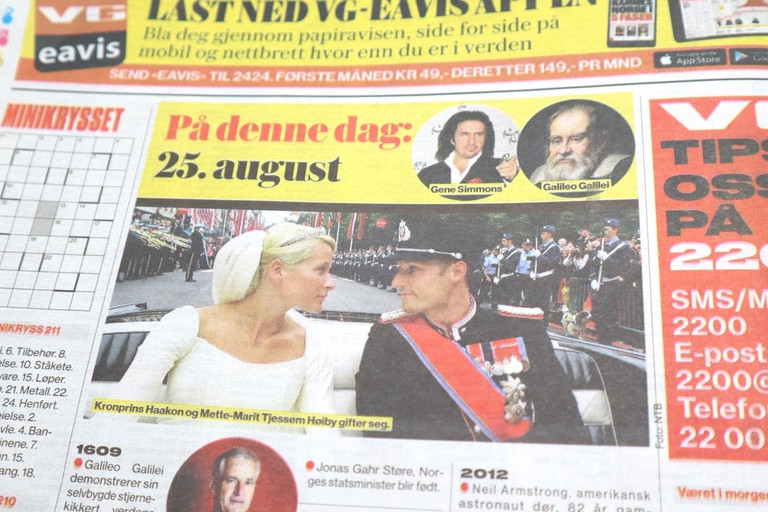
On August 25, 2001, the couple was married at Oslo Cathedral.
The ceremony, widely described as the first royal wedding of the new millennium, brought together European royalty beneath arches filled with flowers. When Mette-Marit walked down the aisle in a minimalist silk gown, holding a cascading bouquet, she no longer appeared as the rebellious young woman from Kristiansand. She was stepping into her new role as Norway’s Crown Princess.
Two moments from that day would come to define the wedding.
The first involved her son, Marius. Traditionally, children born outside of marriage had an uneasy place within royal ceremonies. But that day, the 4-year-old appeared confidently as a pageboy, dressed in a small formal suit. When the newly married couple later stepped onto the palace balcony, Haakon lifted Marius into his arms so he could see the cheering crowd. The gesture was unmistakable: He had not only married Mette-Marit, but had fully accepted her past and her child as part of his family.
The second moment came during Haakon’s speech at the wedding banquet. Before the King, the Queen, visiting heads of state, and the Norwegian public, he addressed his wife directly.
“Mette-Marit,” he said, “I am grateful that I met you. Your strength fills me with admiration, and your vulnerability moves me deeply.”
He paused before continuing, his voice unsteady.
“Your soul shines,” he said. “I do not only love you — I need you.”
The simplicity of the words resonated across the country. This was not a political alliance or a calculated match, but a declaration grounded in shared struggle. Later, Bishop Gunnar Stålsett would summarize it succinctly: they had not chosen the path of least resistance — but love had prevailed.
The weight and warmth of the crown
Fairy tales often end at the wedding. Real life does not.
Marriage marked the beginning of a demanding transformation for Mette-Marit. She had to master royal protocol, study languages and history, and learn to function under constant public scrutiny. Early on, the press criticized her clothing, questioned her spending, and mocked her accent. The pressure took a toll. She developed a fear of flying and often appeared visibly tense at public engagements.
Still, she persisted. She returned to formal study at the University of Oslo and later at the School of Oriental and African Studies in London, earning a master’s degree in management. She became a Special Representative for UNAIDS, traveling to underserved regions in Africa and advocating for people living with HIV — many of whom, like her younger self, had been pushed to the margins of society.
She also championed literature, traveling across Norway by train to promote reading and access to books.
Over time, public perception shifted again. Mette-Marit brought a sense of warmth and approachability to the monarchy. She laughed easily, embraced people in the rain, and spoke openly about uncertainty and effort. Her imperfections, once used against her, became a source of connection. The royal family felt less distant, more recognizably human.
Together, she and Haakon had two children — Princess Ingrid Alexandra and Prince Sverre Magnus — while continuing to raise Marius as a central part of their family. Their household came to represent a modern, blended family within an ancient institution.
Dancing with death
In 2018, the royal family announced that Mette-Marit had been diagnosed with chronic pulmonary fibrosis — a rare, progressive illness that gradually restricts breathing and has no cure.

For someone still in midlife, the news was devastating. The condition would impose permanent limits on her health and energy, and carry uncertainty about the future.
Once again, Haakon adjusted his life around hers. He reduced public engagements and remained close whenever her condition worsened. In public appearances, he was often seen supporting her physically and attentively, his concern evident.
Illness altered the rhythm of their lives, but it also deepened their sense of perspective.
“It has made us value each day more,” Mette-Marit said in an interview. “The illness forced me to slow down. It reminded me that what matters most is not duty or titles, but being with the people you love.”
They continued to appear together — attending events, skiing when possible, sharing moments of quiet affection. Their relationship, tested repeatedly, carried a new steadiness shaped by acceptance and care.
An unfinished story
More than two decades have passed since their paths first crossed. In hindsight, the story of Haakon and Mette-Marit extends far beyond the familiar outline of a fairy tale.
Cinderella was chosen for a glass slipper. Mette-Marit was embraced only after she set aside every pretense and stood openly within her own history.
This is a story about courage: the courage to admit mistakes, to confront judgment, and to accept responsibility. It is also a reflection on modern monarchy — suggesting that its legitimacy no longer rests on spotless lineage, but on empathy, accountability, and shared humanity.
On Norway’s long winter nights, the lights of the Royal Palace still glow. Inside lives a future king and queen, once doubted by their country, who have spent years proving that commitment and honesty can endure public scrutiny.
Haakon was right when he spoke at their wedding. Mette-Marit’s soul does shine — not brightly or theatrically, but with the steady light of someone shaped by experience, tempered by hardship, and still willing to hope.
Their story, like all real ones, remains unfinished.
See Part 1 here
Translated by Audrey Wang
Follow us on X, Facebook, or Pinterest
