

Ampère’s discovery reveals how scientific progress often depends on selective forgetting. In the popular imagination, science advances by accumulation — each discovery stacking neatly atop the last, errors corrected, truths refined. Yet the deeper one looks into its history, the more it resembles a process of careful subtraction. Certain ideas are not disproven so much as quietly set aside, deemed too unwieldy, too complex, or too resistant to calculation to survive the march toward usable knowledge.
What remains is often elegant and powerful — but also narrower than it first appears. This story follows two such disappearances, separated by a century but bound by a shared logic: the sidelining of André-Marie Ampère’s richer electrodynamics and the erasure of the ether from physics. Together, they reveal how scientific convenience can shape not only what we know, but what we stop asking — and why some of today’s greatest cosmic mysteries may be asking us to remember what was once left behind.
When science forgets is how convenience shapes what we call truth
Science is often described as a self-correcting enterprise — a relentless march toward truth, guided by evidence and reason. Yet its history tells a more complicated story. Again and again, science has made progress not only by discovering new truths, but by discarding old ones. Some of those discards were necessary. Others were pragmatic. A few, in hindsight, may have been premature.
What tends to survive is not always what is most complete, but what is most manageable: theories that are calculable, teachable, and usable. Over time, these choices harden into orthodoxy. What once looked like a temporary simplification becomes mistaken for reality itself.
This article is about two such moments of forgetting. The first concerns a largely neglected aspect of electromagnetism uncovered by André-Marie Ampère in the early nineteenth century. The second concerns the removal of the ether from physics by James Clerk Maxwell and Albert Einstein — and the parallel path taken by Nikola Tesla, who never accepted that removal.
Together, these stories reveal something deeper than technical disagreement. They show how a scientific mindset — what questions are permitted, what complexity is tolerated, what is considered “reasonable” — shapes not only answers, but the very landscape of inquiry.
The uncomfortable richness of Ampère’s discovery
In 1820, the Danish physicist Hans Christian Ørsted demonstrated that an electric current could deflect a compass needle. Electricity and magnetism, previously separate domains, were suddenly linked. The news spread quickly across Europe.
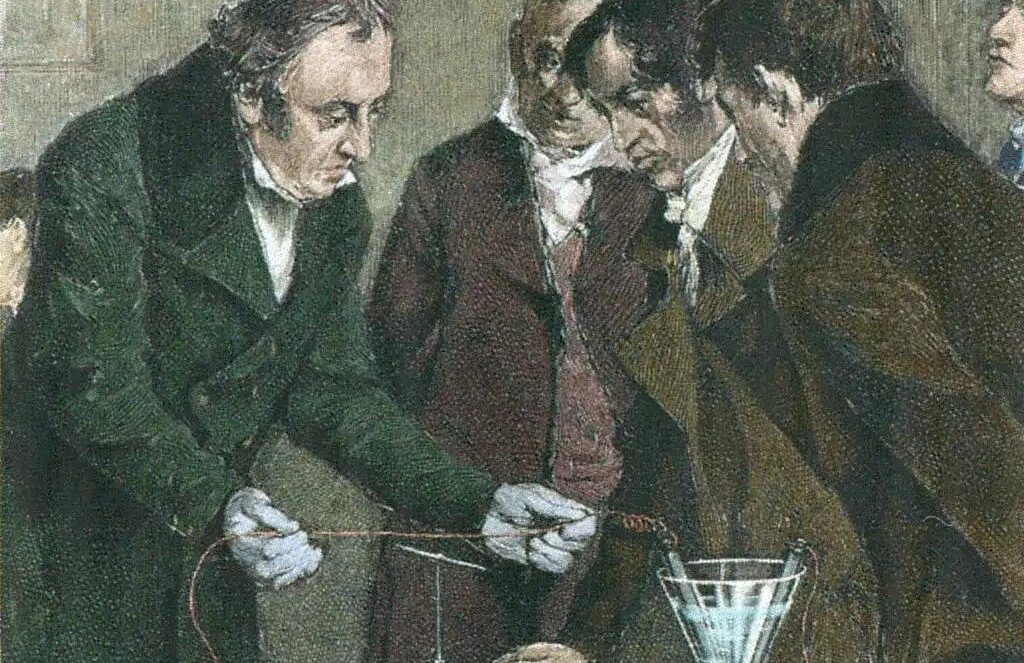
In Paris, André-Marie Ampère responded with extraordinary speed. Within weeks, he was presenting experiments to the French Academy of Sciences showing that parallel currents attract and opposite currents repel. This alone would have secured his place in history. But Ampère went further.
Rather than treating magnetism as a mysterious field surrounding wires, Ampère asked a more radical question: What forces do currents exert directly on one another? Over the following years, he developed a full theory of what he called électrodynamique — a theory of direct force interactions between current elements.
Ampère’s formulation was meticulous. He treated electric currents as real physical entities, composed of moving charges, and derived the forces between infinitesimal elements of those currents. Crucially, his law predicted two components of interaction: A transverse attraction, which we now recognize as the magnetic force. A longitudinal interaction, acting along the line of motion, is repulsive when charges move in the same direction, and attractive when opposed.
Both components emerged from a single force law that depended on geometry. Ampère was not speculating. He devised ingenious experiments — using tightly wound coils and carefully arranged conductors — to isolate these effects. His measurements were precise enough that later physicists, including James Clerk Maxwell, would praise them as exemplary.
Maxwell himself called Ampère’s work “one of the most brilliant achievements of science,” noting that Ampère’s law satisfied Newton’s third law more rigorously than any competing formulation. At the time, Ampère’s ideas were not controversial. They fit comfortably within the Newtonian worldview of forces acting directly between bodies. So why did they disappear?
Bookkeeping triumphs over completeness
As the nineteenth century progressed, physics faced a growing challenge: complexity. Electrical systems became larger, more intricate, and increasingly important for technology. Engineers needed tools that scaled. Ampère’s force law, while conceptually rich, was cumbersome. Calculating interactions between every element of a system’s current state quickly became impractical. New mathematical approaches emerged, offering something invaluable: simplicity.
The German mathematician Hermann Grassmann introduced vector methods that allowed forces to be expressed geometrically. Building on this, later formulations — culminating in the Lorentz force law — described electromagnetic forces as acting perpendicularly to motion, eliminating longitudinal components entirely.
The result was elegant:
- Forces could be calculated locally.
- Interactions could be summarized by fields.
- Complex systems became tractable.
What was lost was not experimental agreement — both approaches predict the same results in most practical cases — but ontological depth. The new framework did not deny Ampère’s findings; it rendered them unnecessary. This was a turning point. Electrodynamics shifted from a theory of forces between matter to a theory of fields in space. What mattered was not how charges interacted, but how fields behaved. The change was so successful that it erased the memory of what came before. Longitudinal forces were said to “cancel out.” Ampère’s original law faded from textbooks. Not because it was disproven, but because it was inconvenient.
Enter the second forgetting
A similar story unfolded with the ether. In the nineteenth century, the ether was not a fringe idea. It was a reasonable hypothesis: if light behaved like a wave, it seemed natural to assume it propagated through some medium. Maxwell himself initially imagined electromagnetic fields as stresses and motions within such a medium.
But as experiments failed to detect ether drift, the concept grew increasingly awkward. Einstein’s theory of relativity removed the need for a preferred frame of reference, and with it the ether itself. Space no longer needed a substance; fields could exist autonomously. This was another triumph of conceptual economy. Physics became cleaner, more unified, more mathematically consistent. Yet something subtle changed. Space was no longer passive. It acquired properties — energy, curvature, dynamics. The ether was gone, but its functions had been absorbed into abstraction. Not everyone followed.
Tesla and the power of a different mindset
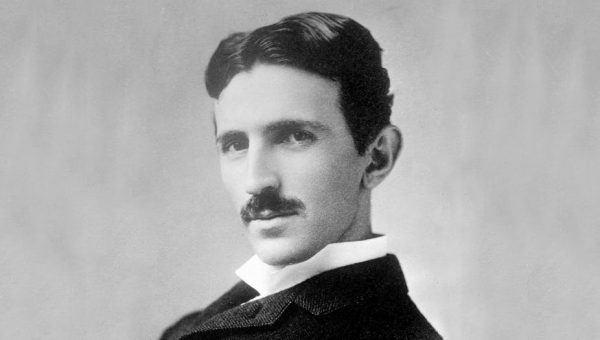
While mainstream physics moved toward fields and relativity, Nikola Tesla pursued a radically different path. Tesla never accepted that space was empty or that electromagnetic phenomena required no medium. His work — on wireless energy transfer, resonance, and high-frequency currents — was grounded in the assumption that something real filled space.
Tesla rarely used the language of fields. He spoke of pressures, vibrations, and transmission through an all-pervading medium. His calculations, experiments, and engineering designs reflected this worldview. The result was not merely a different theory, but a different practice. Tesla built devices that classical theory struggled to categorize. Some of his ideas were impractical; others were decades ahead of their time.
What matters here is not whether Tesla was “right” about the ether. It is his mental framework that led him to explore regions of possibility that others ignored. Science did not reject Tesla because of the ether alone. It rejected him because his approach did not fit the dominant methodological equilibrium — because it was harder to formalize, harder to teach, and harder to standardize.
When simplification starts to fray
For a time, these simplifications worked extraordinarily well. Field theory powered the electrical age. Relativity reshaped cosmology. The twentieth century delivered technologies that would have seemed miraculous to Ampère or Tesla. But as physics pushed outward — toward the largest scales of the universe and the smallest scales of matter — cracks began to appear. Astrophysics now confronts phenomena that resist simple explanation: Galaxies rotate too fast for their visible mass. Cosmic structures form filaments that span immense distances. The universe’s expansion appears to be accelerating.
To preserve existing models, physics introduced new entities: dark matter and dark energy. These concepts are mathematically consistent and observationally motivated. Yet they also represent a familiar pattern: when models strain, we add components rather than question assumptions.
One such assumption is that all meaningful electromagnetic interactions are already fully accounted for by local field theory. Another is that space itself must bear the burden of unexplained effects. Ampère’s forgotten longitudinal forces, or Tesla’s insistence on a substantive medium, do not solve these problems. But they reopen questions that have been prematurely closed.
Science as a mindset, not just a method
The deeper lesson here is not about electromagnetism or ether per se. It is about how science balances convenience and completeness.
At every stage, science must choose:
- What complexity to retain
- What anomalies to postpone
- What frameworks to privilege
These choices are not purely rational. They are shaped by education, tools, and collective temperament. A theory that is calculable will outcompete one that is conceptually richer but harder to manage. This is not a failure of science. It is an inevitable consequence of its success. But forgetting that these choices were made — and mistaking convenience for finality — carries a cost.
Toward a future that tolerates complexity
History suggests that progress does not come from abandoning rigor, but from widening the space of acceptable inquiry. Ampère’s law and the ether were not wrong ideas; they were set aside ideas. As new discoveries strain existing models, science faces a familiar choice: continue adding layers to preserve equilibrium, or revisit foundational assumptions with fresh tools.
The future may not restore Ampère’s electrodynamics or resurrect the ether. It may discover entirely new concepts that serve similar roles — concepts we cannot yet formalize because we lack the language. What matters is the mindset that allows such exploration. Science advances fastest when it remembers that its most powerful truths were once inconvenient.
Follow us on X, Facebook, or Pinterest
