
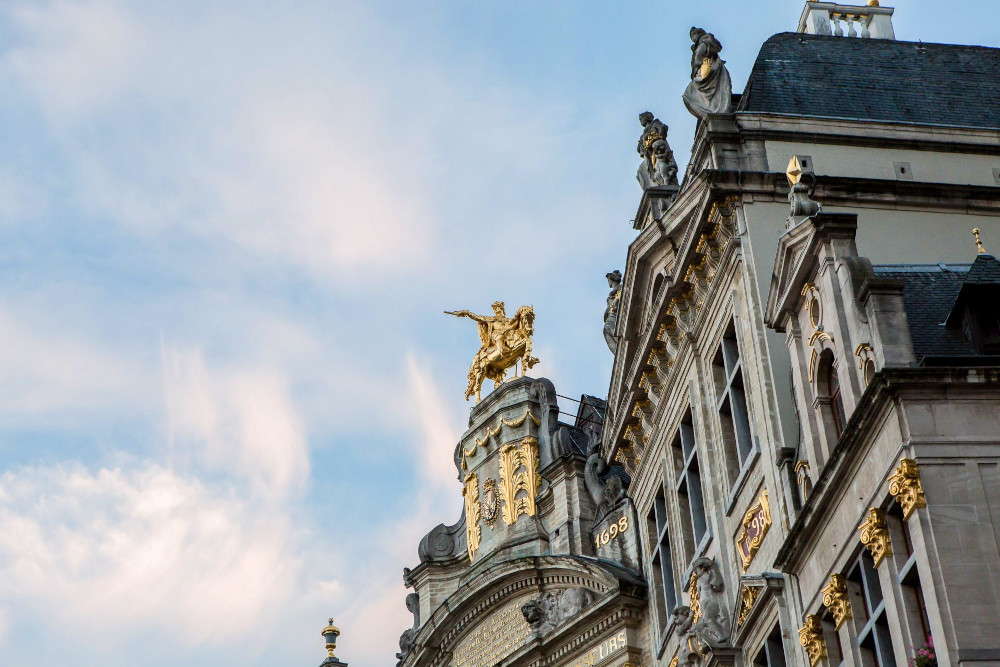
Stand at the edge of the Grand-Place in Brussels just before sunset, and the square seems to hold its breath. Gilded façades catch the last light. The cobblestones, polished by nine centuries of footsteps, glow faintly underfoot. A lone busker tunes a violin. For a moment, the 21st century steps aside, and what remains is the heart of medieval Brussels, a place that has hosted royal banquets, public executions, revolutionary writers, and a war so devastating it reduced the entire square to rubble in three days.
Yet here it stands, more beautiful than ever.
The Grand-Place in Brussels (Grote Markt in Dutch) is the kind of place that rewards slow looking. It is a UNESCO World Heritage Site. It is the architectural and civic heart of Belgium’s capital. And it is, as Victor Hugo once called it, the most beautiful square in the world. But its real story is not about beauty. It is about resilience: a community that watched its city burn and chose, within five years, to rebuild it more gloriously than before.
This is the story of how a marshy meadow became a market, how a market became the soul of a city, and how a city, even after losing nearly everything, refused to lose what mattered most.
A marketplace at the heart of medieval Brussels
In the 12th century, the land that now holds the Grand-Place was a marshy lowland just outside the early walls of Brussels. As the city grew, the marsh was drained, and traders began gathering there to barter goods. The earliest written record names it the Nedermarckt, the “lower market,” distinguishing it from a smaller upper market on higher ground.
Medieval markets were never just about commerce. They were the civic, judicial, and religious hub of urban life. Royal proclamations were read aloud here. Justice was administered. Fairs drew merchants from across Flanders, Brabant, and the wider European trade routes. Religious processions wound through the cobbled square on feast days. By the early 1400s, Brussels had become wealthy enough through cloth, lace, and trade that its citizens decided their marketplace deserved a building worthy of its ambition.
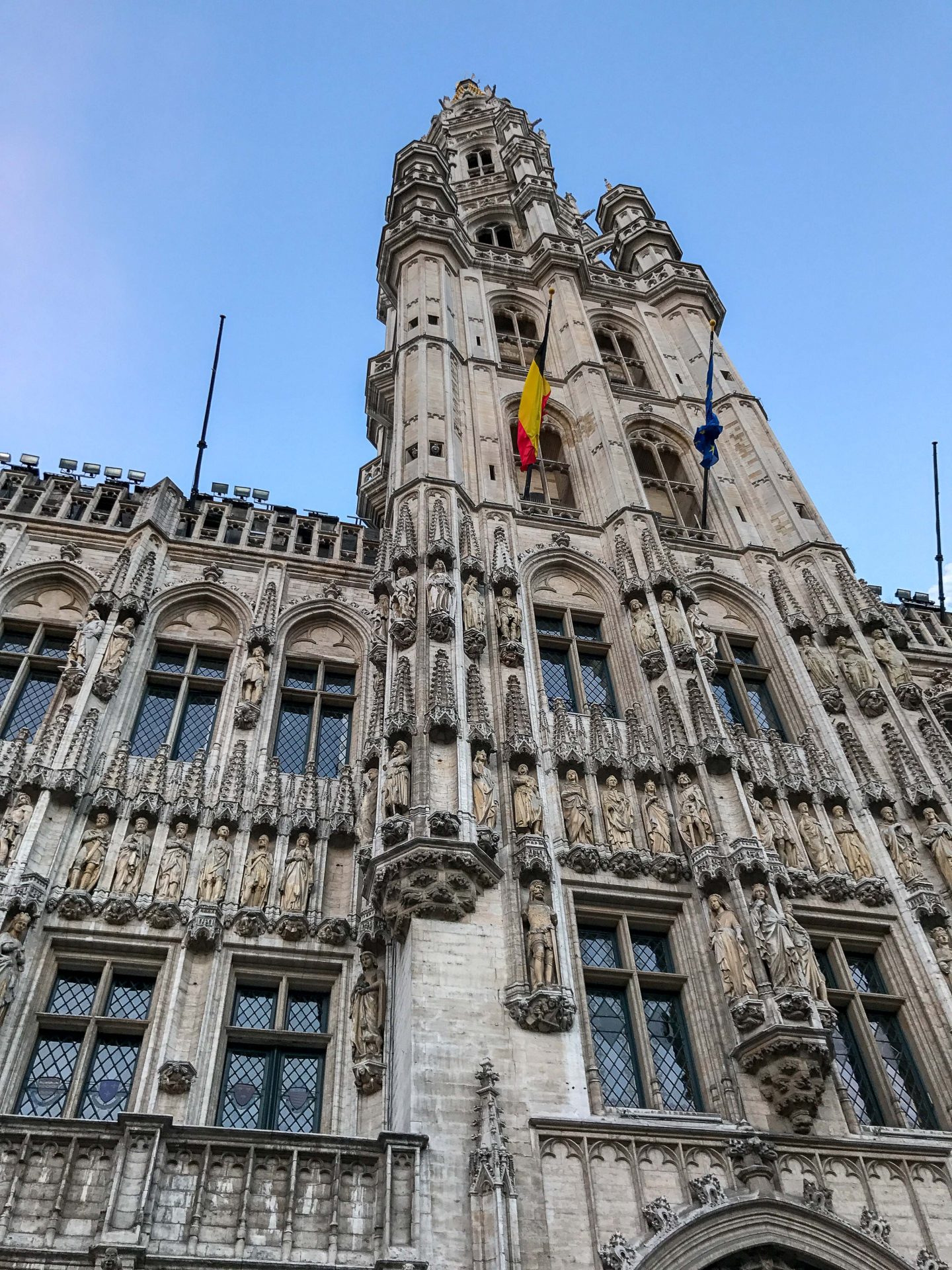
In 1402, construction began on the Hôtel de Ville, the Town Hall. Built in the elegant Brabant Gothic style, with a soaring tower topped by a gilded statue of Saint Michael slaying the dragon, it was the proudest declaration Brussels had ever made. The Town Hall was not commissioned by a king. It was built by the citizens, for the citizens, a statement of civic identity that would outlast emperors.
It still stands today. It is the only original medieval structure on the entire square.
The Town Hall and its crooked tower
The Town Hall’s most famous feature is also its most quietly debated. Look closely at the central tower and you will notice that it is not centered on the building’s façade. The tower sits slightly off to one side, and the main entrance is not aligned beneath it.
A popular legend claims the architect, despairing at his miscalculation, leapt to his death from the very tower he had built. It is a haunting story, and tour guides love to tell it. But the historical record suggests something more interesting: the asymmetry was deliberate. The Town Hall was built in two stages, decades apart, and the architects of the second wing chose to extend the building rather than tear down the first. The crooked tower is not an error. It is a record of a city growing into itself.
Atop the spire, 96 meters above the square, the gilded archangel Michael, patron saint of Brussels, drives his sword into a writhing dragon. He has watched over the square through siege, revolution, and reconstruction. When you walk into the Town Hall today (it is still the seat of city government), you can climb to the upper rooms and stand where Brussels was governed in the age of the Burgundian dukes and Habsburg emperors.
But to understand why this building is the only one of its era still standing, you have to walk through what happened in August 1695.
1695: The three days that destroyed the Grand-Place
By the late 17th century, Europe was in the middle of the Nine Years’ War. France’s King Louis XIV was at the height of his power, and his armies were locked in conflict with a Grand Alliance that included Spain, which then ruled the Spanish Netherlands, including Brussels. When French forces failed to break the Allied siege of Namur, Louis XIV ordered a punitive strike. The target was Brussels.
On August 13, 1695, Marshal François de Neufville, Duke of Villeroy, positioned his artillery within range of the city. For roughly 36 hours, through August 14 and into August 15, French gunners fired an estimated 3,000 cannonballs and 1,200 incendiary mortar shells into Brussels. The Grand-Place was the explicit target. The Town Hall’s tower, visible from miles away, served as the gunners’ aiming point.
The result was catastrophic. Some 4,000 buildings were destroyed across the city. The Grand-Place itself was reduced to smoking rubble. Every guild house, every richly carved façade, every storehouse of cloth and wine and grain, was gone. The bombardment was, by the standards of its day, one of the most destructive artillery assaults Europe had ever seen.
Only the Town Hall remained standing, and only because the dense stone of its lower walls absorbed the shells that were aimed directly at it. Its interior was gutted. Its roof was gone. But the bones survived.
In the days that followed, Brussels could have done what many destroyed cities did. It could have rebuilt cheaply, modestly, mournfully. Instead, the citizens made a different choice.
The guilds that rose from the ashes
To understand the rebuilding of the Grand-Place, you have to understand what guilds were.
In medieval and early-modern Europe, guilds were brotherhoods of craftsmen: bakers, brewers, tailors, weavers, archers, boatmen, cabinetmakers, who organized economic and civic life. Guilds set quality standards. They trained apprentices through years of disciplined practice. They cared for widows and orphans of their members. They marched together in processions, contributed soldiers to the city’s defense, and held seats in municipal government. They were, in modern terms, something like a trade school, a professional licensing board, a mutual-aid society, and a civic club fused into one institution.
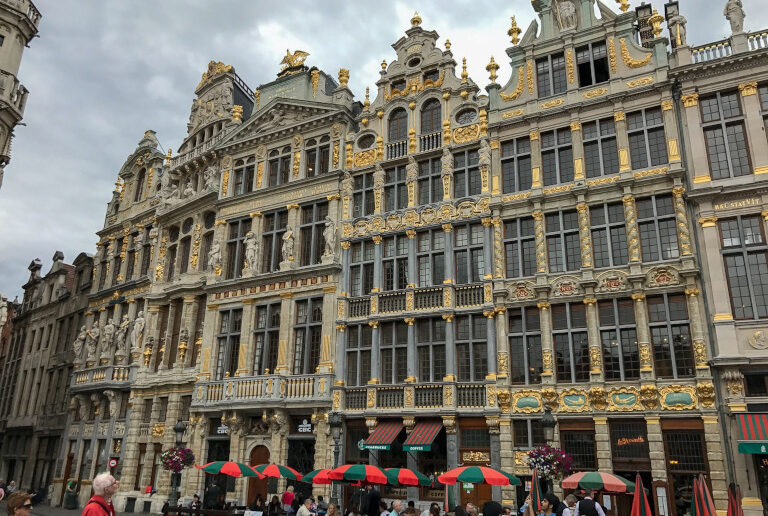
In Brussels, the guilds were proud, powerful, and rich. And after 1695, they decided that their headquarters, their guild houses lining the Grand-Place, would be rebuilt within five years, each more splendid than what had been lost.
By 1705, the work was largely done. Walking the perimeter of the square today is, in effect, a walk through a single decade of intense, coordinated craftsmanship.
Maison des Brasseurs: The Brewers’ Guild
Known as L’Arbre d’Or, the “Golden Tree,” for the gilded sculpture above its entrance, this house belonged to the brewers’ guild. Today it houses the Belgian Brewers Museum, and the brewers’ guild still meets in the upper rooms, making it one of the oldest continuously functioning guilds in Europe.
Maison du Roi: The King’s House
Despite its name, no king has ever lived here. The building stands directly across from the Town Hall and has served, at various points, as a courthouse, a prison, and an administrative seat. Today it is the Brussels City Museum, where the original statues from the Town Hall, including a 14th-century Saint Michael, are preserved indoors, away from weather and time.
Maison des Ducs de Brabant
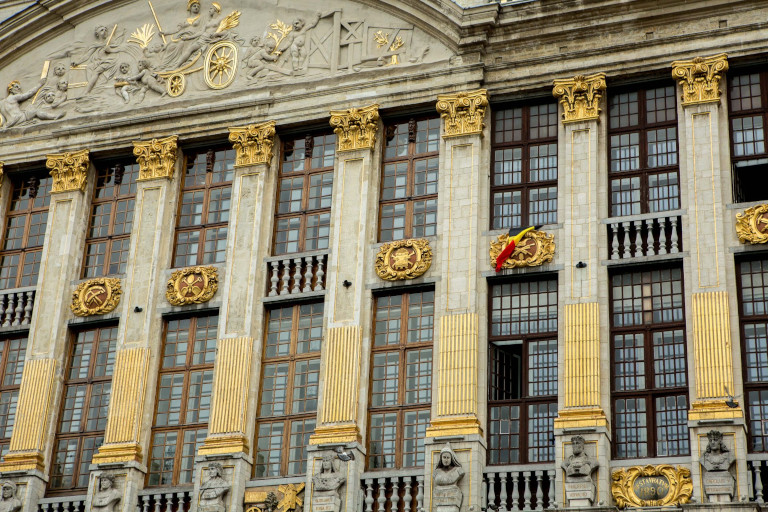
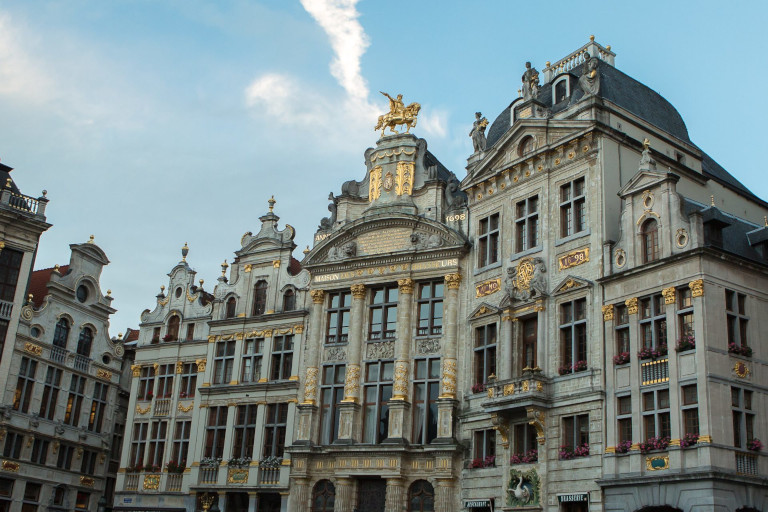
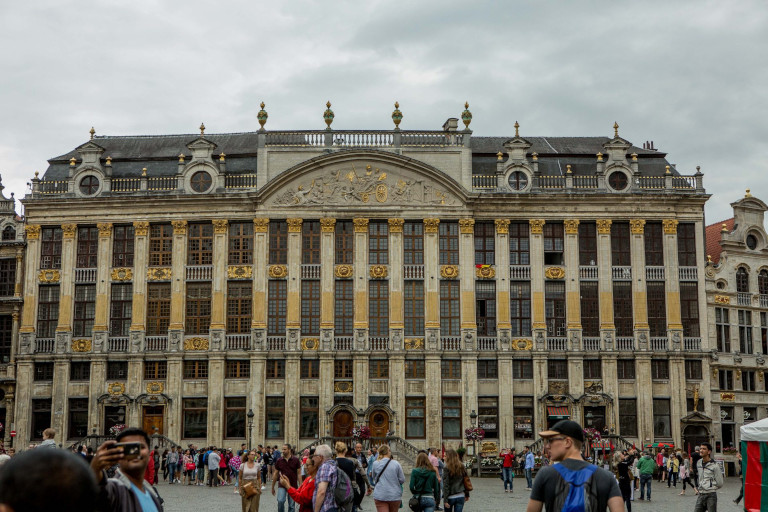
What looks like a single Italianate palace is actually six guild houses unified behind one grand façade. Above the colonnade, nineteen busts of the Dukes of Brabant gaze down on the square: a defiant assertion of regional identity in an age when Brussels was governed by foreign sovereigns.
Le Cygne: The Swan
A more discreet building bearing the carving of a white swan, Le Cygne once housed the butchers’ guild. In the 1840s, two German political exiles, Karl Marx and Friedrich Engels, lodged here. It was within these walls that they refined the ideas that would become The Manifesto of the Communist Party, published in 1848. Whether you celebrate or critique that legacy, the building’s quiet plaque is a reminder that the Grand Place has always been a place where ideas, as well as goods, were exchanged.
The architectural achievement of the rebuilding is its harmony. The new guild houses fused late Gothic verticality with Italian-Flemish Baroque ornament and Louis XIV classical proportions. By any reasonable expectation, this should have produced visual chaos. Instead, the square reads as a single, breathtaking ensemble: proof that civic pride, applied at scale, can produce something no single architect could have conceived.
A stage for history: Famous visitors and living tradition
The Grand-Place did not stop making history after 1705. The square has hosted ducal banquets, royal entries, public executions (including those of the Counts of Egmont and Horn in 1568, whose deaths helped spark the Dutch revolt), jousts, processions, and revolutions.
Victor Hugo, exiled from France in 1851, lodged in a townhouse just off the square. In a letter to a friend, he called it the most beautiful square in the world. Charles Baudelaire, Albrecht Dürer, and Jean Cocteau all walked the cobbles here at different points in their lives. The square has long carried a kind of magnetism for travelers who appreciate the continuity of place. Readers drawn to architectural legends across Europe will find a kindred spirit in the legends of Venice’s Bridge of Sighs, where stones likewise outlast the stories told about them.
Every two years, in mid-August, the central pavement is covered in the Flower Carpet, a 1,680-square-meter floral display traditionally associated with begonias and now also using flowers such as dahlias. The tradition began in 1971 and now draws hundreds of thousands of visitors. In December, the square hosts Plaisirs d’Hiver, the Christmas market, when the gilded façades glow against winter dusk and children clutch warm waffles dusted with sugar.
The medieval European trade routes that fed the original marketplace also brought ideas, languages, and aesthetic traditions from far beyond Brabant. For a deeper look at how cultural exchange shaped European craftsmanship, the Moorish foundations of Western civilization offer a rich companion read.
UNESCO World Heritage and what visitors find today
In 1998, UNESCO inscribed the Grand-Place on its World Heritage list, citing it under criteria ii and iv: for its outstanding example of cultural exchange and as an exceptional architectural ensemble. The official UNESCO listing notes that the square is a remarkably homogeneous body of public and private buildings, dating mainly from the late 17th century.
A visit today rewards both the casual tourist and the patient observer. The Town Hall offers guided tours of the Council Chamber and the Maximilian Room. The Brussels City Museum, inside the Maison du Roi, walks visitors through the city’s history from its 10th-century origins. The Belgian Brewers Museum, in the Maison des Brasseurs, includes a tasting at the end. And the square itself is free, open to the sky, and most magical at two specific hours: just before sunrise, when it is empty and silver, and just after sunset, when the floodlights come up and the gold leaf on the facades catches every photon.
For practical visitor information, the official Brussels tourism site tracks current museum hours, festival dates, and the schedule of the next Flower Carpet. If you happen to be drawn to other journeys of sacred and historical European heritage, another sacred European relic with its own remarkable journey makes a thoughtful counterpart to a day in the Grand-Place.
Why this square still matters
There is a quiet lesson in the stones of the Grand-Place, one that takes a few visits to absorb.
A community can lose almost everything and still choose to rebuild what is most beautiful about itself. Not what is cheapest. Not what is fastest. What is most beautiful. The 17th-century citizens of Brussels could have thrown up modest replacements for their guild houses. Instead, they spent five years and a small fortune ensuring that the next generation would inherit a square that surpassed the one their grandparents had loved.
That is a kind of cultural inheritance worth pausing over. The Grand-Place is not a museum. It is a living square, where commuters cut across the cobbles each morning, where lovers meet at dusk, where cafés serve waffles and beer to a constant tide of travelers. The medieval, the Baroque, and the modern share the same flagstones, and somehow none of it feels confused.
This is what is meant by a looking glass into medieval Brussels. The square does not preserve the past behind glass. It carries the past forward, every day, in working stone.
A final reflection
The Grand-Place in Brussels began as a marketplace where farmers sold turnips. It became the civic heart of a city that grew rich on cloth and wine. It was destroyed in three days by a king who is now mostly remembered for his palace. It was rebuilt in five years by guilds that no king commissioned. It became a UNESCO World Heritage Site only in 1998, relatively late recognition for one of the world’s most extraordinary urban ensembles.
Walk it in the early morning, when the square is empty. Walk it again at dusk, when the façades are illuminated. If you pause at the center and look slowly around, you will see nine centuries of human choice, about what is worth building, what is worth defending, and what is worth rebuilding when defense fails.
That is a kind of hope written in stone. It is the kind of beauty we love to share, beauty that is not exotic or distant, but deeply human, and as alive in 17th-century Brussels as in any wisdom tradition Nspirement holds dear.
Follow us on X, Facebook, or Pinterest
