
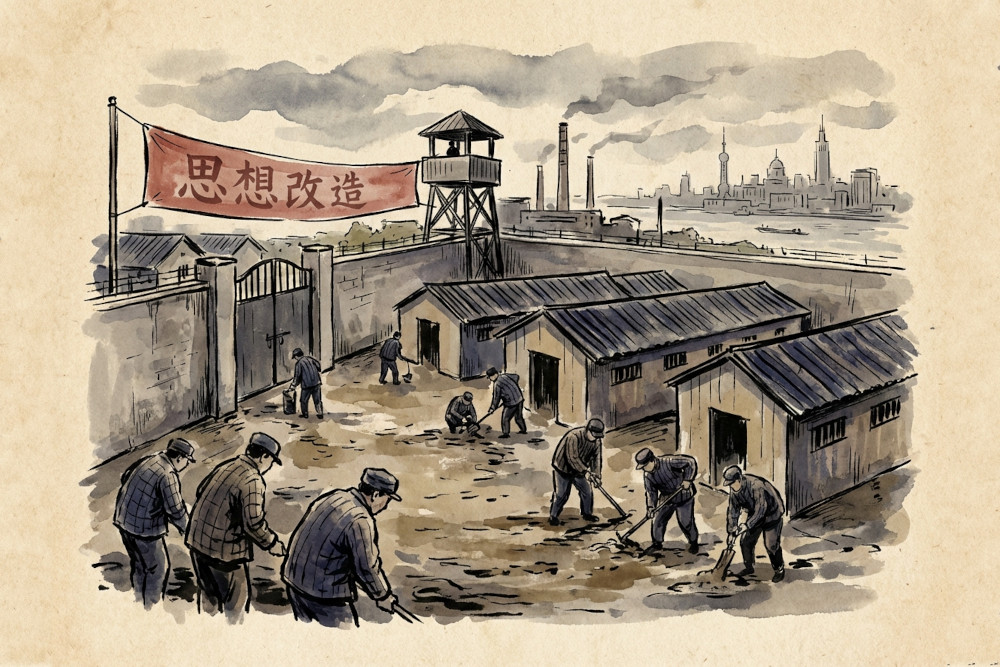
At the height of the Cultural Revolution, people quickly learned that survival often meant keeping their distance — even from those they once knew well. In an environment where a single association could lead to ruin, the line between kindness and cruelty became the ultimate test of character.
Kindness in a bitter winter
In the spring of 1968, Zhang Ruifang, one of Shanghai’s most recognized film stars, was transferred from prison to a correctional facility for further “review.” By the end of 1969, the verdict was delivered: she had committed “serious mistakes.” She was sent to a rural labor site known as the May Seventh Cadre School in Fengxian to undergo continued supervision and ideological reform.
Although she was no longer confined to a cell, Zhang Ruifang understood her precarious position. She kept her head down, worked tirelessly, and spoke only when necessary. When questioned by the “propaganda teams” overseeing the camp, she responded with quiet, fearful obedience.
Many of her former colleagues from the Shanghai Film Studio were at the same camp. But whatever familiarity they once shared had vanished. Most avoided her as if she were a plague, their expressions guarded and distant. Some watched her every move with cold eyes, appearing ready to report any slip-up to prove their own revolutionary zeal.
Only one person behaved differently.
Zhang Yi, a respected veteran actor whose career began in the 1920s, did not shun her. Despite being a member of the “revolutionary masses” while Zhang Ruifang was a “target of supervision,” he treated her with the same respect he always had.
During one especially cold winter in Fengxian, political study sessions were held in a reed-mat shed where the male actors slept. Knowing her low status, Zhang Ruifang sat on a small stool near the door, where the freezing wind cut through the room.
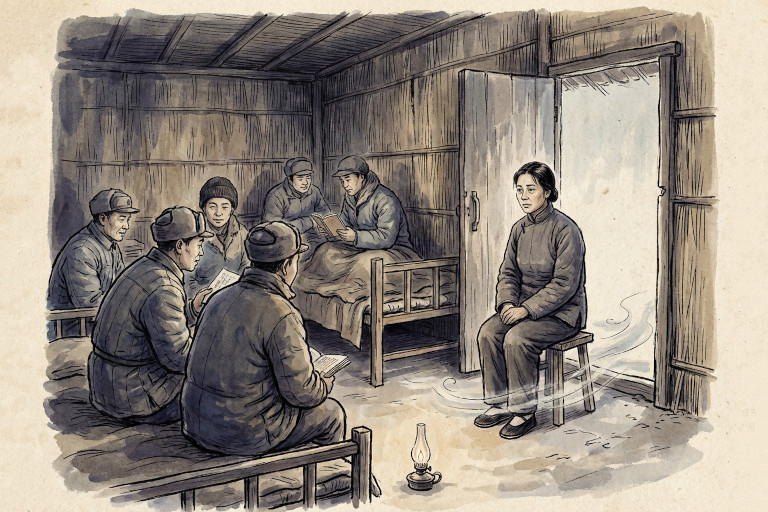
Zhang Yi, whose bed was nearby, noticed her shivering. Without drawing the attention of the guards, he shifted slightly and whispered: “Come sit up here — the ground is too chilly.”
When she hesitated, he insisted with a voice full of kindness. As she sat on the edge of his bed, he casually reached for his thick cotton coat and laid it across her lap. It was a simple, quiet gesture, but in that climate of fear, it was an act of immense courage.
Zhang Ruifang later recalled that she could not hold back her tears. From that day on, the space beside his bed became her sanctuary during meetings. Zhang Yi’s kindness stayed with her for the rest of her life — a reminder that even in the darkest times, humanity can survive.
The price of a pancake and the weight of a system
A decade earlier, another story unfolded — one that revealed how easily “sincerity” could be weaponized, and how “evil” could manifest as bureaucratic coldness.
In the spring of 1957, during the “Hundred Flowers” campaign, a university held a meeting encouraging faculty to “speak freely.” At first, the room was silent; no one dared to offer criticism.
That evening, Vice Principal Yu approached Wu Ningkun, a brilliant scholar who had left a prestigious life in the United States to help build the “New China.” The administrator urged him to take the lead, promising there would be no retaliation. He visited Wu three times, emulating the ancient Chinese tradition of seeking wise counsel with persistence.
Moved by this apparent sincerity, Wu Ningkun spoke honestly. He criticized past injustices and quoted an old proverb: “Preventing the people’s mouths is more difficult than preventing a river from overflowing.”
At first, his remarks were praised. But by September, the political winds shifted. Wu was labeled an “ultra-rightist,” stripped of his position, and sent to the frozen labor camps of the Northeast.
A debt of kindness
In the camps, food was scarce, and the appearance of kwashiorkor (swelling from malnutrition) was a death sentence. Wu survived only because his family sent him high-priced food from the black market.
One day, a fellow scholar named Liu — weak and showing signs of kwashiorkor — wrote Wu a note in beautiful, traditional calligraphy: “Professor, I beg you to lend me a pancake… I promise to return it double.”
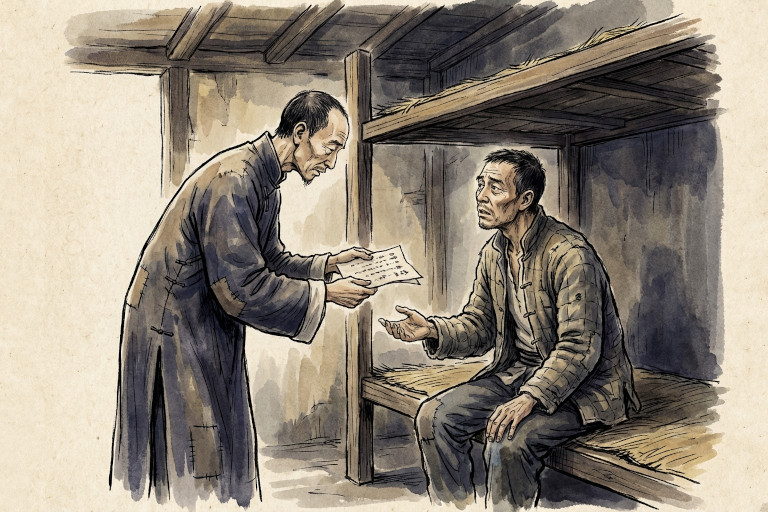
Wu quietly handed him the pancake. The next day, Liu was moved to the ward for the critically ill. Not long after, Wu was ordered to dig a shallow pit in the frozen earth. When the cart arrived to dump a body wrapped in a filthy mat, Wu saw a pair of thin feet sticking out. It was Liu. He had died before he could “repay” the debt, but the memory of that shared pancake remained a testament to a fleeting moment of grace in a hellish place.
The conflict of ‘one good, one evil’
Wu eventually survived the camps, largely due to the tireless appeals of his wife, Li Yikai. Even Vice Principal Yu — the man who had originally encouraged Wu to speak — eventually felt a pang of conscience and helped secure Wu’s medical parole in 1961.
By 1964, Wu was teaching again as a temporary worker. The department’s head, Director Li, recognized Wu’s talent and sought to restore his career fully. He proposed a permanent position and a significant salary increase to reflect Wu’s expertise.
But the effort was blocked.
The school’s Personnel Department refused to grant the promotion, stubbornly clinging to the “rightist” label. They allowed only a tiny increase in his temporary wages.
In this final struggle over a man’s dignity, the contrast was stark: the compassion of Director Li and the cold ruthlessness of the Personnel Department — one good, one evil.
What these stories reveal
These two accounts show that human nature is never a single, predictable force. Under the same pressures of the same era, people made vastly different choices.
Zhang Yi chose to offer a coat and a place to sit when others offered only cold stares and suspicion, proving that even in a crowd of onlookers, one person can choose mercy. Similarly, Director Li chose to fight for a colleague’s dignity and career, while the personnel department chose to uphold a cruel and rigid status quo.
As these stories illustrate, systems can be oppressive, but the true measure of a person lies in these individual moments of resistance. In difficult times, the good and evil within human nature become especially clear.
Translated by Chua BC
Follow us on X, Facebook, or Pinterest
