
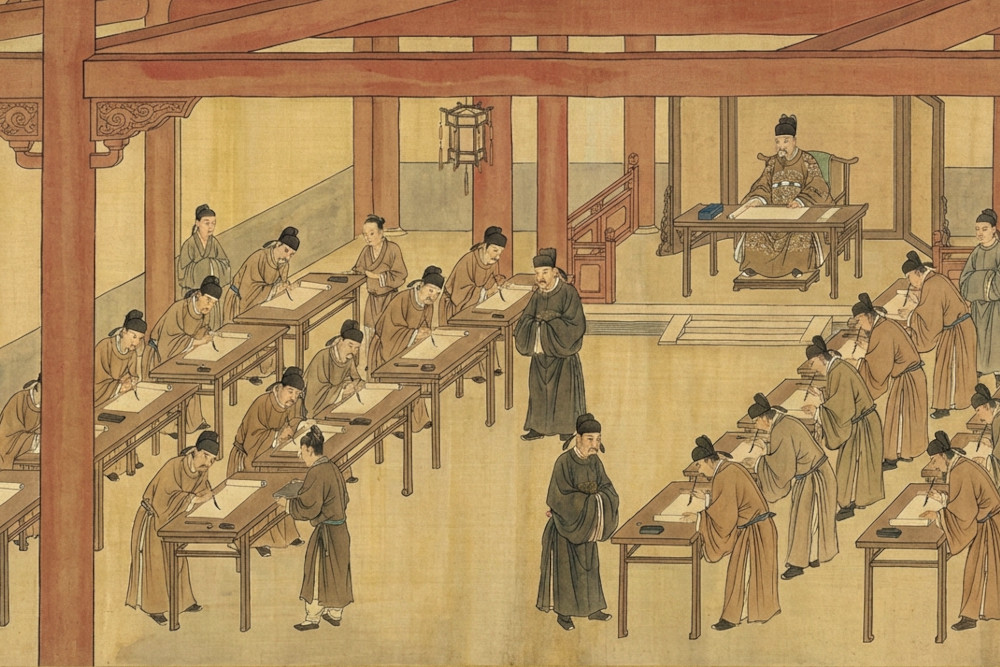
“Live long, learn long” is a familiar Chinese saying. But in imperial China, some men took that idea to an astonishing extreme. They did not simply study into old age. They kept sitting for the civil service examinations into their eighties, nineties, and even past the age of 100.
The imperial examination system held enormous importance in traditional China. It was the official route by which the state selected talent, and for generations of scholars it was also the clearest measure of academic achievement. The exams were famously difficult. Many men spent decades studying and still never passed. Because there was no age limit, however, the examination halls often saw gray-haired candidates — and on rare occasions, even centenarians.
The stories of these elderly candidates are unusual, but they are more than historical curiosities. They reveal not only the intensity of the examination system, but also the seriousness with which many scholars once approached learning, duty, and personal conviction.
A lifetime of study and failure
During the Qing Dynasty, Wang Fujing was born into a farming family in Ling County, Shandong. Thanks to the hard work of earlier generations, the family gradually became more secure and began to place greater importance on education. Wang’s father, Wang Lun, was known locally as an upright and kind-hearted scholar. One story tells of how he once found a bag of silver on the road, waited until the owner returned, and handed it back untouched. Growing up in such a household left a deep impression on Wang Fujing.
From an early age, Wang studied diligently. At 18, he passed the xiucai examination, the first level of the imperial system. But the decades that followed brought repeated disappointment. Over the next 59 years, he sat the provincial examination nearly 20 times and never earned the juren degree. During those years, he supported his family by teaching while continuing his studies whenever he could.
By the ninth year of the Jiaqing reign, Wang was already 80 years old and white-haired, yet he entered the examination hall once again. He failed again. Still, his persistence so moved the Shandong education commissioner that the matter was reported to Emperor Jiaqing. Deeply touched, the emperor granted Wang Fujing the rank of juren by imperial favor.
The news delighted everyone around him. Friends and neighbors believed that at last his long journey through the examination system had reached a happy ending. Wang Fujing, however, felt differently. To him, this honor had been bestowed by the emperor’s kindness; it was not something he had won through his own performance. Refusing to treat the gift as the same as an earned success, he resolved to travel to the capital and sit the metropolitan examination.
An old scholar’s final triumph
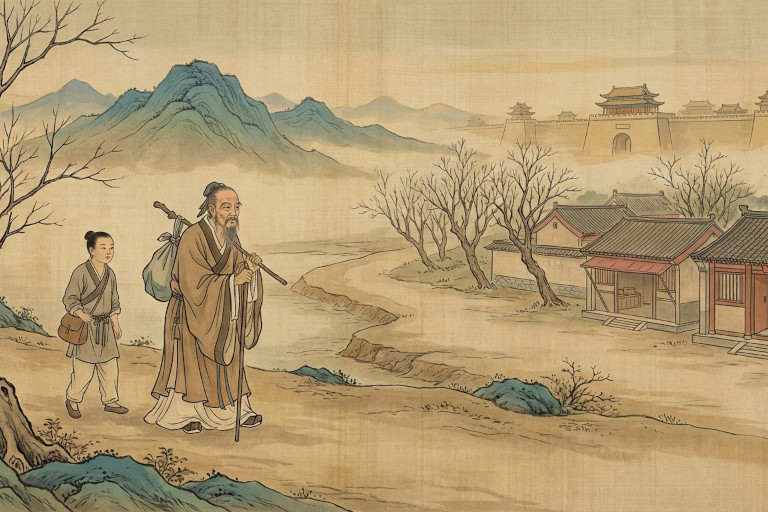
In the thirteenth year of Jiaqing, the 84-year-old Wang Fujing made the long journey to Beijing. He stayed at an inn and threw himself into preparation, rising early and staying up late each day. When the metropolitan examination began, he concentrated fully on his answers. On the day the results were posted, he searched through the names and finally found his own listed in 125th place. At that moment, he was overcome with emotion. After a lifetime of trying, he had finally passed.
He then passed the palace examination as well, placing 238th in the third tier and officially becoming a jinshi.
Emperor Jiaqing greatly admired him and issued a decree appointing him to the position of reviewer at the Hanlin Academy. This was an exceptional honor. Under normal practice, only the top three palace examination graduates entered office directly without further examination, and older jinshi were usually assigned to provincial posts rather than brought into the Hanlin. For a third-tier jinshi of such advanced age to enter the Hanlin Academy was a special mark of imperial favor.
The following year, during the grand celebration of Emperor Jiaqing’s fiftieth birthday, Wang Fujing presented a carefully composed congratulatory tribute. Its imagery was said to be elegant and far-reaching, expressing blessings for both the emperor and the realm. Jiaqing was so pleased that he rewarded Wang with many valuable gifts.
By the fifteenth year of Jiaqing, however, Wang’s age had caught up with him. His eyesight had grown too weak for him to continue his duties, so he submitted a memorial requesting permission to retire and return home. The emperor approved. After serving only two years in office, the elderly jinshi returned to Ling County to spend his final years in peace. In the twenty-first year of Jiaqing, he died there at the age of 92.
Another man who kept going
History records other elderly candidates as well. Huang Zhang, a native of Shunde, began studying at 14 and started taking examinations at 20. He continued for so long that his career stretched across two dynasties, beginning in the Ming and continuing into the Qing. He did not pass the xiucai examination until he was 60, and at 83 he became a gongsheng.
During the Kangxi period, Huang appeared for the Guangdong provincial examination at the age of 99. He had his great-grandson walk ahead carrying a lantern bearing the four characters “centenarian at the examination hall.” Onlookers stared in amazement, but Huang only smiled and said: “I am 99 this year. It is not yet my time to shine in the examination hall. When I return at 102, that will be the year I pass.”
He did not pass that time either. Yet the governor-general of Liangguang and the governor of Guangdong both summoned him for an audience and praised his perseverance. Those present noted that he still ate heartily and remained in excellent health. Afterward, they rewarded him with money and cloth. In the Qianlong period, local gazetteers recorded his story in the Taishan County Gazetteer, the Shunde County Gazetteer, and the Guangdong General Gazetteer, and it was later included in the Siku Quanshu. Even if the record does not tell us whether he returned at 102, his determination left a lasting impression.
Centenarians in the Guangdong examination halls
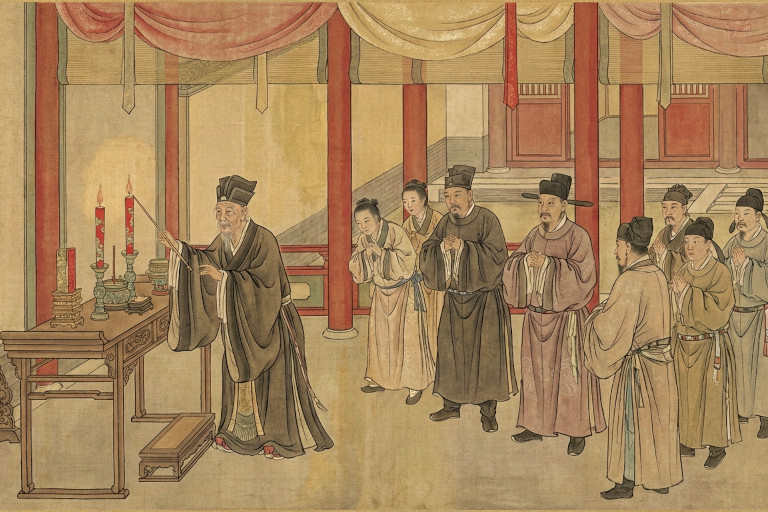
Guangdong produced several other remarkable elderly candidates. Xie Qizuo of Zhaoqing passed the provincial examination and earned the juren degree at 94. He later sat for the metropolitan examination, but did not pass. During Emperor Qianlong’s eightieth birthday celebrations, the court needed a Hanlin scholar over the age of 90 to light the longevity candles. Yet no one in the Hanlin Academy met that requirement. As an exception, the court directly appointed the 94-year-old Xie to the Hanlin Academy as a reviewer. He eventually lived to 104.
During the Guangxu period, another extraordinary figure appeared in the examination halls: Mo Ruyuan, who was 102 years old. He was admired for both his writing and his calligraphy and was granted the juren degree. In the twentieth year of Guangxu, he was further granted jinshi status by imperial favor and later rose to the post of secretary of the Imperial Academy.
During the Daoguang period, Lu Yuncang of Sanshui sat the provincial examination at the age of 102 and was granted the juren degree. At a banquet afterward, an examiner asked whether he could still endure the strain of the three examination sessions, which were exhausting even for younger men. Lu replied that he had no difficulty at all. The following year, he traveled north to Beijing for the metropolitan examination, and his arrival caused a sensation. People came in great numbers to see the centenarian candidate for themselves. They found that he was not hard of hearing, not dim of sight, and still walked with strength and vigor. Although he did not ultimately pass, Emperor Daoguang is said to have greatly admired his spirit.
What these stories were really about
It is easy to look at these men and see only stubbornness or obsession with official rank. But that would miss the deeper values behind the stories.
The Northern Song thinker Zhang Zai famously described the ideal mission of a scholar in these words: to establish the heart of Heaven and Earth, to secure the lives of the people, to continue the lost learning of past sages, and to open the way to peace for future generations.
In that tradition, reading was never meant to be only a path to title and status. A true scholar was not a frail bookworm, nor someone who merely talked about principles on paper. Learning was tied to self-cultivation, ordering the family, governing the state, and bringing peace to the world. A Confucian scholar was expected to possess moral backbone, a sense of inherited tradition, firm belief, and the courage to shoulder responsibility.
Seen in that light, Wang Fujing’s refusal to rest content with an unearned honor makes perfect sense. He was not clinging blindly to an examination title. He wanted to meet the standard through his own effort. Huang Zhang, Xie Qizuo, Mo Ruyuan, Lu Yuncang, and others like them were not simply old men chasing credentials. They were people who remained faithful to what they believed learning should be — not a shortcut to fame, but a lifelong discipline of character, purpose, and duty.
Translated by Joseph Wu
Follow us on X, Facebook, or Pinterest
