
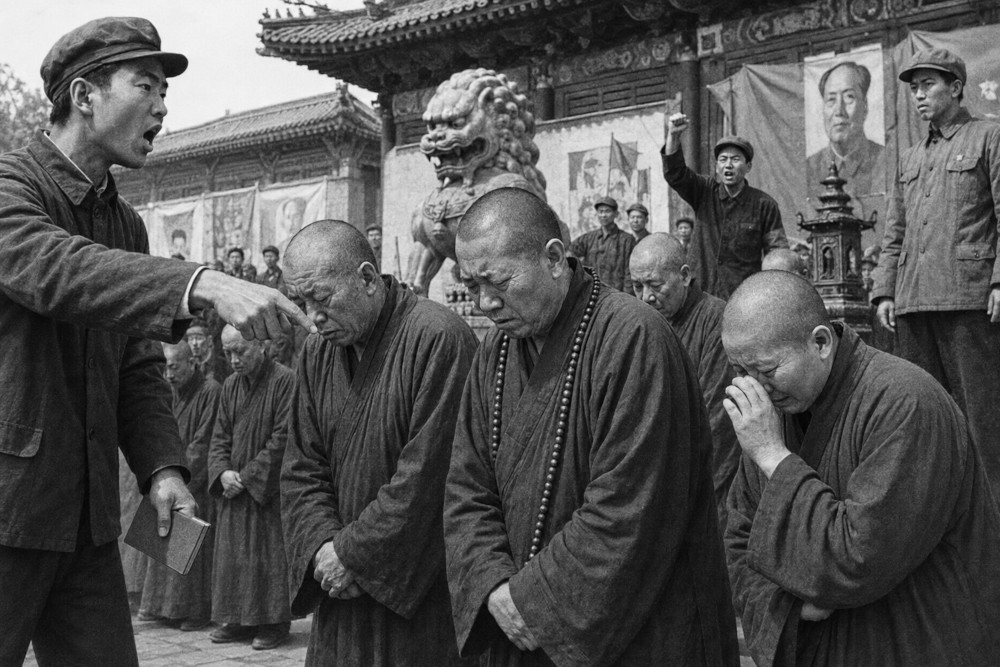
The Buddha, Siddhartha Gautama, prophesied in the Mahaparinirvana Sutra that after his parinirvana, demon kings would reincarnate as monks, nuns, laymen, and laywomen to disrupt and corrupt the Buddhist Dharma.
We naturally have no way to determine exactly whom the Buddha meant. Yet the Chinese Communist Party’s (CCP) destruction of Buddhism did indeed begin by using its United Front tactics to co-opt some members of the clergy. It even dispatched underground Party members to infiltrate religious institutions and undermine them from within.
During a criticism session in the Cultural Revolution, someone questioned Zhao Puchu, then vice president of the Buddhist Association of China: “You are a Communist Party member, so why do you believe in Buddhism?”
Destroying the precepts
The Buddha attained supreme, perfect enlightenment through “precepts, concentration, and wisdom.” Before entering Nirvana, he earnestly taught his disciples to uphold the precepts and not violate them. He warned:
“Those who break their vows are universally detested by heavenly beings. Their bad reputation spreads far and wide.… Upon death, they will suffer according to their karma and endure the torments of hell. After countless ages, they may emerge, only to take on the form of a hungry ghost or beast, cycling endlessly without hope of liberation.”
Political monks, however, ignored the Buddha’s warning.
In 1952, when the Buddhist Association of China was established in mainland China, the CCP sent officials to attend the proceedings. During the meeting, many attendees proposed that Buddhist monastic rules and precepts should be abolished, claiming that these regulations had ruined the lives of many young men and women.
Some even argued: “There should be religious freedom. Monks should be free to marry nuns, and they should be free to drink alcohol and eat meat. No one should interfere.”
Master Xuyun, who was present at the meeting, saw that Buddhism was in danger of being destroyed. He stood up in protest and insisted that the precepts and traditional Buddhist attire be preserved.
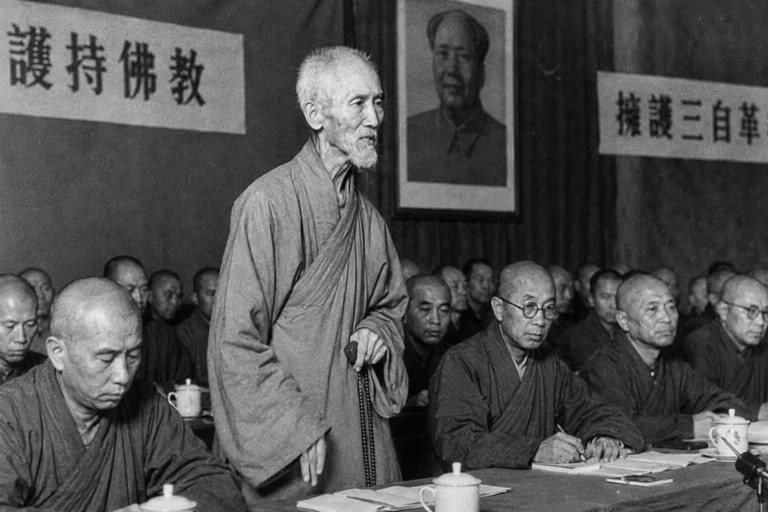
This was the same Master Xuyun who had previously been falsely accused of being a “counter-revolutionary.” He was confined to the abbot’s quarters, denied food and water, and forbidden even to leave to relieve himself. They also ordered him to surrender gold, silver, and firearms.
When Xuyun replied that he had none, he was brutally beaten, leaving his head bleeding and his ribs broken. At the time, he was already 112 years old. Military police pushed him from his couch and knocked him to the ground. When they returned the next day and found that he was still alive, they beat him again.
Turning religion into a political tool
The Buddhist Association of China, established in 1952, and the Taoist Association of China, established in 1957, both explicitly stated in their founding declarations that they would operate “under the leadership of the people’s government.” In reality, this meant submitting to the leadership of the atheistic Communist Party.
Both organizations also pledged to participate actively in production and construction, implement government policies, and align their activities with state goals. In this way, they became thoroughly secularized organizations.
Meanwhile, monks and Taoist practitioners who diligently observed their religious precepts were labeled “counter-revolutionaries.” Under revolutionary slogans calling for the “purification of the Buddhist and Taoist ranks,” they were imprisoned, sent to labor camps, or even executed.
Christianity and Catholicism, both introduced to China from the West, were not spared.
According to the 1958 book How the CCP Persecutes Christians, based solely on figures disclosed in written records, 8,840 clergy members in mainland China were killed after being branded “landlords” or “local tyrants,” while 39,200 were sent to labor camps. Another 2,450 were killed after being labeled “counter-revolutionaries,” and 24,800 were sent to labor camps under the same accusation.
Religion is fundamentally a path of spiritual cultivation that transcends the mundane world, focusing on “the other shore” and the “Kingdom of Heaven.”
Siddhartha Gautama was once a prince in India. In search of pure and tranquil liberation, he gave up his throne and entered the mountains and forests to practice asceticism.
Before Jesus began his spiritual mission, Satan took him to a high mountain, showed him the splendor of all the world’s kingdoms, and said: “If you bow down and worship me, I will give you all these things.”
Jesus was not tempted.
Yet political monks and political pastors co-opted by the CCP’s United Front apparatus concocted a series of claims such as “Humanistic Buddhism” and “Religion is truth, and socialism is also truth,” along with the assertion that “this shore and the other shore are not contradictory.”
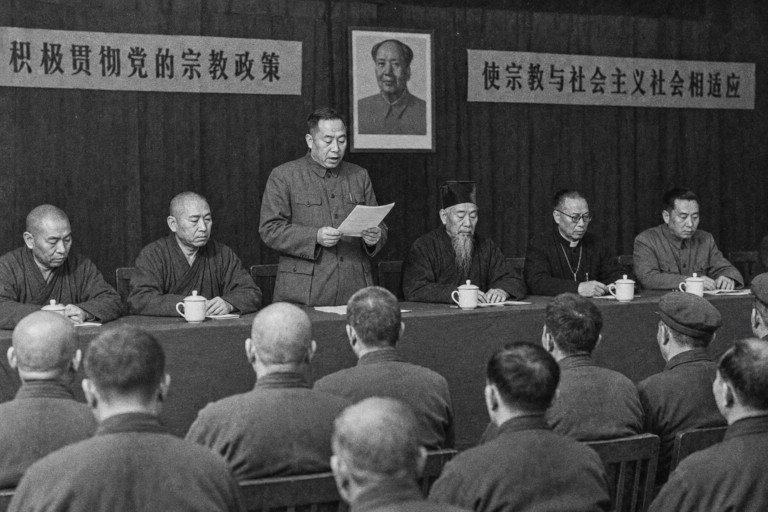
They encouraged religious practitioners to pursue worldly happiness, glory, and wealth, thereby changing religion’s doctrines and fundamental nature.
Sending monks to the battlefield
Buddhism prohibits killing. During the CCP’s campaign to suppress “counter-revolutionaries,” people were killed relentlessly. Political monks then fabricated the idea that “killing counter-revolutionaries is a greater form of compassion.”
During the “War to Resist U.S. Aggression and Aid Korea,” as the Korean War was called in China, monks were even sent directly to the front lines to kill.
Christianity provides another example.
In 1950, Wu Yaozong established the “Three-Self” church on the principles of “self-governance, self-support, and self-propagation.” It claimed to sever ties with “imperialism” and actively supported the “War to Resist U.S. Aggression and Aid Korea.”
One of Wu’s close friends refused to join the Three-Self movement and was imprisoned for more than 20 years, enduring severe beatings and abuse.
This friend once asked Wu Yaozong: “How do you view the miracles performed by Jesus?”
Wu replied: “I have discarded all of those.”
His friend said: “To deny the miracles Jesus performed is to deny the Kingdom of Heaven he taught. If someone does not even acknowledge the Kingdom of Heaven, can that person still be considered a Christian?”
Yet Wu Yaozong, as the founder of the Three-Self Church, became a member of the Standing Committee of the Chinese People’s Political Consultative Conference (CPPCC).
When he walked into the Great Hall of the People, he must have completely forgotten Jesus’s words:
“Love the Lord your God with all your heart, with all your soul, and with all your mind. This is the first and greatest commandment.”
And:
“Give to God what is God’s, and to Caesar what is Caesar’s.”
Forced labor and forced marriage
The CCP confiscated temple property, forced monks and nuns to study Marxism to intensify their ideological indoctrination, and compelled them to perform manual labor.
For example, in Ningbo, Zhejiang, there was a “Buddhist workshop” where more than 25,000 monks and nuns were exploited for their labor.
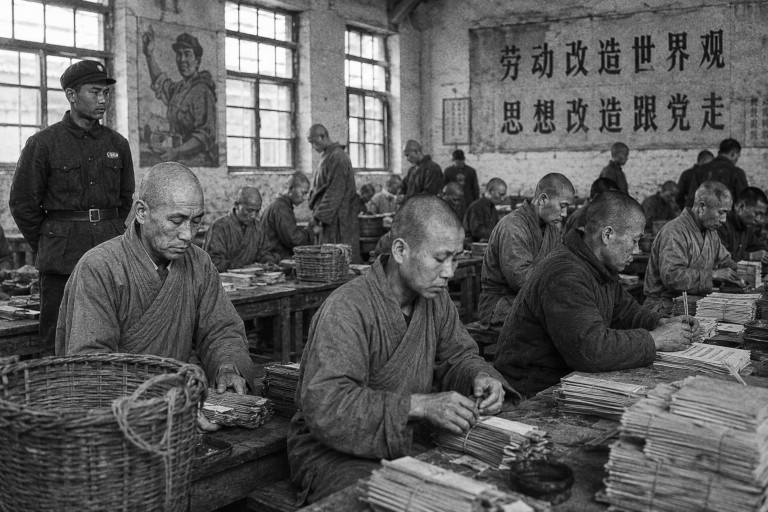
Even more absurdly, the CCP encouraged monks and nuns to marry in an effort to undermine Buddhist faith.
Shortly before International Women’s Day in 1951, the Women’s Federation in Changsha, Hunan, ordered all nuns in the province to decide within just a few days that they would marry.
Young, able-bodied monks were also forced to join the army and sent to the battlefield as cannon fodder.
Under the CCP’s violent suppression, China’s various religious communities were devastated. Genuine leaders and accomplished practitioners within the Buddhist and Taoist communities were persecuted. Many who remained returned to secular life, while many others were undisclosed Communist Party members.
These people wore kasayas, Taoist robes, and Christian clerical garments while distorting the Buddhist Sutras, the Taoist Canon, and the Holy Bible, searching the scriptures for passages they could use to justify the CCP’s political movements.
Translated by Chua BC
Follow us on X, Facebook, or Pinterest
