
More than 2,000 years ago, China was coming apart at the seams. The great house of Zhou had lost its grip, and the land splintered into rival states that spent generations at war. Fields were trampled, families were scattered, and the old certainties dissolved. Yet from that long season of chaos came something extraordinary: a flowering of ideas so rich that we still draw on it today. Three of those ideas grew into the schools that would shape a civilization: Confucianism, Taoism, and Legalism.
Each began with the same aching question. In a world falling into disorder, how should a person live, and how should a ruler govern? The three schools answered in strikingly different voices. One looked to virtue and relationships. One looked to nature and stillness. One looked to law and power. Understanding them is like being handed three keys to the Chinese mind, and, as you will see, to some quietly useful wisdom for our own restless age.
The hundred schools of thought: Wisdom born from chaos
To understand these philosophies, picture their birthplace. The Spring and Autumn period (around 771 to 476 BCE) and the Warring States period (around 475 to 221 BCE) were centuries of near-constant conflict. As central authority collapsed, thinkers wandered from court to court, offering rulers a path back to order. This remarkable era of debate is known as the Hundred Schools of Thought (诸子百家, zhuzi baijia), sometimes described as “a hundred schools contend.”
There were not literally a hundred, but there were many, each with its own vision of the good society. Confucians, Taoists, Legalists, Mohists, and others argued, taught, and wrote. Out of this ferment, three traditions proved durable enough to steer Chinese history for the next two millennia.
What unites them is easy to miss beneath their disagreements. Each school reached for the same goal: to restore peace, order, and harmony to a broken world. They simply could not agree on the road. If you enjoy tracing how ideas grow from their soil, the wider world of Chinese culture and traditions is full of these living roots, and historians of ancient Chinese philosophy still return to this founding age.
Confucianism: The path of virtue and harmony
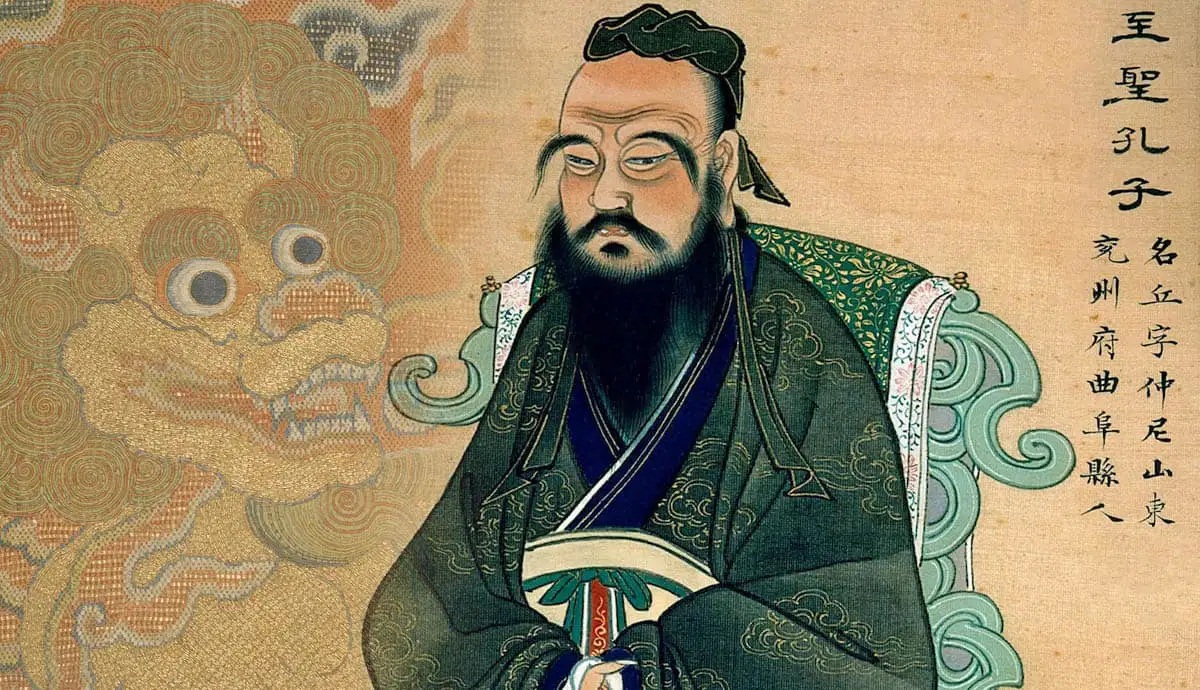
Confucianism is the moral and social philosophy that grew from the teachings of Confucius (Kongzi, 孔子, 551 to 479 BCE) and was carried forward by thinkers like Mencius and Xunzi. At its heart lies a hopeful belief: people are teachable, improvable, and capable of goodness. A well-ordered society, in this view, begins with well-cultivated hearts.
Two ideas anchor the tradition. The first is benevolence (仁, ren), a warm, active care for others that Confucius placed at the center of a good life. The second is ritual propriety (礼, li), the web of courtesies, roles, and ceremonies that lets people treat one another with dignity. Add loyalty, righteousness, and filial piety (孝, xiao), the deep respect owed to parents and ancestors, and you have the moral architecture of Confucian life.
Confucius gathered his reflections in conversations later collected as The Analects (论语, Lunyu). His golden rule still rings clear:
“Do not do to others what you do not want done to yourself.”
On governing, Confucius trusted character over coercion. A ruler should lead by moral example, not fear:
“He who governs by virtue is like the North Star, which stays in its place while all the other stars turn around it.”
That faith in cultivation ran through the whole school. Mencius argued that human nature is fundamentally good, a seed needing only care to flower. His own upbringing became a legend of devoted parenting, retold for centuries in the story of Mencius’s mother. Confucianism would eventually become the moral backbone of Chinese education and public life.
Taoism: Living in harmony with the Tao
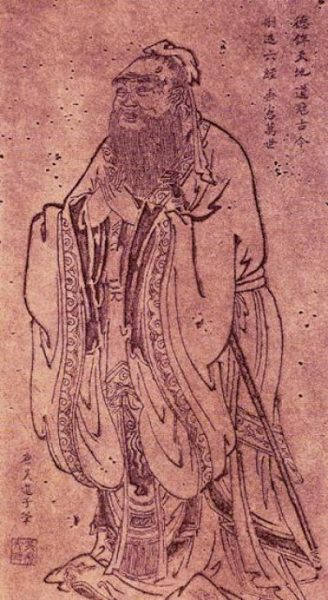
If Confucianism looks toward society, Taoism (道教, Daojiao) turns toward nature. It is the philosophy of living in accord with the Tao (道, dao), “the Way,” the deep, flowing pattern that moves through all things. Traditionally traced to the sage Laozi (老子, the “Old Master”) and elaborated by Zhuangzi, it prizes simplicity, spontaneity, and inner peace over striving and control.
Its founding text, the Tao Te Ching (道德经, Daodejing), opens with a famous humbling of language itself:
“The Tao that can be spoken is not the eternal Tao.”
The tradition’s most influential idea is wu wei (无为, wu wei), often translated as “non-action.” It does not mean doing nothing. It means acting without forcing, moving with the grain of things rather than against it, like water that yields yet wears down stone. A Taoist trusts that when we stop grasping, life tends to right itself:
“The sage acts without striving, and nothing is left undone.”
This is also the world of yin and yang (阴阳), the complementary forces whose interplay keeps the cosmos in balance, an idea explored across Chinese thought and mapped in systems like ancient Chinese cosmology. In government, Taoism prized a light touch. The best ruler, Laozi suggested, governs so gently that people scarcely notice they are governed at all, and credit their peace to themselves.
Legalism: Order through law and power
Legalism (法家, Fajia) took the hardest look at human beings of the three and reached the sternest conclusion. It is the philosophy that lasting order comes not from virtue or nature but from clear, strictly enforced law backed by a strong central state. Its leading voice, Han Fei, gathered these ideas in the text that bears his name, the Han Feizi (韩非子).
Where Confucians saw people as improvable, and Taoists saw them as naturally good, Legalists saw self-interest that only firm rules could restrain. Their answer was law (法, fa) applied equally to all, regardless of rank or relationship, paired with a plain system of rewards and punishments. Behave well and be rewarded; break the law and be punished, without exception. Order, in this view, is engineered, not preached.
A quiet tragedy in Han Fei’s own life is rarely mentioned by the school’s admirers. A prince of the state of Han who is said to have stuttered, he poured his sharp mind onto the page instead of into speeches. He had studied under the Confucian master Xunzi, so the greatest Legalist was, improbably, the pupil of a Confucian. His writings so impressed the king of Qin that the king longed to meet him. But Han Fei’s own former classmate, the Qin minister Li Si, feared his brilliance and turned the court against him. Around 233 BCE, Han Fei died in prison, undone by exactly the ruthless power politics he had described so coldly. The philosopher of the iron state was crushed by its gears.
The Legalists were unsentimental about power. The ruler should hold firm control, strengthen the state, favor practical work like farming over what they saw as idle scholarship, and keep the machinery of law running whatever the cost. A genuine insight is buried here, one modern societies still lean on: fair, predictable rules can protect people from the whims of the powerful. Yet, as historians of Legalism note, its indifference to mercy would soon show its darker edge on the grandest possible stage.

Confucianism, Taoism, and Legalism compared
Set side by side, the three schools reveal how differently thoughtful people can answer one question. Confucianism reforms the world by cultivating virtue. Taoism harmonizes with the world by letting go of control. Legalism orders the world by enforcing law. The table below distills the contrast that students and curious readers most often search for.
| Confucianism | Taoism | Legalism | |
|---|---|---|---|
| Founder(s) | Confucius (Mencius, Xunzi) | Laozi (Zhuangzi) | Han Fei (Li Si) |
| Key text | The Analects | Tao Te Ching | Han Feizi |
| View of human nature | Good and perfectible through learning | Naturally good when left unforced | Self-interested, needing restraint |
| Ideal government | Rule by virtue and moral example | Rule as little as possible (wu wei) | Rule by strict, impartial law |
| Core value | Virtue and harmony (ren, li) | Harmony with nature, simplicity | Order, discipline, a strong state |
Imagine a single village where a local official has grown lazy and dishonest. A Confucian would work to reform the man’s character, restoring the right relationships and rituals until duty came naturally again. A Taoist would suspect that heavy-handed meddling caused the trouble in the first place, and would strip away needless rules so the village could settle back into its own quiet rhythm. A Legalist would simply enforce the law: measure the official against a clear standard, and reward or punish him accordingly, whatever his rank. Same problem, three very different hands.
Notice that the schools are not simply right or wrong. Each captures something true about human life that the others underplay. That is exactly why none of them vanished, and why, over time, Chinese civilization found ways to hold more than one at once.
How the three schools shaped Chinese history
Ideas have consequences, and these three reshaped an empire. In 221 BCE, the state of Qin conquered its rivals and unified China for the first time, guided by Legalist doctrine and the chancellor Li Si. Strict law, standardized weights, roads, and script welded the realm together with astonishing speed. But the same severity that built the Qin also broke it. Harsh punishments and the suppression of rival schools bred resentment, and the dynasty collapsed after roughly 15 years, discrediting Legalism as a public creed.
The Han dynasty (206 BCE to 220 CE) learned from the wreckage. Its early rulers embraced a gentler, Taoist-flavored approach known as Huang-Lao, governing with a light hand while the exhausted country recovered. Then Emperor Wu (reigned 141 to 87 BCE) elevated Confucianism as the state’s guiding philosophy, prizing virtue, learning, and social harmony.
Yet the Legalist machinery never truly disappeared. What emerged was a lasting synthesis, Confucian in its values and Legalist in its administration, a blend later summed up as “Confucian outside, Legalist inside.” That marriage of morality and law would govern China, through its scholar-officials and the great civil examinations, until the early 20th century. For readers who love watching principle meet power, more history and insight await in every dynasty that followed.
From three schools to three teachings
Here is a twist that many summaries miss. The famous trio of the classroom, Confucianism, Taoism, and Legalism, is not the same trio the Chinese later cherished as their spiritual inheritance. As the centuries passed, Legalism dissolved into the practical craft of statecraft rather than surviving as a tradition people belonged to. A newcomer took its place in the popular imagination.
Buddhism arrived in China around the first century CE and slowly wove itself into the cultural fabric. By the Tang dynasty (618 to 907 CE), a new ideal had taken shape: the Three Teachings (三教, Sanjiao), meaning Confucianism, Taoism, and Buddhism, living side by side. The vision was not rivalry but harmony, captured in the phrase “the three teachings are one” (三教合一).
This is perhaps the most beautiful lesson of the whole story, and a genuinely Chinese one. A person did not have to choose a single school and reject the rest. As scholars of the three teachings of China observe, one could be Confucian in public duties, Taoist in private reflection, and Buddhist in facing life’s deepest questions, all without contradiction. Wisdom, in this view, is not a wall to defend but a well to draw from.

What Confucianism, Taoism, and Legalism teach us today
You do not need to live in ancient China for these philosophies to speak to you. Each offers a quiet, usable insight for modern life.
Confucianism reminds us that character and relationships are the ground of a good life. In an age of quick transactions, its call to treat family, colleagues, and strangers with genuine respect, and to keep growing in virtue, feels less like an antique and more like a remedy. Its stories of loyalty and humility still carry ancient lessons in humility worth keeping close.
Taoism offers the gift of letting go. When we are stretched thin by striving, wu wei whispers that not every problem must be forced, that stepping back, resting, and moving with life’s current is its own kind of strength. Anyone who has felt calmer after a walk in nature already knows a little of the Tao.
Legalism, for all its severity, leaves us a sober truth: good systems protect people. Fair rules, applied without favoritism, are part of how a just community cares for its most vulnerable members. Held together, the three are less a menu of competing answers than a fuller picture of the human situation. We need character, we need balance, and we need fair structures, all at once.
Common questions about the three schools
What is the main difference between Confucianism, Taoism, and Legalism?
Confucianism seeks order through personal virtue and respectful relationships. Taoism seeks harmony by living naturally and governing as little as possible. Legalism seeks order through strict, impartial laws and a strong state. In short: virtue, nature, and law are their three very different roads to the same peace.
Which came first, Confucianism, Taoism, or Legalism?
Confucianism and Taoism arose first, during the 6th and 5th centuries BCE, with Confucius and the sage Laozi traditionally seen as near-contemporaries. Legalism came later as a distinct system, reaching its fullest form with Han Fei in the 3rd century BCE, near the end of the Warring States period.
Are Confucianism, Taoism, and Legalism religions or philosophies?
All three began as schools of thought, not religions. Taoism later grew a religious branch with temples, deities, and rituals, while Confucianism functions as an ethical and social framework. Legalism remained purely a political philosophy of statecraft and never became a faith or popular tradition.
Conclusion
Confucianism, Taoism, and Legalism began as three answers to one timeless question, born in a China desperate for order. Confucianism looked to virtue and harmony, Taoism to nature and stillness, and Legalism to law and power. Each shaped how China was governed, how families lived, and how millions understood their place in the world.
What makes their story so moving is that China never simply crowned a winner. It learned to weave these threads together, and later to welcome Buddhism into a wider tapestry of the Three Teachings. That gift for holding difference in harmony may be the deepest wisdom these ancient schools leave us. In our own divided moment, it suggests something hopeful: that we can honor more than one truth, and be the richer for it.
The philosophers of the Warring States turned their darkest age into a golden one of ideas. Their voices, patient and humane, are still ours to listen to. May they help you live with a little more virtue, a little more ease, and a little more fairness.
Follow us on X, Facebook, or Pinterest
