
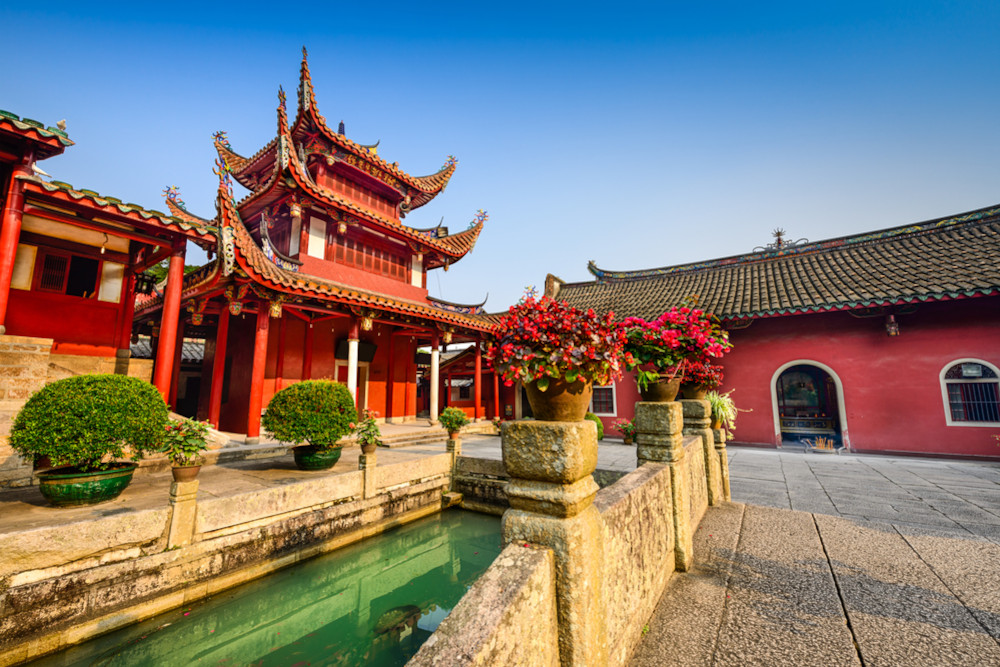
In 1734, during the 12th year of the Yongzheng Emperor’s reign in the Qing Dynasty, a remarkable story unfolded at Yongquan Temple on Gushan. It is a tale of a teenage abbot, an empty granary, and a miracle that temple tradition says gave rise to the monastery’s unusual seated image of Weituo, the guardian deity who protects Buddhist temples.
A 16-year-old abbot faces a crisis
At the time, the elderly abbot of Yongquan Temple, Master Yuanyu, had been called away to assist in compiling the Buddhist canon. Unable to manage the monastery himself, he recommended his youngest disciple, Fa Yin, to take his place as abbot.
It was a startling choice. Fa Yin, whose secular name was Li Xiangxian, was only 16 years old.
He had entered monastic life as a child and was known for his intelligence, discipline, and dedication to Buddhist study. But Yongquan Temple was no small monastery. With several hundred monks in residence, it was a major religious institution, and many senior monks were uneasy about placing such a young novice in charge.
Out of respect for their old master, they did not openly object. Privately, however, some mocked the decision and quietly waited to see the boy fail.
After formally taking office, Fa Yin devoted himself even more deeply to spiritual practice. He immersed himself in Buddhist learning and is said to have copied scriptures using his own blood, a traditional expression of extreme religious sincerity. Yet while he focused on cultivation and study, many practical affairs of the temple were left to others.
Before long, trouble arrived. The monk in charge of the granary reported that the temple had only enough food left for four or five days. Fa Yin immediately sent people down the mountain to buy rice, but what they brought back was nowhere near enough to sustain the entire monastic community.
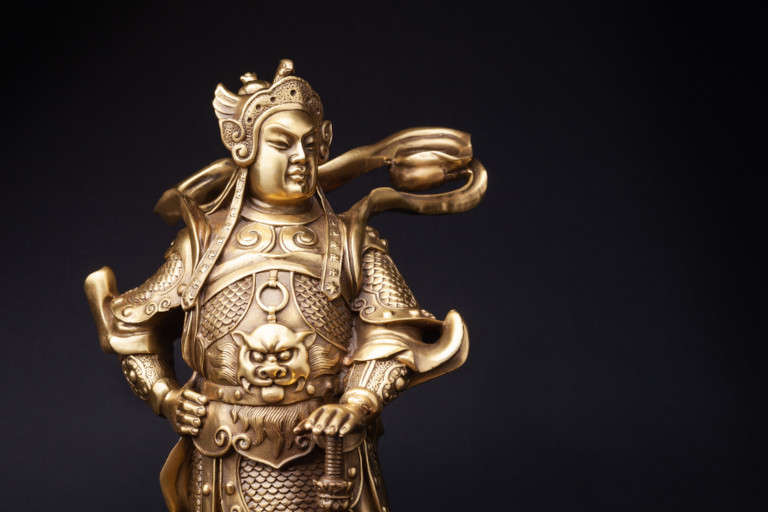
Anxious and at a loss, the young abbot went from hall to hall in prayer. He paid his respects before the Buddha, then finally stood before Weituo and burned incense, asking the temple’s guardian for help in overcoming the crisis.
A dream sends the monks down the mountain
That night, Fa Yin sat in meditation as usual. At some point, in a state between sleep and wakefulness, he saw Weituo appear before him.
According to the story, the deity told him: “Tomorrow morning, someone will bring rice. Send people to the riverside at once to fetch it.”
Fa Yin woke with a start. Realizing he had drifted from meditation into sleep, he felt he had failed to keep proper discipline. He quickly sat upright again and tried to steady his mind, but he remained restless until dawn.
As soon as morning came, he washed, struck the temple gong, and summoned the monks. When everyone had assembled, he folded his hands, prayed silently for a moment, and announced that Weituo had appeared to him in a dream and instructed them to go down the mountain that very morning to collect rice.
The younger and stronger monks were told to prepare carrying poles and sacks. The elderly and infirm were to remain at the temple.
The assembly was stunned. One monk finally asked the obvious question: Was there really rice waiting below the mountain?
Fa Yin answered with confidence: “We will know when we get there.”
Though puzzled, the monks obeyed. More than a hundred set out together, with even a few older monks joining the group out of curiosity. They passed Lingyuan Cave and made their way down the mountain path toward Kuiqi.
Before they even reached the foot of the mountain, they saw a vessel by the riverside surrounded by government soldiers.
The rice merchants’ desperate story
At that time, maritime restrictions were strict, and smuggling was treated as a grave crime. The ship in question had been transporting white rice for sale in Siam. But following the death of a king there, conflict among rival princes had caused disorder and a grain shortage. On the journey, the smugglers were caught in a violent storm and forced to seek shelter near the mouth of the Min River. Their movements drew attention, and they were tracked and stopped for inspection at Kuiqi.
Terrified that they might lose their lives, the rice merchants improvised a story. They claimed the cargo was not contraband at all, but rice intended as a charitable donation to Yongquan Temple.
The officer in charge did not believe them. Yet while he was questioning the merchants, he suddenly saw a large group of monks approaching from the mountain with poles and sacks. Suspicious, he asked how the temple could possibly have known to come if no prior arrangement had been made.
Fa Yin stepped forward and said that Weituo had appeared to him in a dream and told him to come to the river for rice.
The merchant, quick to seize the opportunity, immediately added that during the storm and heavy fog at sea, it had also been Weituo who guided their ship safely into the Min River.
The officer happened to be a Buddhist believer. Hearing both accounts, he did not press the matter further. The cargo was allowed to be unloaded, and the merchants, relieved to have escaped disaster, willingly helped carry the rice up the mountain as an offering.
Why Weituo came to sit
As soon as the rice arrived at the temple, the monks hurried to thank Weituo before the grain had even been stored away.
There, they were astonished by what they saw. The standing image of Weituo seemed to be covered in sweat, as though it had exerted itself to the point of exhaustion. To the monks, it appeared that the guardian deity had personally labored on their behalf and was now too weary to remain standing.
Filled with awe, they bowed and cried out that Weituo had worked hard and should now rest.
Fa Yin immediately ordered the temple sculptor to create a seated image of Weituo so that the guardian could “rest” in the main hall. Temple tradition says this is how Gushan’s distinctive seated Weituo first came into being.
News of the miracle spread quickly. Visitors climbed the mountain to see the image for themselves, and donations began to pour in. From that point on, Yongquan Temple no longer had to worry about food shortages.
What survived destruction
The original seated Weituo did not survive the early years of the Cultural Revolution. It was smashed by Red Guards during the campaign to destroy the “Four Olds,” one more example of the devastation inflicted on sacred art and traditional culture during that era.
In 1988, a new seated Weituo was commissioned from the well-known folk sculptor Chen Shishan. The recreated statue remains on display today in the northeast corner of the Great Hero Hall. About as tall as an ordinary person, it sits on a rock in full armor, holding a pestle angled toward the ground as if subduing evil.
Another treasured relic is also said to have survived: the scripture Fa Yin copied in his own blood, which remains in the care of the monks of Yongquan Temple.
The story closes with a warning that fits its moral arc. People later said that the Red Guards involved in destroying the seated Weituo suffered one misfortune after another, and those familiar with the story regarded it as retribution for desecrating a sacred image.
Translated by Joseph Wu
Follow us on X, Facebook, or Pinterest
