
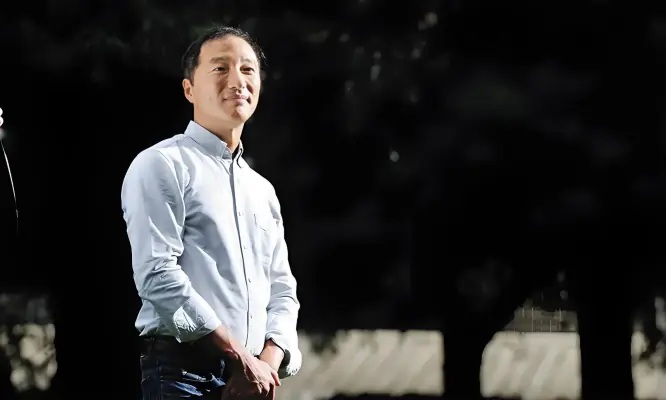
Yang Dingyi’s way of understanding the world was never entirely conventional. From a young age, his learning did not rely solely on effort. There was a quality to his perception — direct, intuitive — that set him apart. How does a genius read? What you’re about to hear may sound hard to believe.
Yang Dingyi described an unusual way of “reading.” He found that by placing his hand on a book, closing his eyes, and becoming still, he could sense what it contained — as if grasping much of its content without going through it word by word. Curious, he experimented further. At times, he would place a book under his pillow before going to sleep. By morning, he felt as though he understood what was inside.
Years ago, during the height of the qigong craze, there were reports of children said to possess similar abilities — recognizing words through touch with their fingertips, rather than relying on vision. Many dismissed these stories as tricks or staged performances. But Yang Dingyi suggested otherwise. He believed such abilities are real — and perhaps not as distant from us as we imagine. With practice, he said, one might even rediscover them. Using this unusual way of “reading,” he went through many books. Among them, three would shape the course of his life.
Ramana Maharshi
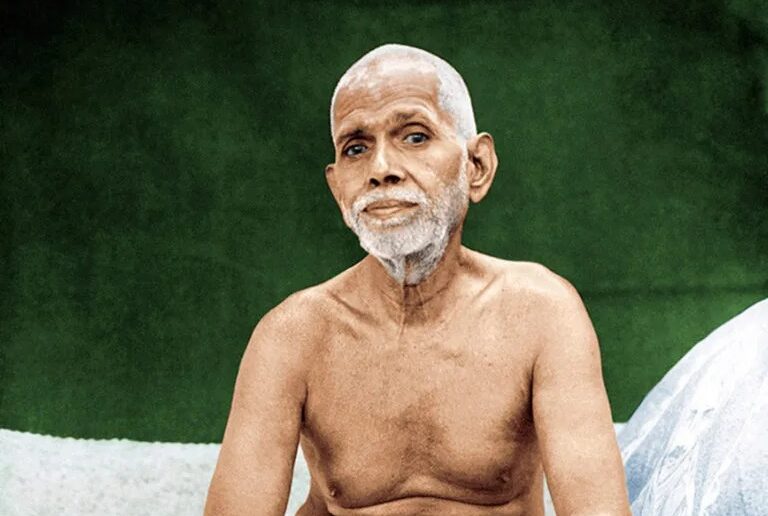
At the age of twenty, while walking along a street in New York, Yang Dingyi suddenly caught the scent of sandalwood drifting through the air. Following the fragrance, he found himself drawn into a bookstore. There, he saw a book. On its cover was the image of an Indian elder — strangely familiar. And in that instant, something within him stirred.
It was as if he had been struck by a current of electricity — his awareness slipping into another layer of time. Deep within his memory, that face already existed. Someone once very close to him. Without knowing why, tears began to fall — freely, uncontrollably. He didn’t need to read the book. He already knew it.
The man on the cover was Ramana Maharshi, the great Indian sage who lived from 1879 to 1950 and spent much of his life in quiet realization at the sacred Arunachala Mountain. Though Ramana had passed away before Yang Dingyi was born, Yang Dingyi felt an undeniable connection. “He was once my teacher,” he would later say. And in this lifetime, through a single book, that teacher had found him again — awakening something long forgotten.
Memories across lifetimes
From that moment on, fragments of memories began to surface. Not as a continuous story, but as scattered glimpses — like pieces of a mosaic slowly coming together. He saw himself in different roles, across different lives: A priest in South America. A tribal chief. A beggar wandering the streets. And even — beyond Earth itself — living on various other planets, among civilizations more advanced than our own.
He also experienced realms described in Buddhist teachings — the heavenly realms. There, beings appeared in countless forms. Some communicated through language, others through their eyes, and still others through subtle vibrations. But the most universal form of communication was something beyond all these: Love. The same boundless, radiant love he had once received from Jesus in that childhood encounter — flowing like a quiet, endless current.
The Platform Sutra
On that same day in the bookstore, he also picked up another text: The Platform Sutra of the Sixth Patriarch. He opened it. Read the first line — and again, tears came. He realized he had encountered these teachings before — somewhere, somehow. Then something extraordinary occurred. His awareness seemed to detach from his body, rising upward, expanding into the vastness of the cosmos.
From the origin of the universe to the countless civilizations on Earth, everything unfolded before him in a single instant — like a great, living panorama. And in that moment, he saw: Everything we take to be real…may be no more than a kind of illusion. As a scientist, everything he thought he knew about reality collapsed in that instant. When he finally returned to himself, he found that he had already reached the last page of the book. From that day forward, the world no longer looked the same.
Master Xuyun
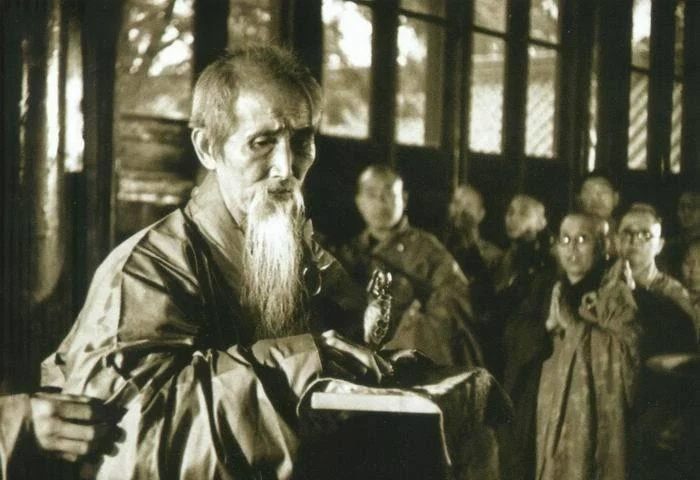
The third book came from a friend. On its cover was an elderly Chinese monk — sharp-eyed and with a long, flowing beard. This was Master Xuyun, who had written his autobiography at the age of 113. Though deeply revered in Buddhist circles, he was unfamiliar to Yang Dingyi , who had grown up in a Catholic environment and left Taiwan at the young age of seven. And yet, the moment he saw the master’s face, tears flowed once more. Another face that felt deeply, inexplicably familiar.
Without thinking, he sat down cross-legged. And remained there… all night. Time seemed to reverse itself — like a tape playing backward. He relived childhood… then before birth… then past lives… further and further back — through early humanity, even into the instinctive life of animals. The memories spiraled deeper and deeper.
Then, suddenly, the Heart Sutra appeared before him. He began to “read” it — backward, from the final word to the first. Each word revealed unexpected depths of meaning. Then, in a moment beyond description, it felt as though his entire being exploded. Everything dissolved. Nothing remained. In that vast stillness, he witnessed a scene from 2,600 years ago: Buddha Shakyamuni, seated beneath the Bodhi tree, opening his eyes to behold the universe. And then, he, too, opened his eyes — and saw the world anew.
Many worlds within one
From these experiences, Yang Dingyi came to perceive reality differently. The universe, he said, is not singular, but multi-layered. It exists as a multiverse, where multiple dimensions coexist within the same space. Even here on Earth, countless forms of life and worlds may overlap — present, yet unseen, not interfering with one another. But how could such realms be proven?
He turned his attention to a concept from Buddhism: śarīra — the crystalline relics said to remain after the cremation of enlightened beings. Some believe these relics are manifestations of high-energy matter from another dimension. Yang Dingyi studied them closely. He found that in beings such as the Buddha, his body and consciousness had reached complete harmony — a state of “perfect freedom,” almost like a biological superconductor.
Within these relics, he identified what he called a “true element” — something that did not react with anything else, as if it existed slightly beyond the material world. Does this perhaps prove that these relics come from another dimension? With a quiet sense of awe, he remarked: Even after 2,600 years, humanity has yet to step beyond the palm of the Buddha.
Besides Buddha Shakyamuni, Yang Dingyi also felt a strong connection to Buddha Maitreya. In his dreams, he would often travel to Tushita Heaven to listen to Buddha Maitreya expound the teachings, and each time, he found himself reluctant to return to the human world. Yang Dingyi also spoke of the future. He felt that his life carried a certain purpose — to help pave the way for great spiritual teachers such as Maitreya and Jesus, as if preparing the ground for their future return.
He also spoke of Buddha Maitreya as already possessing a complete system of teachings, one that would be applied to humanity when the time was right. According to him, Maitreya’s Dharma is particularly distinctive in its emphasis on consciousness being superior to matter — a view that contrasts with modern scientific thinking. He suggested that this contradiction is ultimately unimportant because present-day science will eventually be surpassed, and Maitreya’s Dharma will one day become the foundation of future science, religion, and philosophy.
Children of a new age
Yang Dingyi also spoke about children born in recent decades, a group referred to as “Indigo Children.” These children were said to have begun appearing around forty years ago, with energy fields described as glowing in shades of blue and violet — signs of a natural inclination toward spirituality over material concerns. Yet many of these children were misunderstood — often labeled as hyperactive or inattentive. In structured environments, they were often seen as struggling to meet conventional expectations.
More recently, another group has emerged: the “Crystal Children,” described as those born from the mid-1990s into the 2000s. Their presence is often portrayed as gentle and luminous, carrying a milky-white or rainbow-like aura. They are said to be kind, peaceful, and highly intuitive, often displaying a wisdom that seems to exceed their years.
Many accounts describe them as deeply attuned to nature, music, and subtle energies, and as having a calming or harmonizing effect on the people and environments around them. They are unusually forgiving, resistant to anger or conflict, and naturally drawn to healing, compassion, and spiritual awareness from a very young age.
The Crystal Children are considered successors to the Indigo Children and bear the mission of creating a peaceful, benevolent future for humanity. Yang Dingyi believed these two groups would work together — bringing about a world where spiritual awareness and material life are no longer in conflict, but harmonized. A world shaped not by division, but by understanding.
See Part I here
See Part II here
Translated by Katy Liu and edited by Tatiana Denning
Follow us on X, Facebook, or Pinterest
